
Europe’s Deeptech Ambition: Trust, Alliances and the Capacity to Act
Europe’s Deeptech Ambition: Trust, Alliances and the Capacity to Act
An evening with Supernova Invest, on the commitments behind scientific and industrial progress.
The main ideas, in 20 slides.

A fellow investor recently reviewed one of our portfolio companies: extraordinary technical results, but, in his view, monetisation was moving too slowly.
That conversation stayed with me at Supernova Invest’s annual party, held on the evening following its AGM. It brought together LPs, prospective LPs, founders and fellow investors. I was happy to join them as my own focus moves further into Hard AI, particularly techbio, new materials, industrial technology and supply chains.
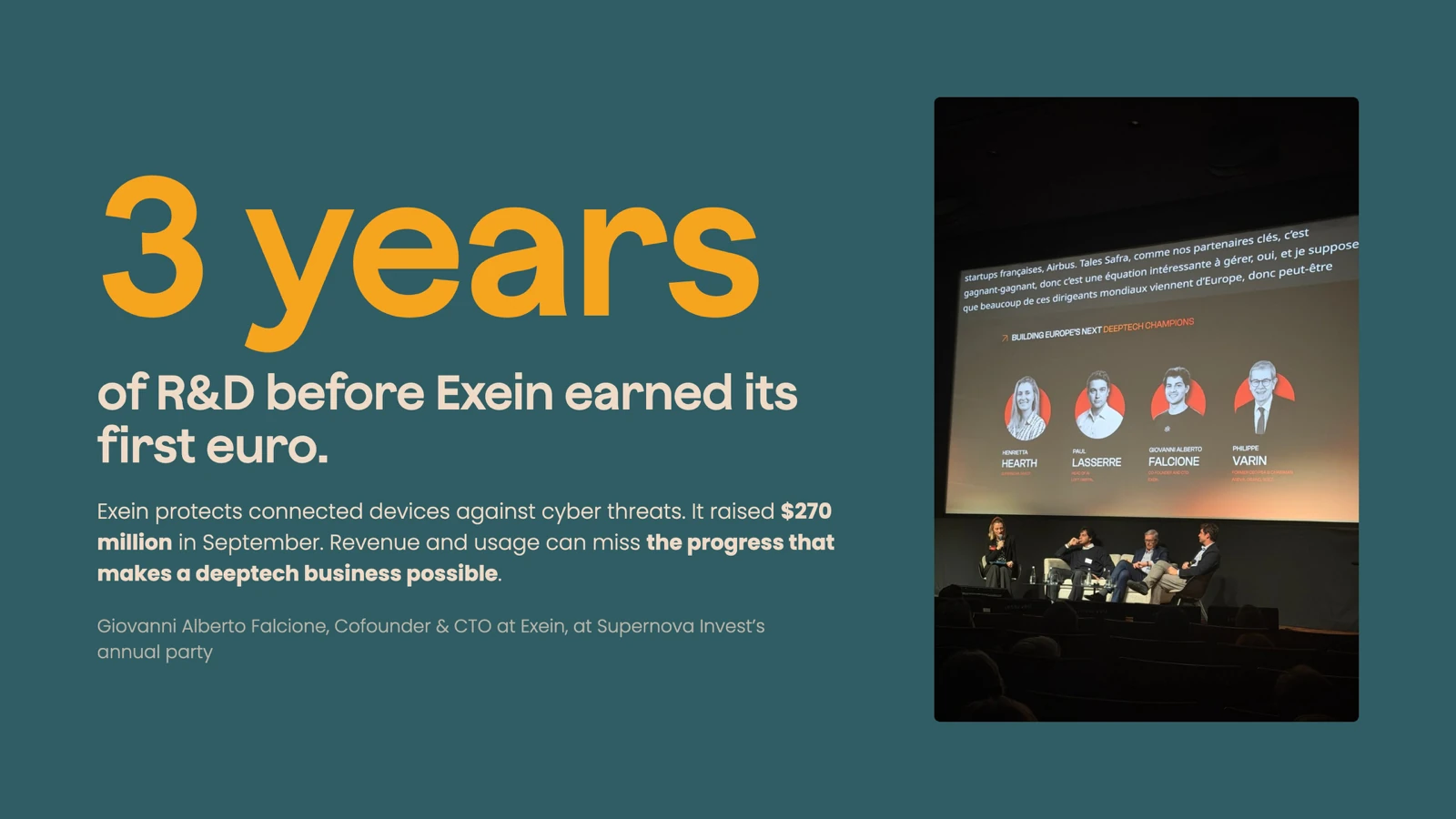
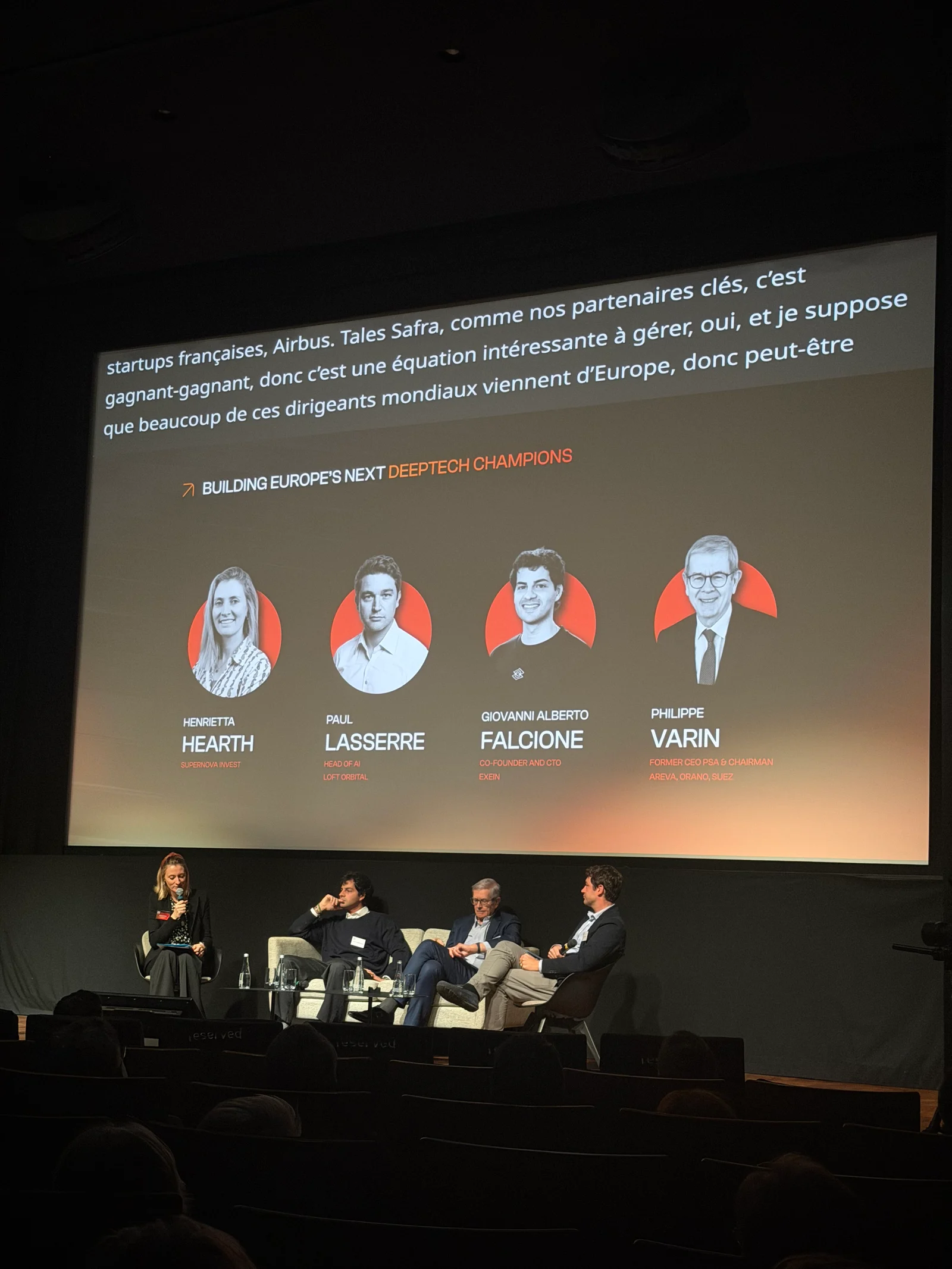
During the panel on building Europe’s next deeptech champions, Giovanni Alberto Falcione, cofounder and CTO of Exein, described three years of R&D before the company earned its first euro. That seems a reasonable sequence to me: some capabilities take years to develop before they become useful products. Exein protects connected devices against cyber threats and is developing autonomous security agents; it raised $270 million in September.
Revenue and usage are convenient measures for VCs, but can miss the progress that makes a deeptech business possible. Which uncertainty has been resolved, and what can the team now demonstrate? Patient capital gives those questions time to yield answers, with funding tied to meaningful milestones. In cybersecurity’s Red Queen race, that research earns a credible entry. Becoming a new benchmark, and remaining one, requires continual improvement as threats evolve.
Later that evening, French philosopher Julia de Funès addressed “From individual ambition to collective commitment”. Her discussion of trust gave me another way to read the founders’ accounts: what makes someone commit before the outcome can be known?
1. Trust and the evidence we cannot obtain in advance
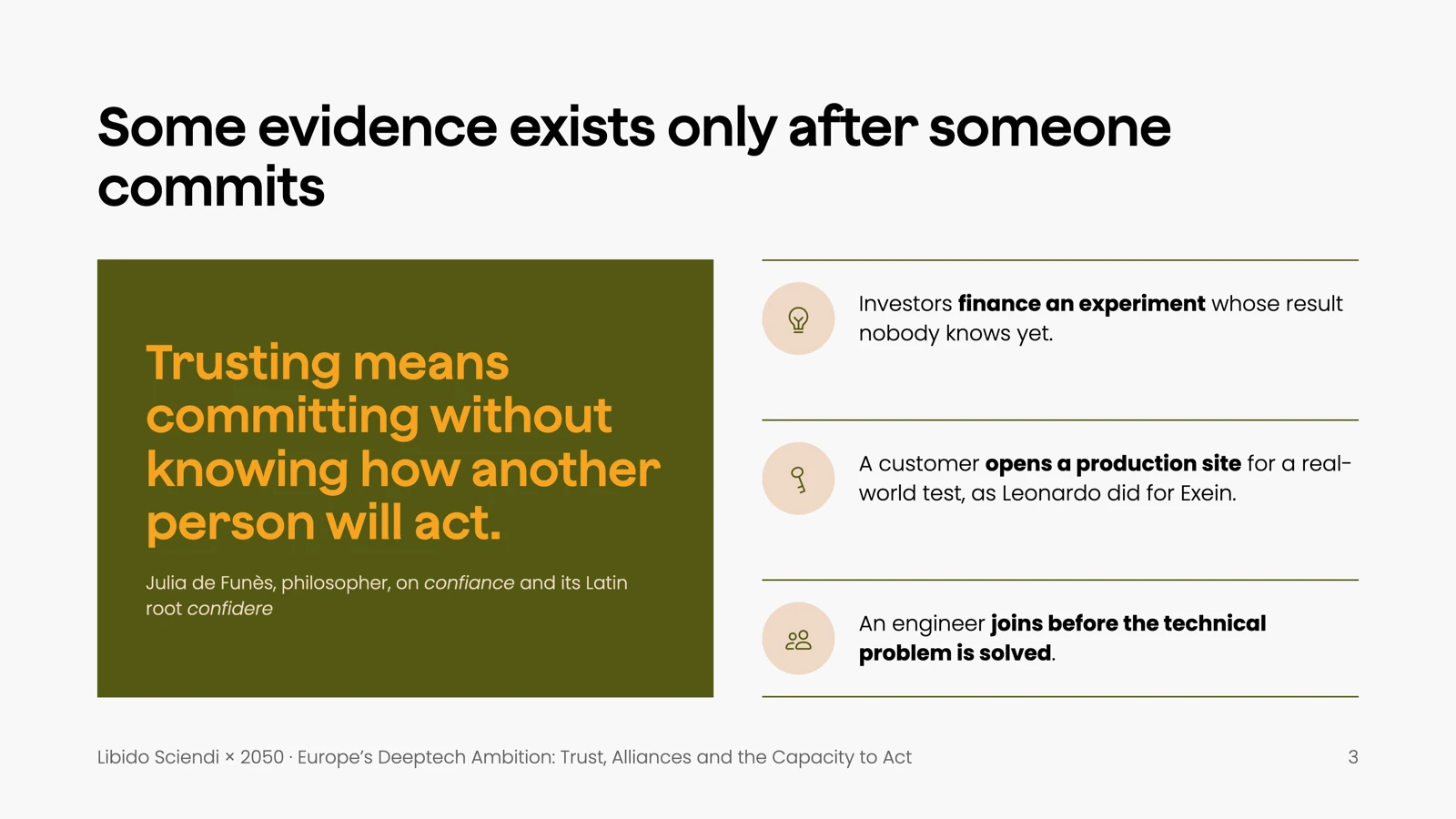
Julia returned to the Latin root of confiance, confidere, and its connection to faith. Trusting means committing without knowing how another person will act. It is an act of faith. Checking seeks knowledge; a contract specifies obligations and recourse. In her strict distinction, a “contract of trust” joins opposing logics: seeking guarantees and accepting their absence.
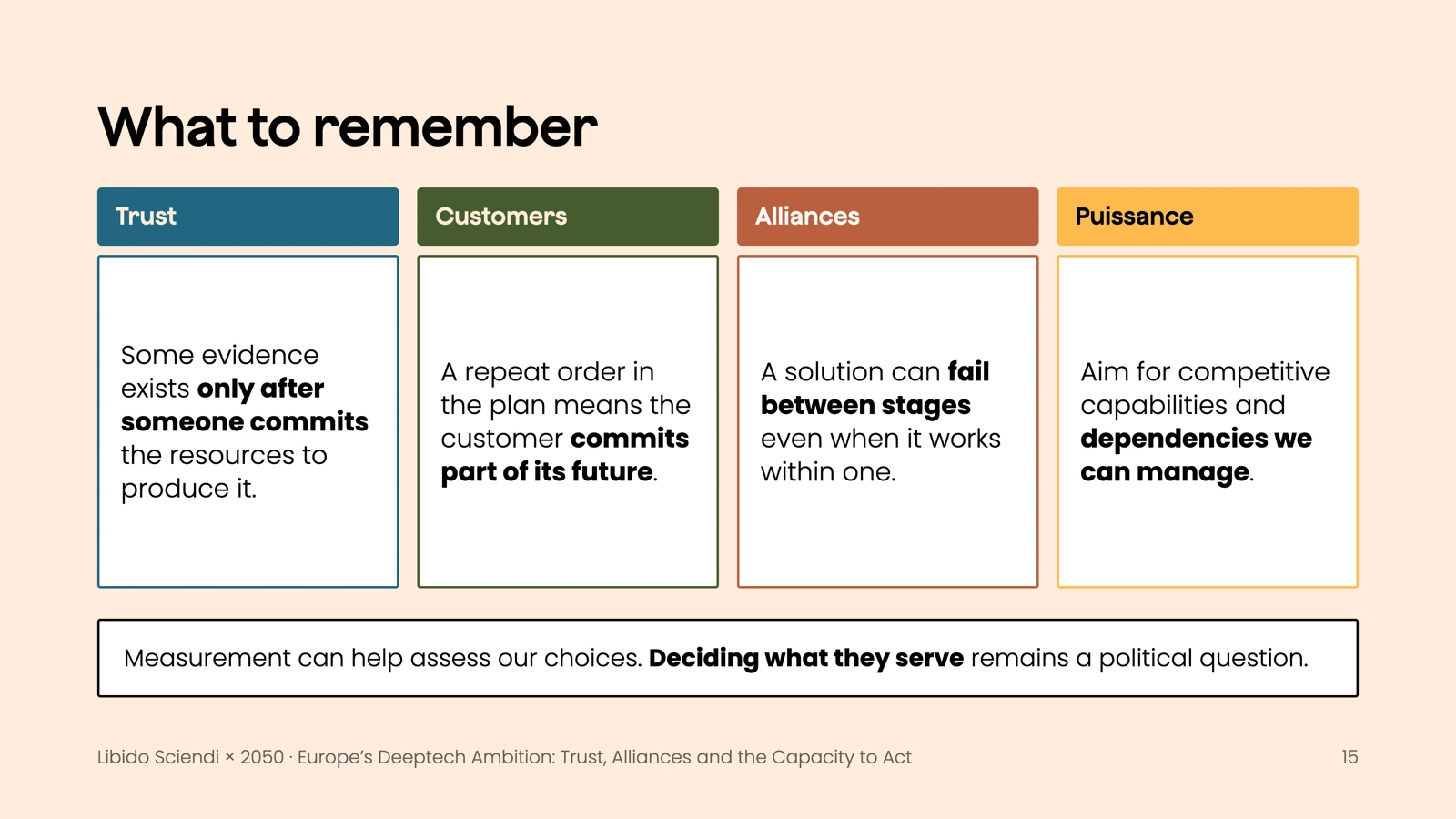
In deeptech, some evidence exists only after someone commits the resources needed to produce it: investors finance an experiment, a customer opens a production site for a real-world test, an engineer joins before the technical problem is solved. Diligence may clarify (some of) the uncertainty, but someone still has to act first.
Exein’s early industrial partners, including Leonardo, the Italian aerospace and defence group, helped with deployments in conditions the company could not reproduce alone. The same constraint runs through Hard AI, which we explored in our French AI Report 2026: a model needs relevant data to learn from, and its predictions must be tested against experiments and operating conditions. Access to the world is part of the capability.
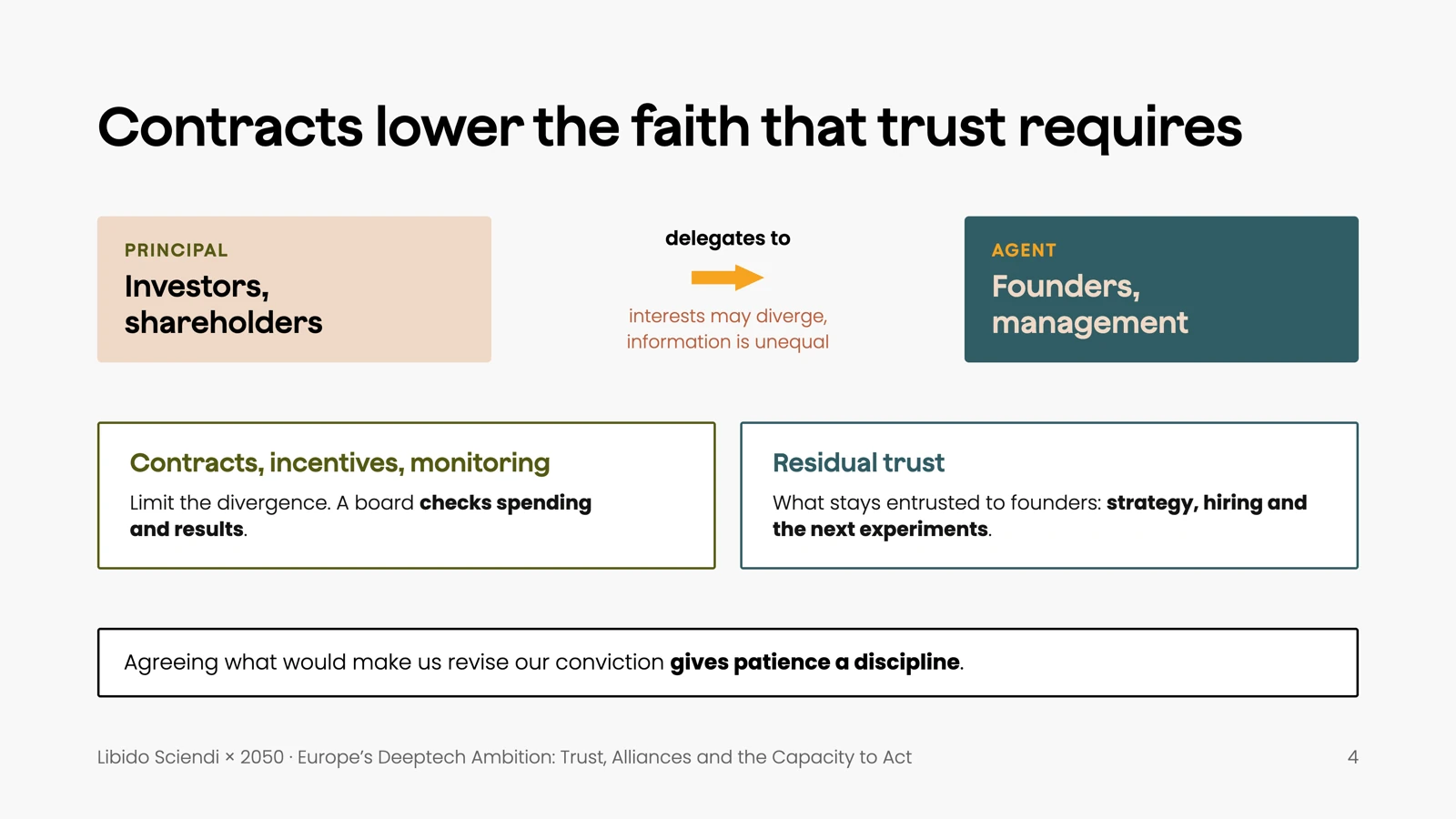
I was reminded of my economics studies and agency theory, which examines delegation: a principal entrusts an agent with acting on their behalf, although their interests may diverge and their information is unequal. Shareholders (including us as investors) or founders no longer involved in operations face this problem when delegating to management. Contracts, incentives and monitoring limit that divergence. They can lower the level of faith required, and define where the residual trust is required. A board can check spending and results while entrusting founders with the strategy, hiring and next experiments.
That arrangement also depends on being able to discuss bad news. A failed experiment should change the next decision; concealing it should change our assessment of the team. Agreeing what would make us revise our conviction gives patience a discipline without requiring every discovery to follow an initial plan.
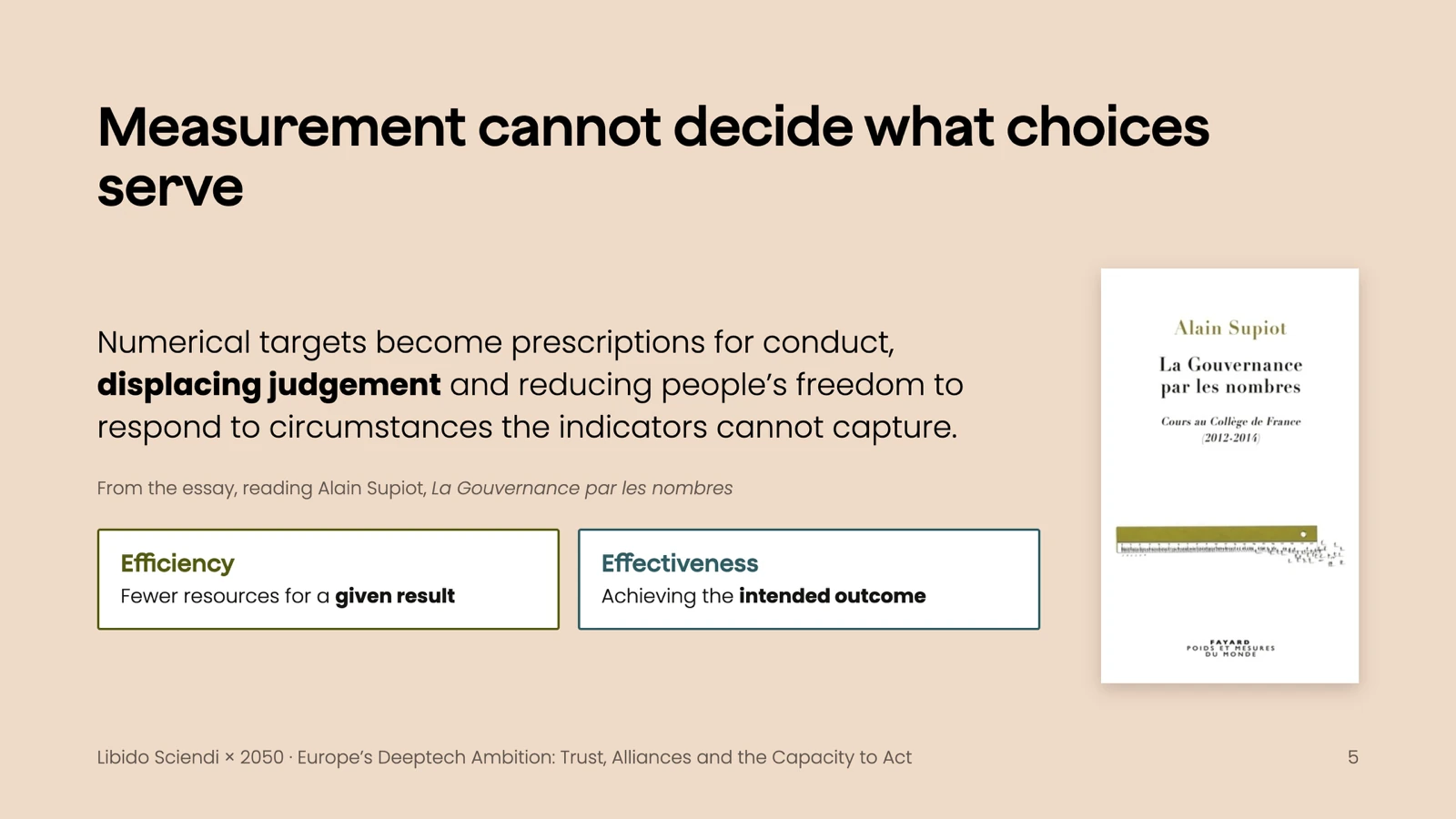
Organisations increasingly manage through quantified targets, even when the right course of action remains uncertain. Efficiency means using fewer resources to produce a given result; effectiveness means achieving the intended outcome. Optimising a process too early can make it harder to discover whether it serves the purpose we care about.
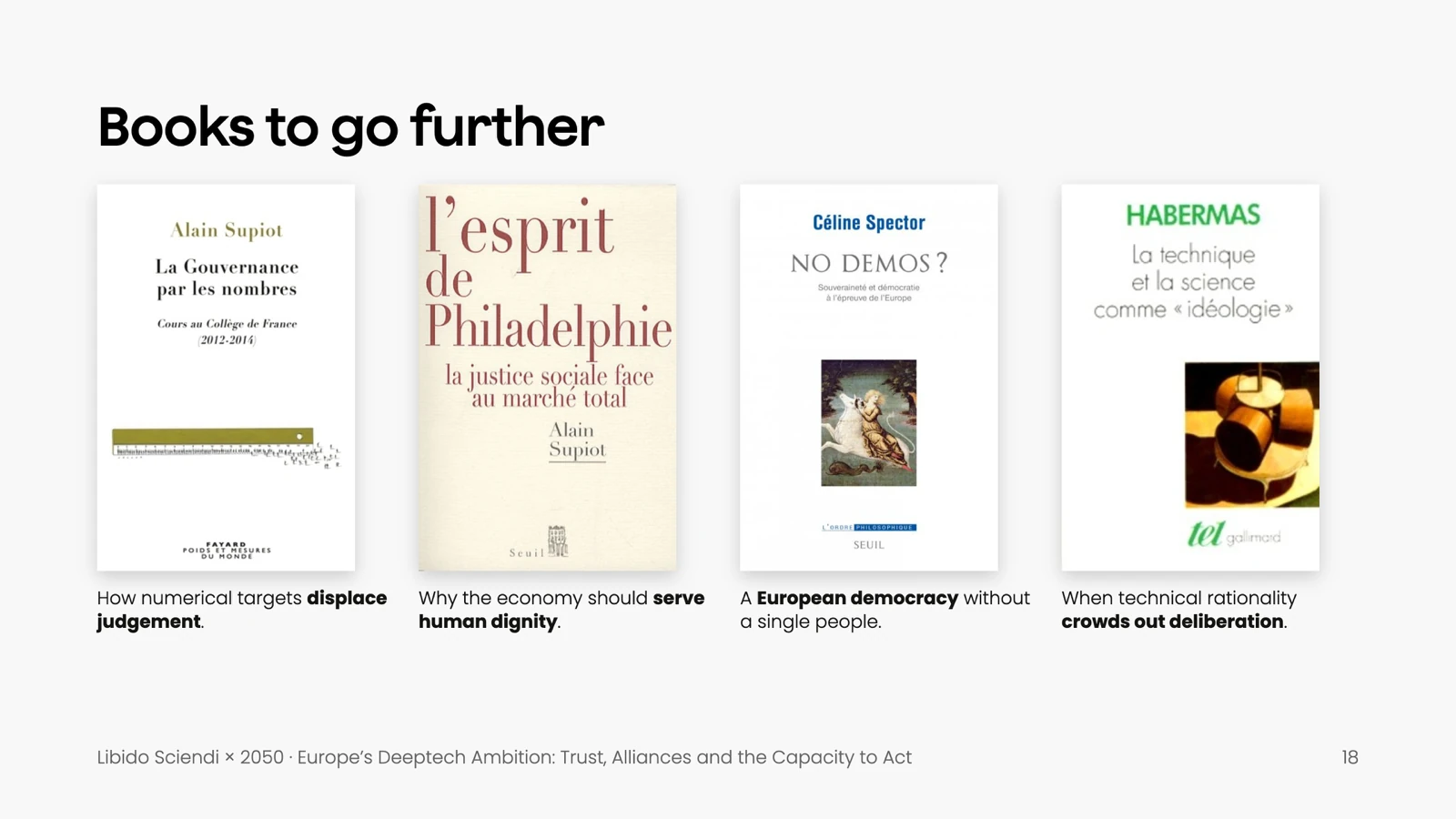
Alain Supiot examines the broader institutional consequences in La Gouvernance par les nombres: numerical targets become prescriptions for conduct, displacing judgement and reducing people’s freedom to respond to circumstances the indicators cannot capture. In L’Esprit de Philadelphie, he argues that economic organisation should serve human dignity and social justice, rather than treating market requirements as unquestionable constraints. Measurement can help assess our choices but it cannot decide what those choices should serve.
2. Customers who commit, and dependencies we accept
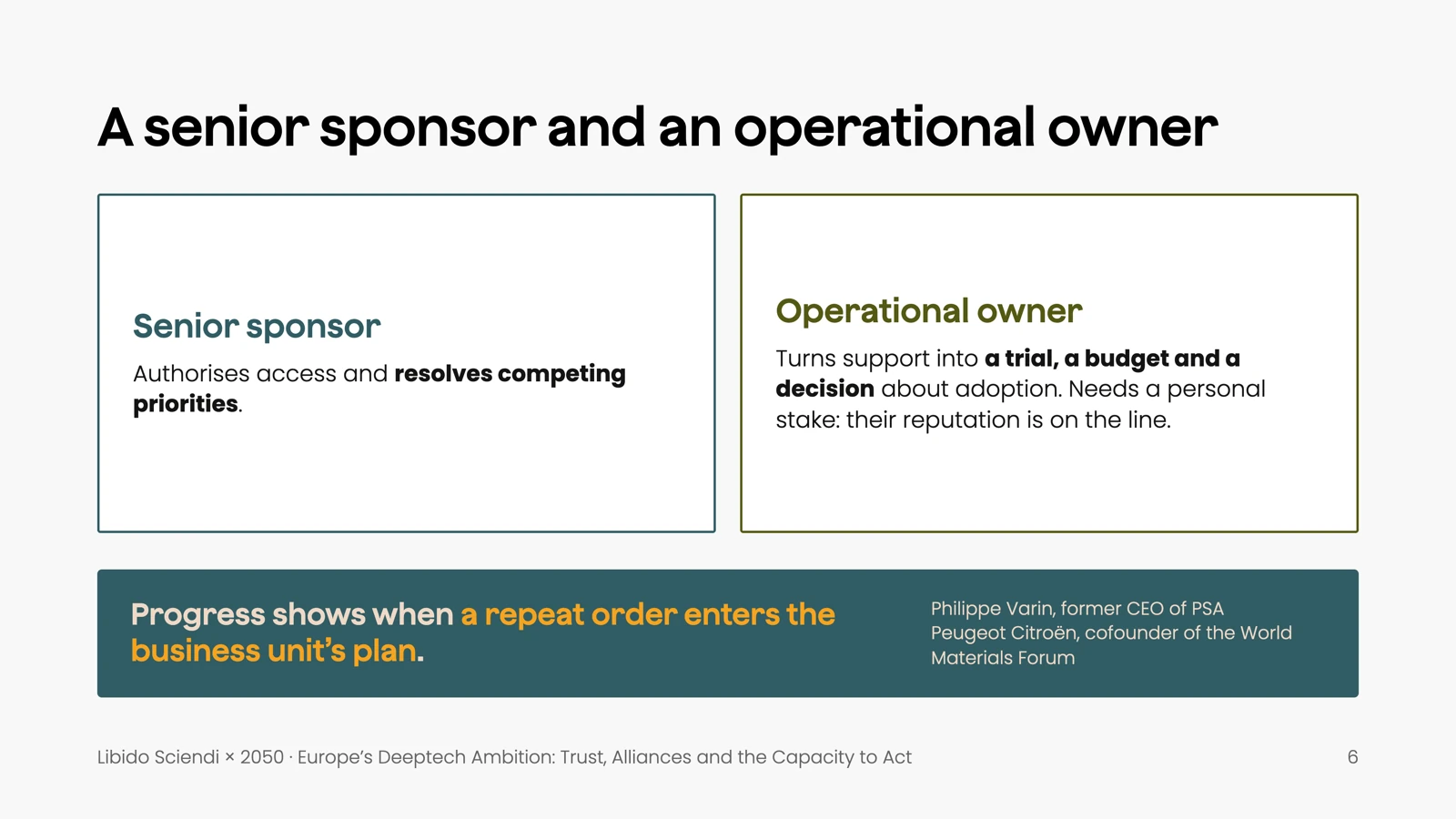
How can young deeptech companies secure that access to real operating conditions, particularly inside large established businesses? Philippe Varin, former CEO of PSA Peugeot Citroën, former chairman of Areva, Orano and Suez, and cofounder of the World Materials Forum, recommended securing both senior sponsorship and an operational owner. A senior sponsor can authorise access and resolve competing priorities; an operational owner turns that support into a trial, a budget and a decision about adoption.
My belief is that the operational sponsor also needs a personal stake in adoption: solving a problem internal teams have struggled with, improving results, perhaps advancing their career. Backing the solution also means putting their reputation on the line if it fails.
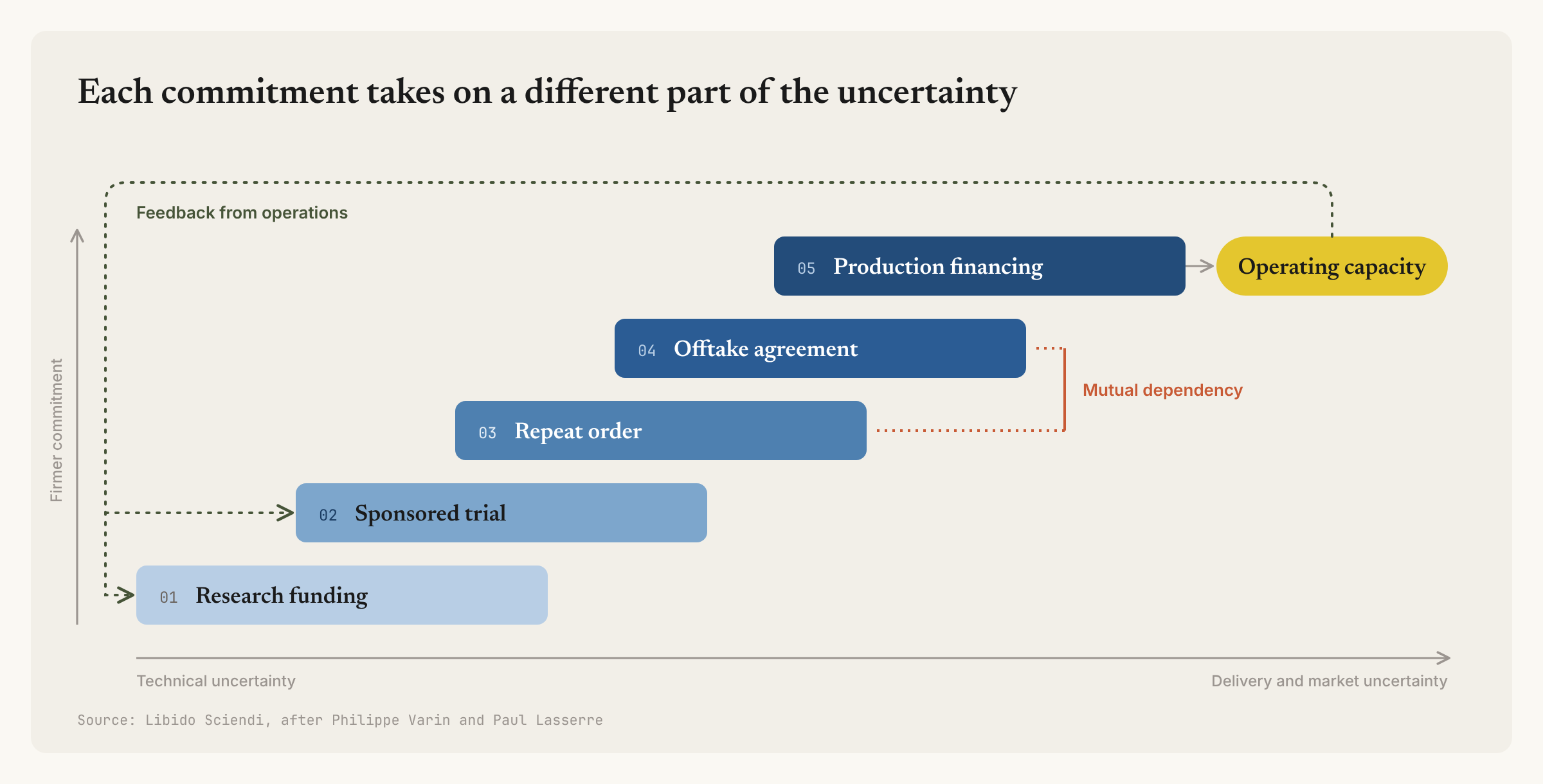
Philippe’s clearest sign of progress was a repeat order entering the business unit’s plan. The customer has committed part of its own future to the supplier, allowing it to hire, manufacture and finance delivery.
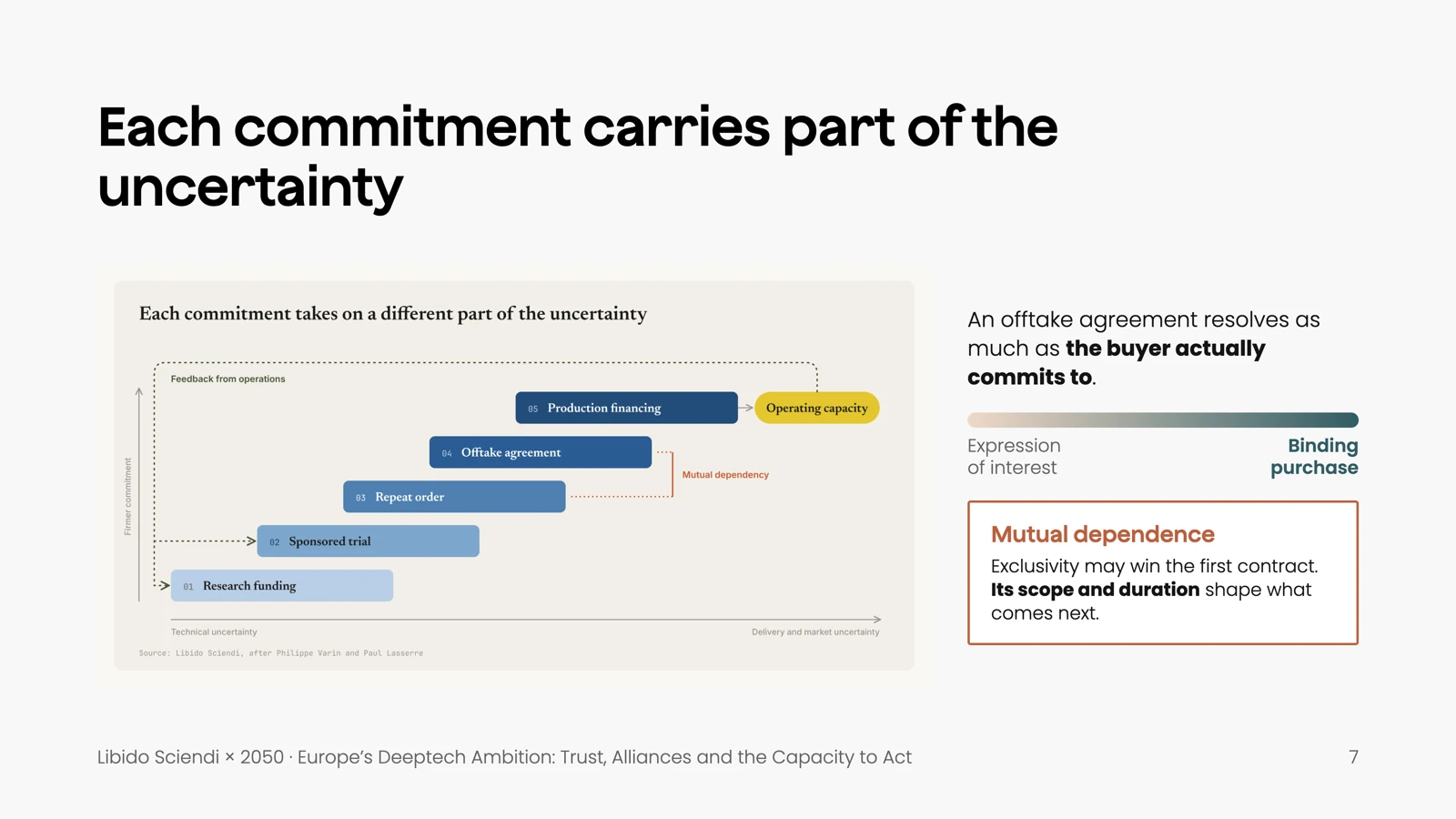
Offtake agreements can also bring that commitment forward. A buyer agrees to purchase future output, with negotiated volumes, pricing terms and conditions tied to quality, delivery dates or production milestones. Future demand can help finance the capacity needed to meet it. How much uncertainty an offtake agreement resolves depends on what the buyer commits to. A conditional expression of interest provides less assurance (and signal) than a binding purchase commitment, though even the latter may depend on agreed quality, volume and delivery conditions.
These commitments also create mutual dependence: the buyer comes to rely on a young supplier’s ability to deliver, while the startup may build its capacity around a single customer’s needs. The first agreement must therefore secure demand without closing off future markets or compromising core intellectual property. Exclusivity may help win the initial contract, but its scope and duration shape what the company can pursue next.
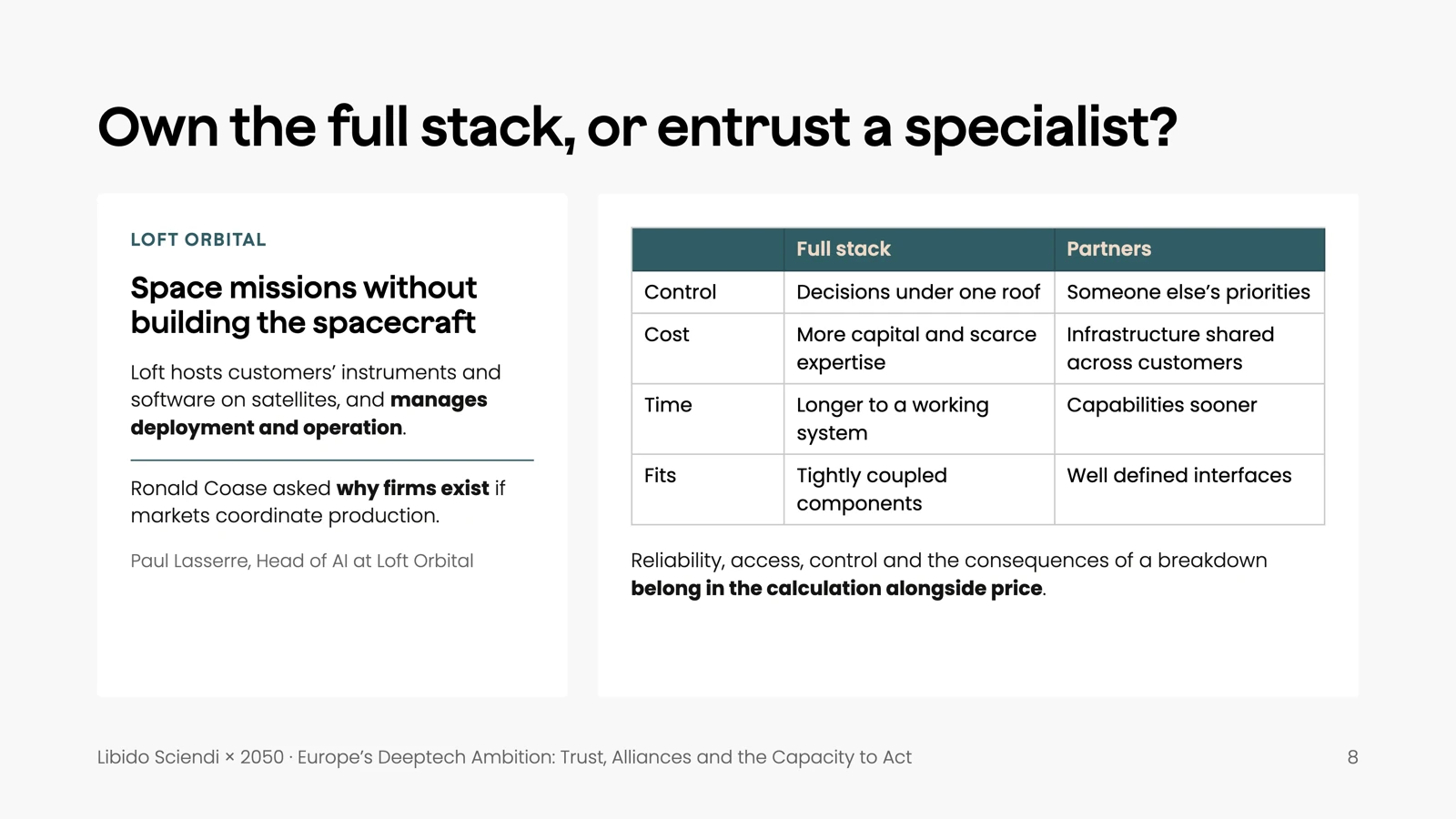
Paul Lasserre, Head of AI at Loft Orbital, described how customers can undertake space missions without building the entire spacecraft themselves. Loft hosts their instruments and software on satellites and manages deployment and operation.
It made me think of Ronald Coase, who asked in The Nature of the Firm why firms exist if markets coordinate production. Finding suppliers, negotiating agreements and coordinating delivery incur transaction costs; organising internally has costs of its own. Loft’s customers face a concrete version of that choice: which capabilities must they own, and which can they entrust to a specialist? Reliability, access, control and the consequences of a breakdown belong in the calculation alongside price.
Building the “full stack” brings more technical decisions and dependencies under one organisation’s control, but requires more capital, scarce expertise and time before the complete system can operate. Partners can provide capabilities sooner and spread infrastructure costs across customers, while introducing contractual constraints and dependence on someone else’s priorities. The boundary depends partly on where coordination is the hardest: tightly coupled components may benefit from common control; well defined interfaces make specialisation easier, while that very assessment changes as the technology and value chain mature.
Paul also described UAE partnerships supporting satellite manufacturing and deployment, including a billion dollar investment through a dedicated vehicle. The financing has to match the uncertainty being carried. Research funding backs a capability still being developed; production financing must also assess delivery costs, schedules and customer commitments.
3. Building an alliance around a common problem
An industrial LP knows which production constraint is expensive and what a site can tolerate. A founder may see how to remove it. A fund can connect that knowledge to a test, a budget and a prospective buyer, then establish what result would justify adoption.
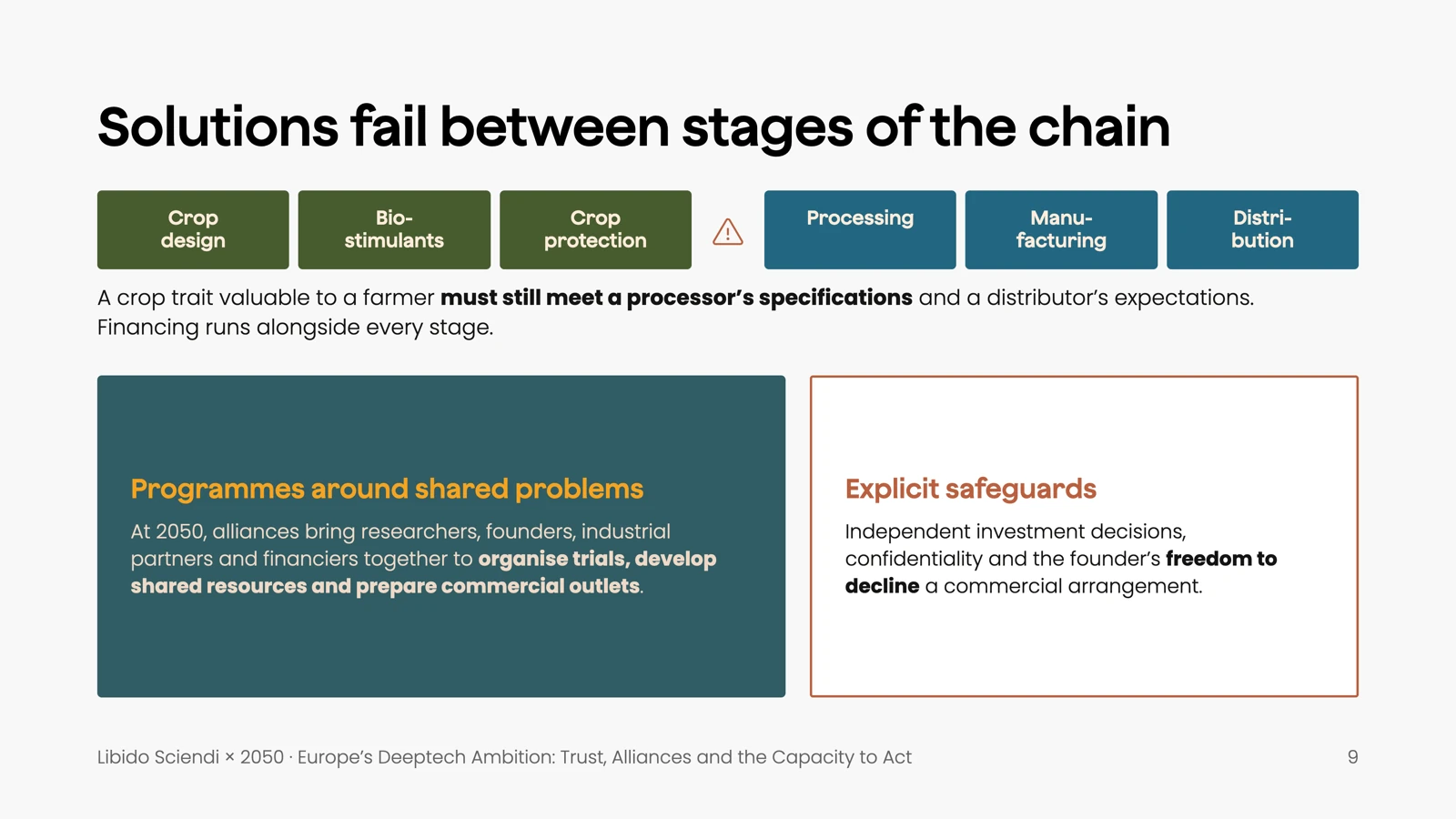
With an investor at Capagro, a venture firm specialising in agriculture and food technology, we discussed alliances spanning crop design, biostimulants, crop protection and financing, through to processing, manufacturing and distribution. A solution can fail between stages even when it works within one. A crop trait valuable to a farmer must still meet a processor’s specifications and a distributor’s expectations. Bringing those actors together helps establish requirements before each commits to a different solution.
At 2050, we organise investment programmes around such shared problems. Research helps us identify systemic physical constraints and critical dependencies; alliances bring researchers, founders, industrial partners and financiers together to organise trials, develop shared resources and prepare commercial outlets. We finance companies while also addressing obstacles that sometimes no single company could readily remove. What happens in those trials and businesses then informs the research and our investment priorities.
A later conversation with investors at Air Liquide, which supplies gases, technologies and services to industry and healthcare, illustrated how expertise accumulates in use. Medical oxygen or nitrogen for protective atmospheres comes with requirements for purity, continuity of supply, equipment and process integration. The customer depends on the surrounding system as much as on the molecule. Replacing the supplier means reproducing that operating knowledge too.
Cooperation requires explicit safeguards when interests diverge. An industrial LP may seek exclusivity, founders need access to a broad customer base, and investors may have different time horizons. Independent investment decisions, confidentiality and the founder’s freedom to decline a commercial arrangement allow participants to work together without assuming their interests fully align.
4. Critical materials and the cost of resilience
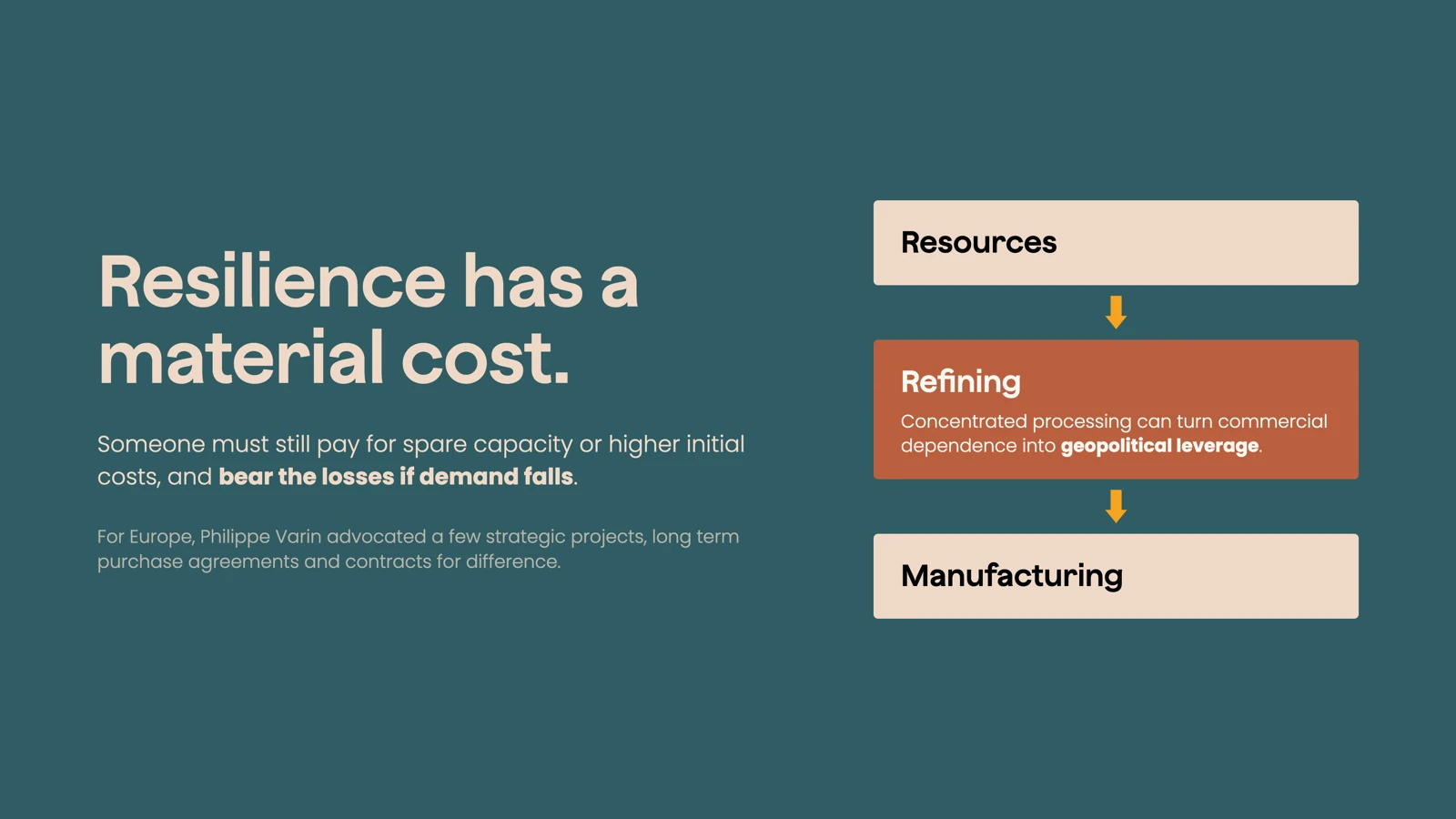
Philippe’s discussion of critical materials extended these commitments to Europe. Electrification, AI infrastructure and defence compete for physical inputs. Inventories and alternative supply chains require resources beyond those of a system optimised for immediate delivery. Resilience has a material cost.
His account of China’s strategy emphasised coordination from resources through refining and manufacturing. A mineral deposit alone does not give an industry usable inputs. Concentrated processing capacity can turn commercial dependence into geopolitical leverage, several suppliers away from the company whose product we buy.
For Europe, Philippe advocated a limited number of strategic projects, supported by industrial leadership, long term purchase agreements and mechanisms to reduce price uncertainty, including contracts for difference. These can stabilise revenues around an agreed reference price. A buyer’s commitment can make a producer’s investment financeable, helping a refining or recycling process move beyond technical success.
Someone must still pay for spare capacity or higher initial costs, and bear the losses if demand falls. Building a factory requires commitments that last beyond the political attention that helped get it funded.
5. Sovereignty beyond a company’s address
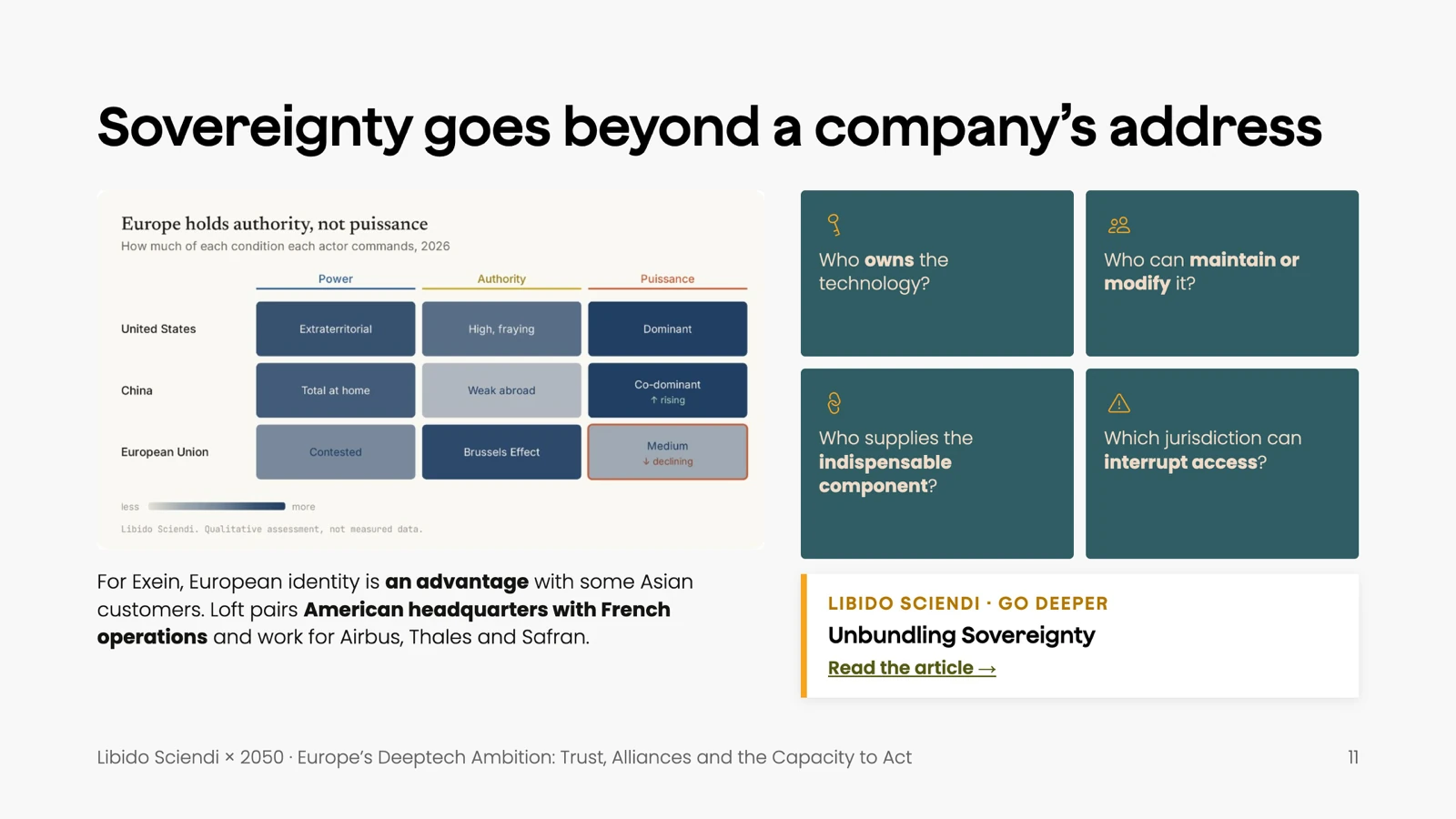
In Unbundling Sovereignty, I separated institutional power, recognised authority and the material capacity to act, for which I kept the French word puissance. Europe can set rules others adopt while relying on equipment, energy and computing capacity controlled elsewhere.
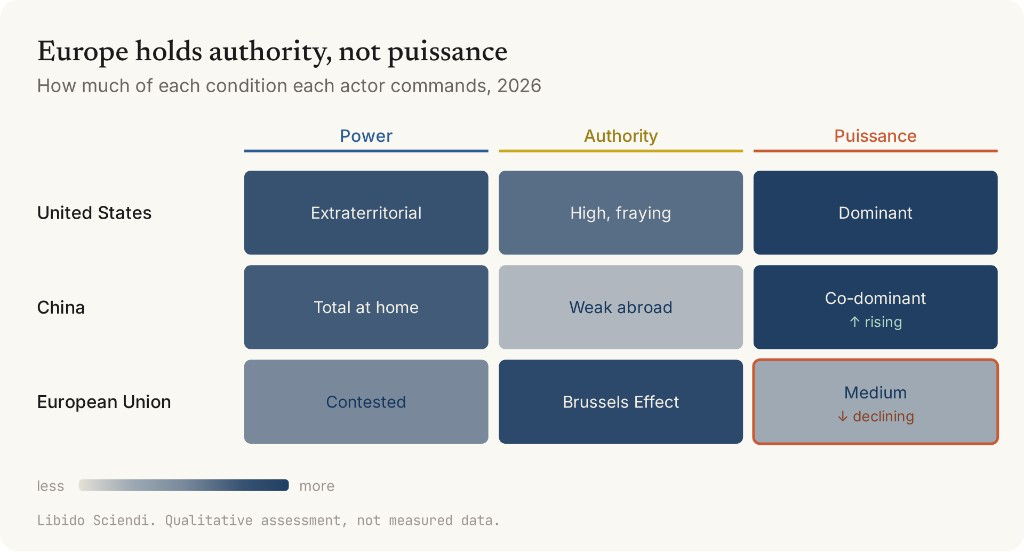
Exein and Loft complicate any equation between sovereignty and registered address. Giovanni described European identity as an advantage with some Asian customers. Paul described American headquarters, French operations and international contracts generating work for Airbus, Thales and Safran. International expansion can strengthen European capabilities while creating new dependencies.
Those dependencies need to be understood and managed: who owns the technology, who can maintain or modify it, who supplies the indispensable component, and which jurisdiction can interrupt access? What alternatives exist, and how much time and investment would switching require? Operating a system locally does not mean being able to replace its underlying technology; a contract may secure access to one layer without addressing the dependencies beneath it.
A company can improve Europe’s position by adding an alternative supplier, retaining scarce expertise or making an input substitutable. Becoming indispensable to others can also improve bargaining power. Mutual dependence gives each side something to lose from rupture, though it cannot guarantee access in a crisis.
6. The European level, and its legitimacy
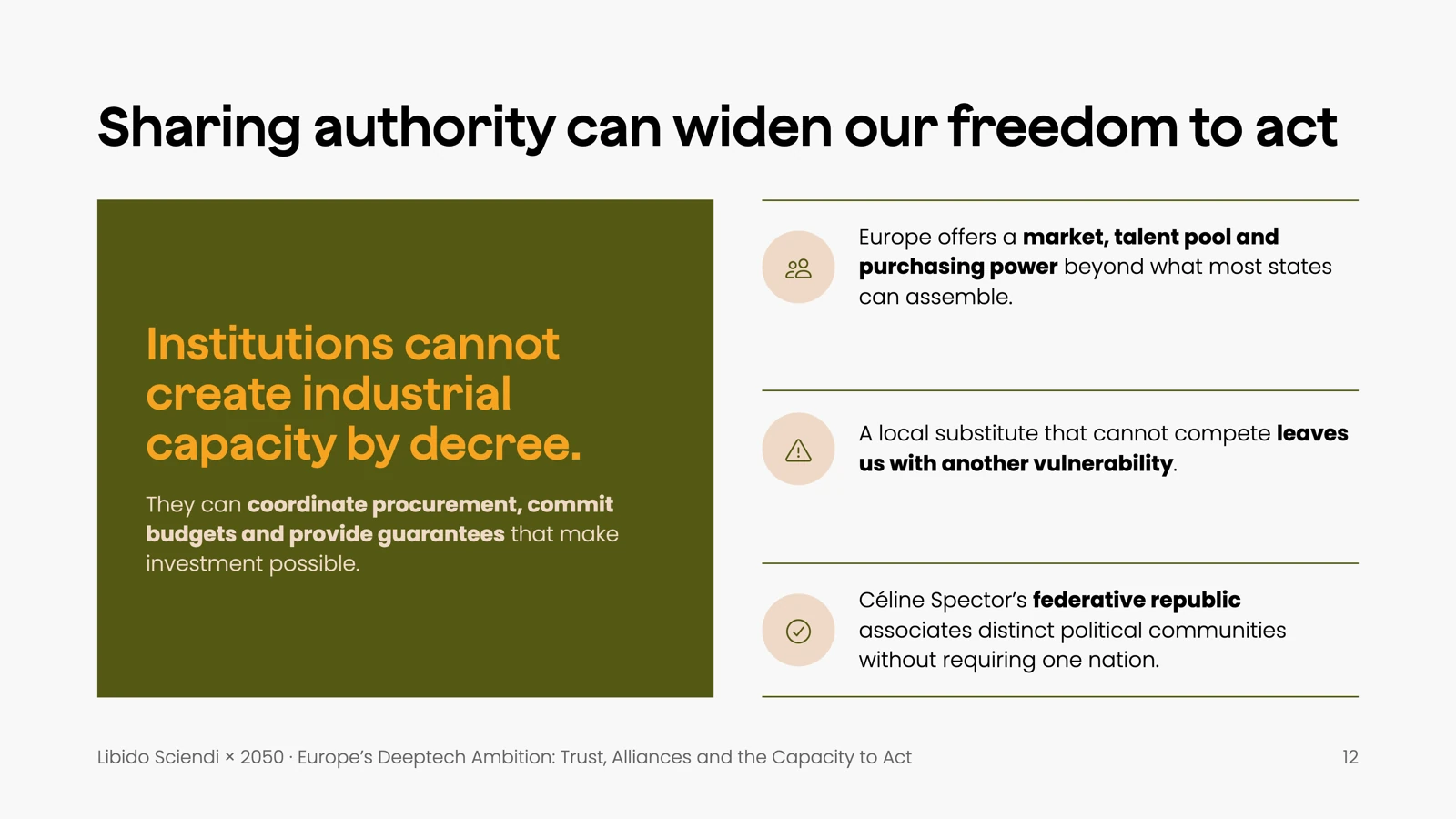
I see a growing ambition among founders and funds to rebuild core capabilities in Europe, from industrial production to frontier technologies. The European Tech Champions Initiative reflects the effort to finance that ambition at continental scale. The aim should be competitive capabilities and dependencies we can manage, with credible alternatives when access is interrupted. Building a local substitute that cannot compete leaves us with another vulnerability.
Geopolitical tensions, export controls and economic coercion make those alternatives more urgent. Europe offers a market, talent pool and potential purchasing power beyond what most individual states can assemble. Shared procurement and financing can support capabilities whose costs exceed national markets. They also require agreement on who pays, where capacity is built and whose priorities it serves.
Céline Spector’s No demos ? challenges the claim that the absence of a single European people makes European democracy impossible. Her proposed European federative republic associates distinct political communities without requiring them to become one nation.
Nations themselves are historical formations, shaped through institutions, conflicts and solidarities. Spector rejects the idea that a democratic people must share one culture, language or religion. But shared institutions need citizens who can authorise, contest and redirect their decisions. Her argument includes a stronger European Parliament with legislative initiative.
For me, this strengthens the institutional argument in my sovereignty essay: institutions cannot create industrial capacity by decree, but they can coordinate procurement, commit budgets and provide guarantees that make investment possible. Sharing decision-making authority can increase our actual freedom to act. Keeping that authority exclusively national achieves little if we still depend on capabilities we can access only on others’ terms.
7. Choosing what those capabilities are for
In a France Culture interview, sociologist and philosopher Dominique Méda recalls moving from a philosophical education centred on political life to the ENA, where growth and competitiveness dominated. Reading Habermas helped her ask what had happened to the discussion of the society those objectives were meant to serve.
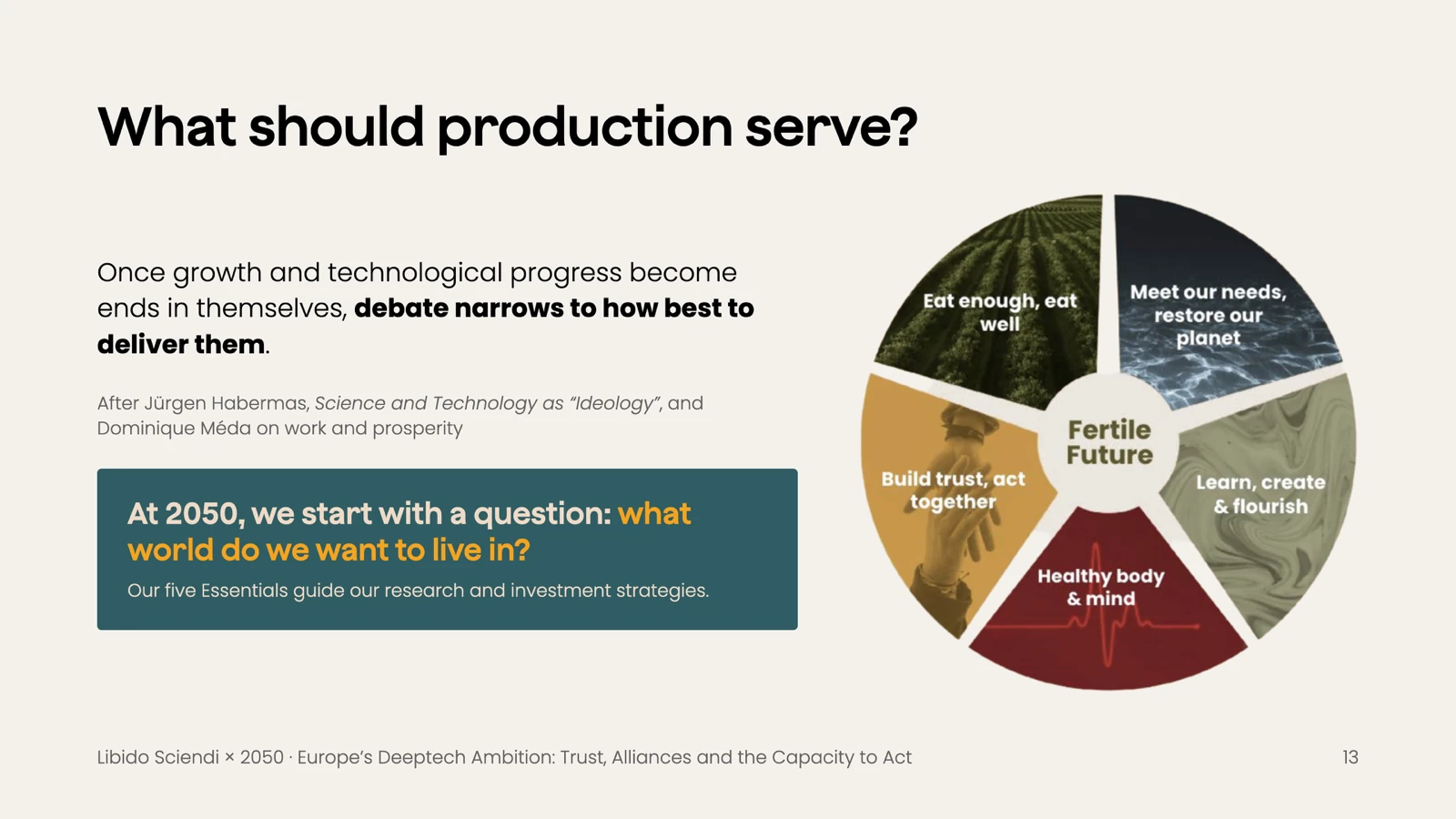
In Science and Technology as “Ideology”, Habermas examines how technical rationality can displace political deliberation: once growth and technological progress become ends in themselves, debate narrows to how best to deliver them. Méda brings this question to our understanding of work and prosperity: what should production serve, and what makes a society prosperous beyond the volume it produces?
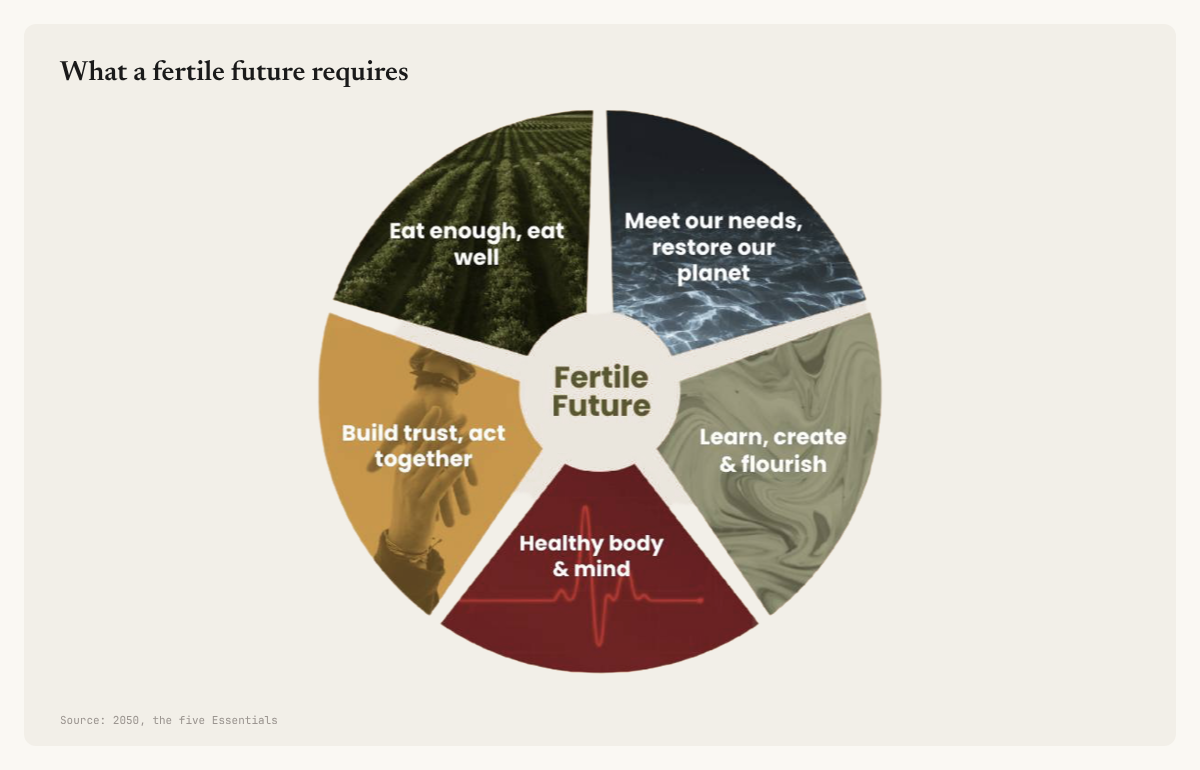
At 2050, we start with a question: what world do we want to live in? Our five Essentials describe what we believe a fertile future requires. They guide our research and the investment strategies we develop to help make it possible.
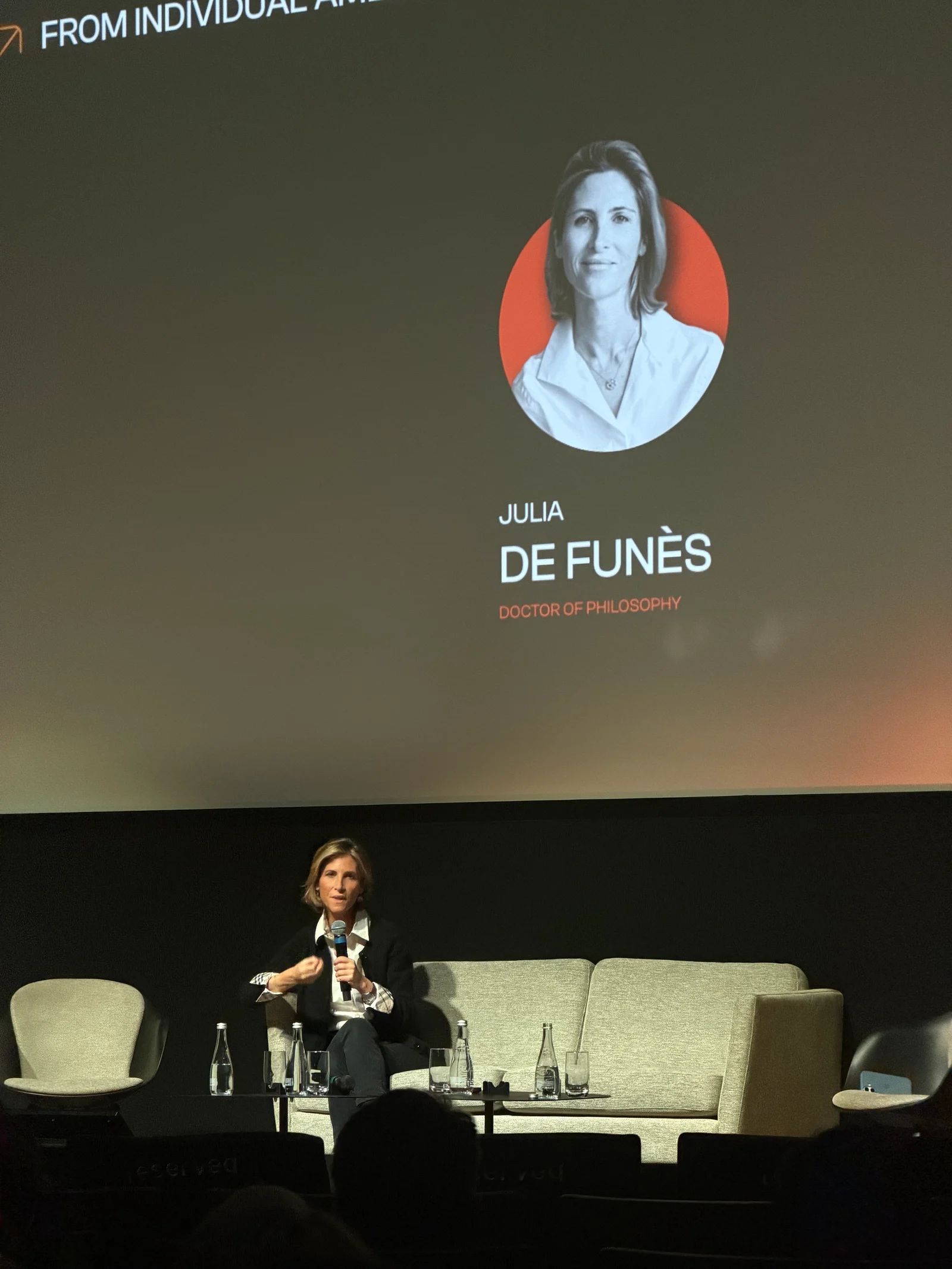
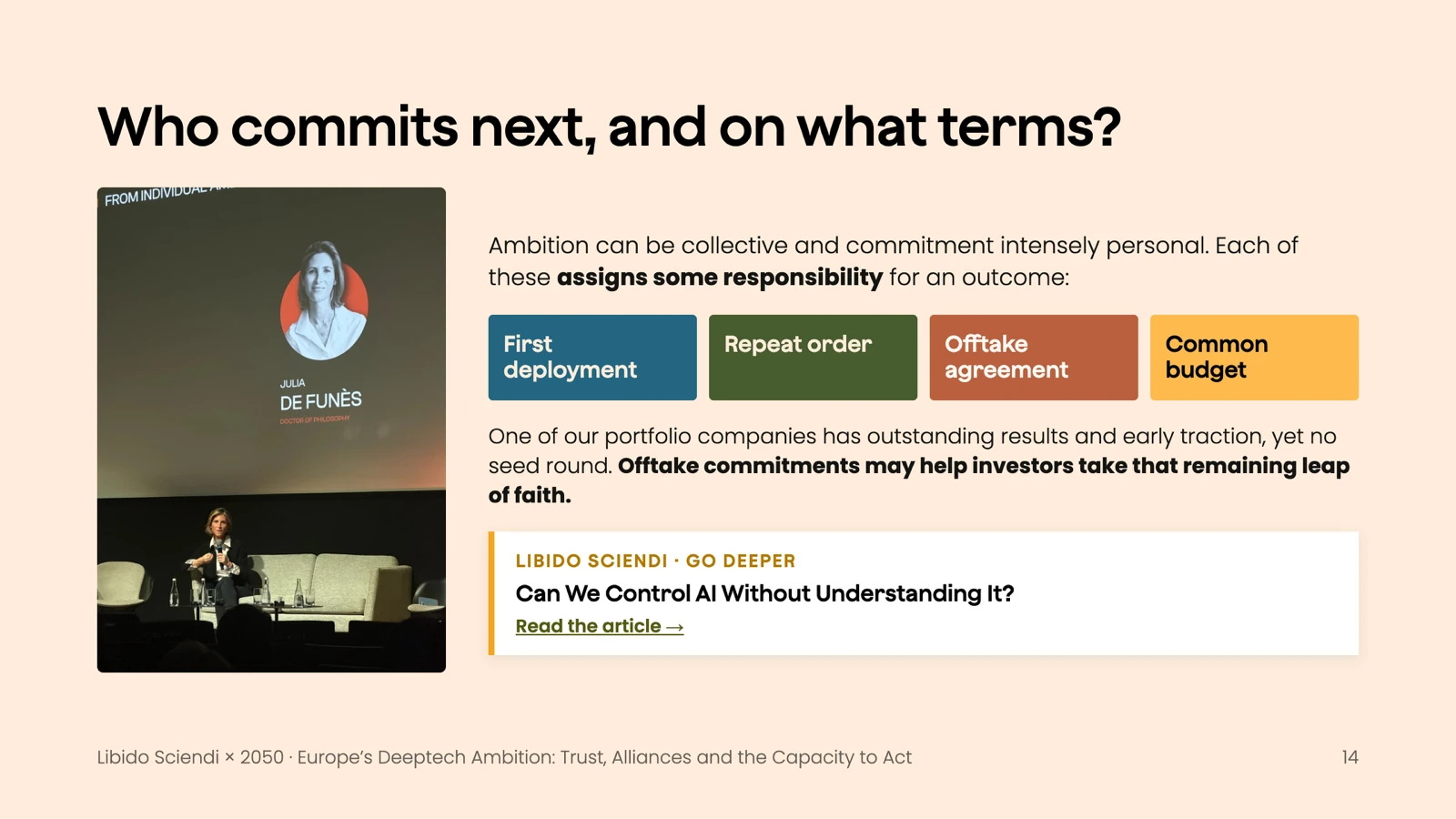
Julia questioned the opposition in her assigned theme: ambition can be collective, and commitment intensely personal. We can share an ambitious objective while undertaking very little ourselves. The first deployment, a repeat order, an offtake agreement or a common budget each assigns some responsibility for making an outcome possible.
Her warning about the artificialisation of judgement also stays with me. In Can We Control AI Without Understanding It?, I explored why approval means little without the understanding, time and authority to intervene. A process cannot carry responsibility in place of someone able to judge and act. That applies to an industrial partnership or public investment too, even though trust in people and reliance on machines remain different relationships.
I left thinking about who would commit next, on what terms, and with what freedom to change course. It brought to mind another company in our portfolio: despite outstanding scientific results and early commercial traction, it had yet to secure its seed round. Offtake commitments may help investors take that remaining leap of faith.
I also left with Julia’s Pensées distinguées and a handwritten dedication. Thank you to the Supernova Invest team and the speakers for the evening. Thank you to Diane Yakovlev for the invitation.

These reflections draw on the discussions and my conversations at the event. The connections to agency theory, Coase, sovereignty, Spector, Méda and Habermas are my own.
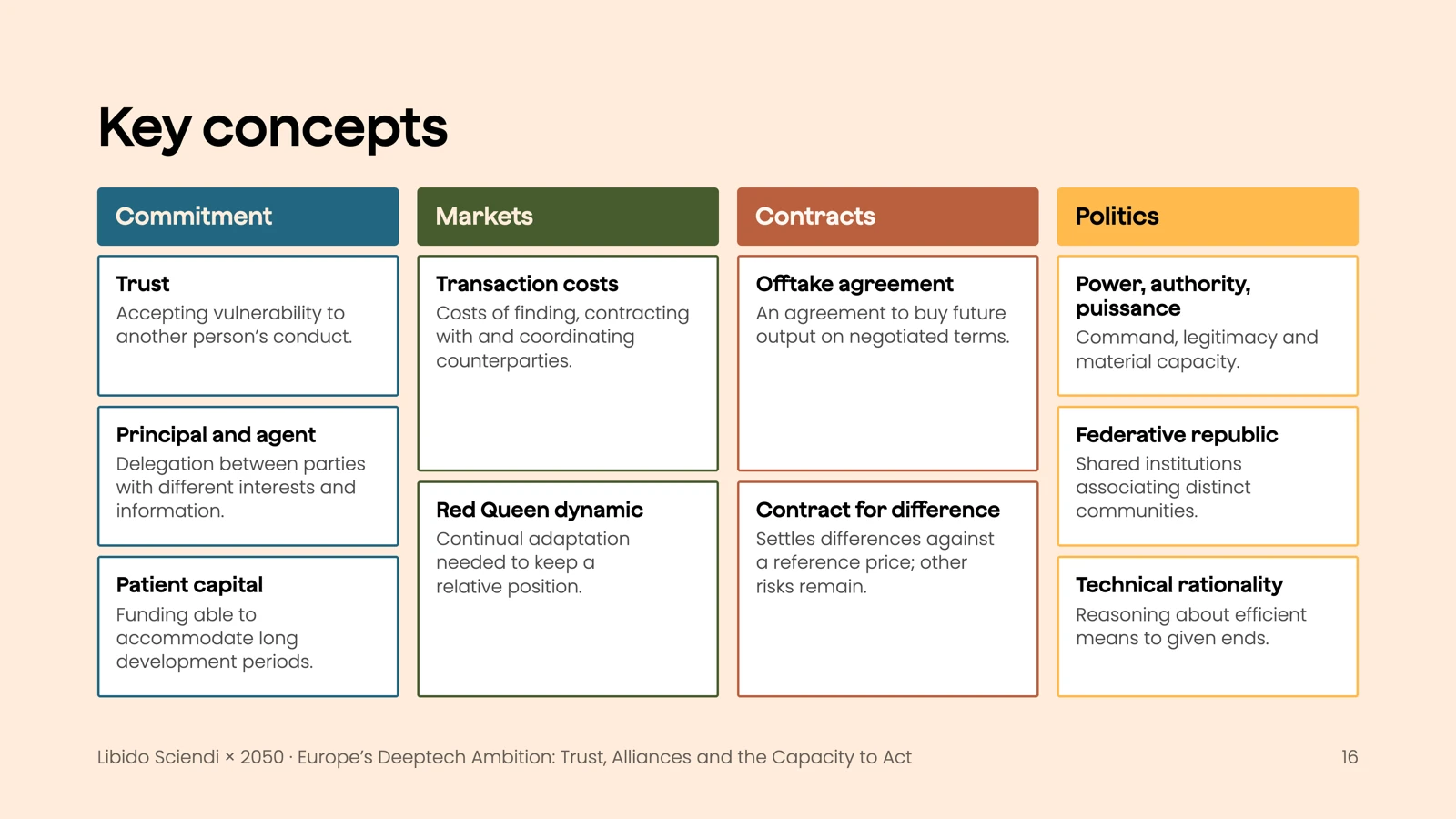
Conceptual Toolbox
| Concept | What it means | Use in this article |
|---|---|---|
| Patient capital | Funding able to accommodate long development periods. | Assess resolved uncertainties and milestones before revenue appears. |
| Red Queen dynamic | Continual adaptation needed to maintain a relative position. | A successful security product still faces evolving threats. |
| Trust | Accepting vulnerability to another person’s conduct. | Some commitments precede evidence of their outcome. |
| Principal and agent | Delegation between parties with potentially different interests and information. | Incentives and oversight address conflicts without eliminating discretion. |
| Transaction costs | Costs of finding, contracting with and coordinating counterparties. | Compare external partnerships with internal organisation. |
| Offtake agreement | An agreement to buy future output on negotiated terms. | Customer commitments can support production financing. |
| Contract for difference | A mechanism settling differences against a reference price. | Reduce specified price exposure; other risks remain. |
| Power, authority, puissance | Institutional command, recognised legitimacy and material capacity. | Identify which dimension of sovereignty is missing. |
| Federative republic | Shared political institutions associating distinct communities. | Combine European capacity with democratic authorisation. |
| Technical rationality | Reasoning about efficient means to given ends. | Keep the choice of ends open to political debate. |
Unless otherwise stated, photographs are by Willy Braun.