
Unbundling Sovereignty
Unbundling Sovereignty
Three conditions hide inside one word. Pulling them apart shows what Europe is losing.
Issue N°594 of the French weekly Le 1, late May 2026, runs under a blunt title: Souveraineté, une illusion française (“Sovereignty, a French Illusion”). Robert Solé opens it by counting, with some irony, the sovereignties now in circulation, monetary, budgetary, nuclear, industrial, food, energy, pharmaceutical, digital, and lately a cognitive sovereignty meant to keep machines from reading our neural data. None of these is invented. Behind each is something a country can be cut off from, a fuel, a chip, a vaccine, a payment network. The trouble is that one word now stretches across all of them, so it no longer tells you which kind of dependence is in play.
Bodin bundled three things into one word
In the same issue, the political theorist Jean-Yves Pranchère takes the word apart. Sovereignty was theorised for the absolute monarchies by Jean Bodin in 1576, and Bodin folded together things that are really separate. There is the legal right to command, and there is the recognition that makes a command obeyed, which is not the same thing. A ruler can hold the legal right and still be ignored. Underneath both sits a third condition Bodin barely marked, the material means to act on a decision once it is taken. A state can have every legal right to defend itself and still lack the army.
One word, three jobs. They look like a single thing because, for centuries, a single figure did all three at once. The absolute monarch held the legal right to command, was recognised as legitimate, and owned the army and the treasury that made the command bite. Separate the actor from the throne and the three conditions come apart. Each needs its own name.
Power rests on institutions. Authority rests on recognition. Puissance rests on matter.
- Power is the capacity to obtain obedience through an institution.1 It is relational, because someone has to obey, and revocable, because it lasts only as long as the obedience holds. A regulator that can fine a company has power.
- Authority, in Hannah Arendt’s sense, is recognition that needs no force. The moment force is required, authority has already failed. A standard the whole world copies without being made to has authority.
- Puissance is the material capacity to act, lodged not in any institution but in infrastructure, in arsenals, foundries, energy and code. Whoever owns the means of production and destruction has puissance.
The hard part is telling the first apart from the third, because English files both under the same word, “power”. Olivier Beaud, the constitutional theorist, gives each its own name, potestas, the legal right to command, and potentia, the raw capacity to act on it. Puissance is his potentia. I keep the French because English has no clean word for it and blurs the two.
NVIDIA is where the split shows most plainly. It has puissance and almost no power. It holds the accelerators, the specialised chips on which the most advanced AI models are trained, that decide who can build at the frontier, yet no institutional chain gives it the right to order anyone to do anything. A European regulator is the mirror image, holding the recognised right to command a firm and none of the means to build what the firm builds. Sovereignty in its old, strong sense was the rare moment when one actor held all three at once.2
Europe has authority, not puissance
Europe has authority. It holds contested power. And it is short of puissance.
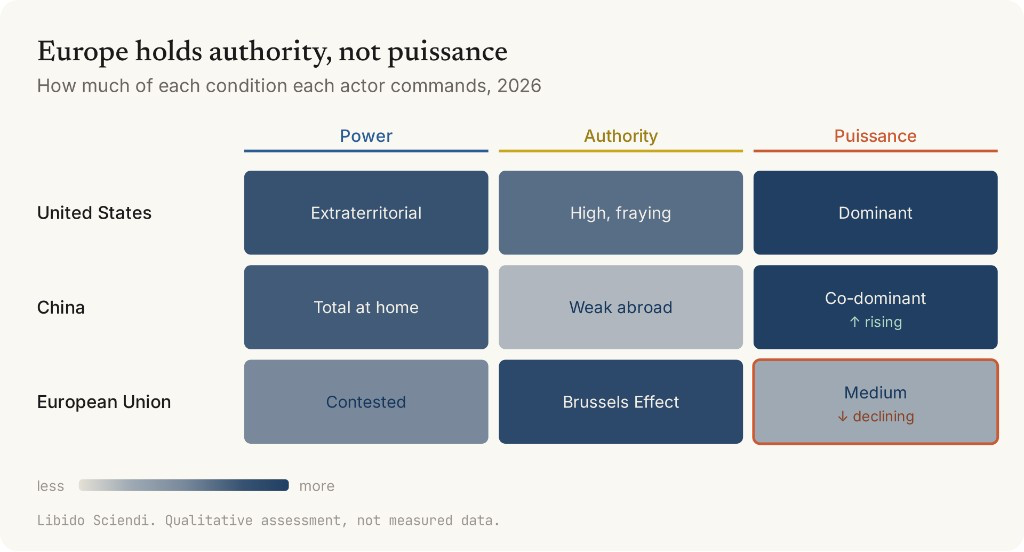
Its authority is real and travels far. The Brussels Effect, the worldwide adoption of EU rules through the price of access to its market, is authority projected without force, and the AI Act and the Digital Markets Act of 2022 are studied and copied across jurisdictions.3 Its power is contested but real, exercised each time the Commission fines an American platform, though no fine has ever built a chip foundry. Where Europe falls short is puissance. In the digital domain that word has a precise address: the compute, the foundries, the labs that train the frontier models. NVIDIA holds the accelerators, TSMC fabricates the chips in Taiwan, the American and Chinese labs train the frontier models. The one heavyweight piece of this puissance that is European, ASML, the Dutch maker of the lithography machines that print circuits onto silicon, Europe holds without fully controlling. Where Pranchère writes that Europe lacks a common defence, the digital version is that Europe lacks a sovereign capacity to compute. It is the same gap in different clothes.
Confederation fixes the wrong layer
Pranchère’s cure is the right place to start. Drop the word sovereignty, he argues, with its myth of all three conditions fused in one hand. Keep two hard cores for the state, not being colonised and being recognised in law. For everything above that, speak of autonomy, which asks the realistic question, does Europe hold enough of the three conditions to act, rather than the mythical one, does it possess an indivisible sovereignty no one ever had. His route to it is confederal, specific powers pooled upward without dissolving the member states. And confederation works on two of the three. It can build the power Europe lacks, a common defence and a Parliament that can raise taxes, and it can lean on the authority Europe already holds. The third condition, puissance, it cannot reach. For the institutional layer, that is enough, and he is right.
The digital layer does not yield to the same cure, for three reasons no treaty reaches. First, the puissance is privately held but never purely private. When Washington decided NVIDIA could not sell its best chips to China, the call was the government’s, made over the company’s public objection, and when a cut-down version was later let through the state took a 25% cut of the sales. Even ASML ships its machines under rules Washington shapes. This cuts against the easy objection that the state plainly can govern this puissance, so it cannot be ungovernable. It can, by the state that hosts it. NVIDIA’s capacity answers, in the last instance, to Washington, and to no one in Brussels. Europe’s problem is not that the puissance obeys nobody. It is that it obeys someone else. Second, a company domiciled in Europe is not the same as a European instrument. The legal hook is narrower than the slogans suggest. US law reaches a firm only through specific channels, American components above a threshold, or US-person staff on controlled work. The broader pull is not legal at all. When the capital, the leadership and the scarce engineers all point toward another ecosystem, the firm’s reflexes, partnerships and roadmap point there too, whatever its registered address. Ownership can be European and the centre of gravity sit somewhere else. Third, the stack is a chain of dependencies, and extraterritorial law travels down it. The CLOUD Act, the 2018 US statute that lets American authorities compel data from US providers wherever the servers sit, reaches any layer built on an American hyperscaler.
The workaround on offer shows both the demand and the ceiling. S3NS, the Thales and Google Cloud joint venture, now runs Google’s cloud technology from three data centres near Paris, operated only by French staff, qualified in December 2025 by ANSSI, the French cyber agency, as immune to the CLOUD Act.4 It is real autonomy at the layer of operation and control. It is also still Google’s technology running on NVIDIA H100 chips. You can re-domicile who operates the system and who holds the keys. You cannot, by contract, re-domicile the puissance underneath.
So Pranchère hands us the right tool and the right word. Autonomy, not sovereignty, is what Europe should be after, and his three conditions map cleanly onto the stack. But the three do not yield to one strategy. Power is built by treaty, a common defence, a budget, a Parliament that can tax. Authority is held by writing rules the world copies, and Europe already does this well. Puissance is built by none of these. It comes from foundries, energy and frontier labs, the things a confederation cannot legislate into being.
That difference sets the order of work. In the short term, autonomy is the priority, and it is reachable. Pool the power, lean on the authority, and buy operational independence at the margins, the way S3NS walls off a layer of cloud from the CLOUD Act. None of it touches the chips underneath, but it lowers the daily exposure, and it can be done with the instruments Europe has.
The long-term task is to rebuild all three, and the hardest of them is puissance. This is the deepest threat Europe faces, deeper than any single fine or platform, because it is the one condition no treaty, no vote and no standard can summon into being. Power can be pooled. Authority can be projected. Puissance has to be physically built, in fabs and reactors and labs, on a timescale measured in decades. A Europe that recovers the first two and not the third will keep the right to command and the means of no one. That is the thread a Libido Sciendi series now in preparation will follow, and its clearest living case is the one traced in Nvidia, or the Repricing of a Watt, puissance accumulated where no treaty could build it.
Footnotes
-
[Source] Reading power as obedience obtained through an institution follows Bertrand de Jouvenel, Du Pouvoir, Hachette, 1945. ↩
-
[Context] Pranchère’s wider claim is that indivisible sovereignty was always an ideological myth, the individual, the people, the nation and the state never quite coinciding, a line he traces through Sieyès, Rousseau and Schmitt. ↩
-
[Source] The term is Anu Bradford’s, in The Brussels Effect, Oxford University Press, 2020. ↩
-
[Source] S3NS, the Thales and Google Cloud joint venture (Thales majority shareholder), received SecNumCloud 3.2 qualification from ANSSI for its PREMI3NS offering in December 2025, certified immune to extraterritorial law including the CLOUD Act and FISA. ↩