
MacAskill on Speed-Ups and Trajectory Changes
MacAskill on Speed-Ups and Trajectory Changes
Significance, persistence, contingency, why almost no venture deal scores on the third, and speed-ups against trajectory changes.
Venture as acceleration
Venture capital exists to give founders the resources to turn an idea into something a customer can buy. It is also the industry most inclined to see itself as the parent of the last century of technological progress, with HP, Apple, Amazon, Google, Tesla and Uber as the evidence.
Upstream, the picture looks different. The transistor, the packet-switched network, satellite positioning and the statistics behind machine learning all came out of public and military research budgets, a point William Janeway pressed for four decades from inside a venture seat. What venture added was the push to a mass market, fast and at scale. That may well be what innovation means in practice, and it is real work. It is also a different claim from having caused the thing to exist.
A few deals are genuinely non-inevitable, in the sense that nobody else would have done them. In June 2008, Airbnb was still AirBed & Breakfast, three founders letting strangers sleep on air mattresses in their San Francisco flat. They asked seven Silicon Valley investors for $150,000 at a $1.5m valuation, ten per cent of the company. Five said no and two never replied.1 Deals like that are rare, and structurally so, since the ones nobody wants are the ones that look worst on the day.
The self-image probably held up when the industry was small. There are a great many funds now, and most deals that get funded are competitive, increasingly so in whichever category is in fashion, whether AI applications, AI infrastructure or defence technology. The ones nobody competes for mostly fail to raise. An outstanding outcome, then, usually means a product arriving a few years sooner than it would have, with one company holding more of the market than it otherwise would. It is just an acceleration. That is worth something. William MacAskill, an Oxford philosopher now at the Forethought Centre for AI Strategy, helps put a number on it.
Speed-up vs trajectory change
A hundred years of growth half a percentage point off trend shifts the date at which growth reaches its ceiling by about twenty-five years, out of a thousand. Nothing else shifts.2 Chapter 7 of What We Owe the Future uses that sum to sort the ways of affecting the far future into two families. Speeding things up moves the same civilisation along the same road at a different rate. A trajectory change alters the average value of civilisation over the whole of its remaining life. Growth rates sit in the first family, the abolition of slavery in the second. Both terms are Nick Beckstead’s.3
The machinery underneath is a product of three important concepts:
- Significance: how much better the world is, on average, for being in a given state.
- Persistence: how long that state lasts once it exists.
- Contingency: how long the world would have waited for it had nobody acted.
Newton’s calculus scores low on the third, since Leibniz got there independently a few years later. Jane Eyre scores high, since nobody else would have written it. A technology whose only effect is to advance its own arrival by four years is worth four years of its own benefits and nothing beyond that.
A venture investment can score well on the first two. The company lasts, and the product changes how a few million people do something. The third is where it usually fails. A market this uncertain pushes almost everyone towards deals with visible momentum, in categories where traction is already on the board, and backing what several other funds are willing to back is low on contingency by construction. None of that makes the work easy or useless. It does mean additionality counts for very little in how we judge it.
Figure 7.2 sets the three cases side by side and shows survival and trajectory dwarfing acceleration, on one condition, and MacAskill puts it in the caption: “assuming that acceleration doesn’t change the longterm state we end up in”.
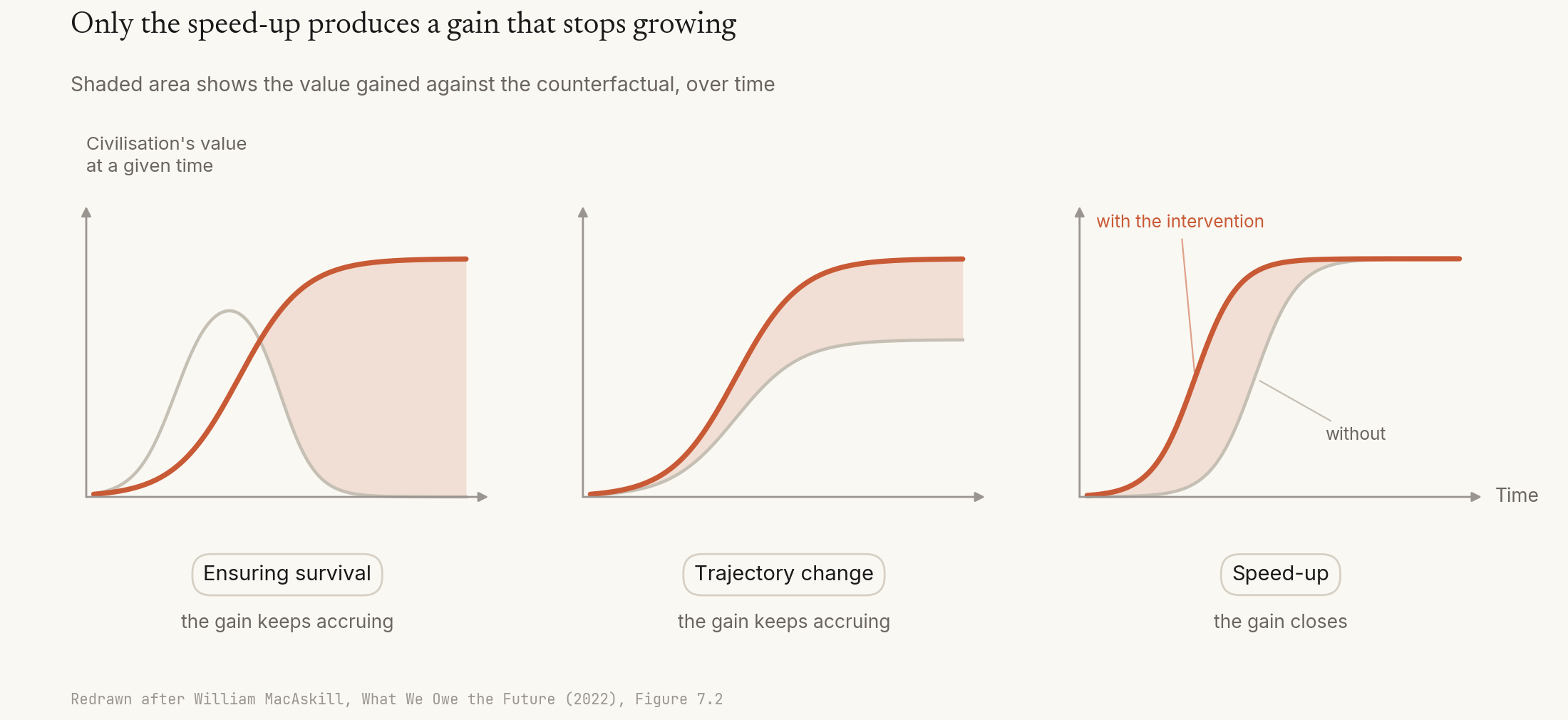
All three panels rest on the same picture of the far end, a curve that flattens. MacAskill defends the flattening on physical grounds, since holding today’s growth rates for ten thousand years would mean producing trillions of present civilisations’ worth of output for every atom within reach. No argument from me on the principle. The AI and energy series on this site runs on the same premise, and the Smil and Yergin entries treat physical limits as the ones that bind.
The claim covers total world output rather than the adoption curve of any single technology. MacAskill assumes it, and the figure depends on it. The sharper worry is about shape rather than height. Speed settles what gets built first, who builds it and which precautions get skipped, and those choices decide which curve a civilisation ends up on.4 Chapter 7 does not test the point.5
Value lock-in
Chapter 2 supplies the general mechanism. Some moments carry outsized long-run effects because a period of plasticity, when many outcomes are still available, is followed by one of rigidity. Economics calls the result path dependency, where a system’s end state turns on which small events happened early. W. Brian Arthur formalised it in 1989 and named the frozen end state lock-in, the word MacAskill later borrows for values.6 MacAskill’s own image is glassblowing. Molten glass takes many shapes, and once cooled it can only be changed by melting it down. How long it stays molten is set by the speed of everything else in the room.
Chapter 4 supplies the case where that happens. Software is information, and information copies at almost no cost, so a value system written into a durable enough system outlives everyone who argued about it. Value lock-in is MacAskill’s name for the result, an event that causes a single value system to persist for an extremely long time.7
Lock-in at that scale is the far end of something ordinary. Contingency runs low on whether a technology arrives and high on what it arrives as. Recommender systems were coming either way. Recommender systems tuned to hold attention for as long as possible were a choice, made by particular firms answering to particular incentives, and the argument over what that did to public discourse is still running. The organisation that builds a technology decides what it optimises for, and that decision outlives the people who made it.
Chapter 4 then makes a point that Chapter 7 never picks up. Even if artificial general intelligence is a century or more away, the date it arrives is the date at which the values prevailing at that moment could be fixed, and which values those are depends on what happens between now and then.
That breaks the speed-up model, which assumes that when you arrive and where you end up are two separate things. For a technology that fixes defaults on arrival they are one thing, because the arrival date decides how much arguing, drafting and institution-building fits in beforehand. Law knows the slow version, the centuries it takes to settle a protected value at the top of a legal system.
Intelligence explosion and better futures
His work since the book has gone straight at the case where that condition fails.8 Preparing for the Intelligence Explosion, written with Fin Moorhouse, a Forethought research fellow who worked at Oxford’s Future of Humanity Institute before it closed, in March 2025, asks the reader to imagine the hundred years from 1925 to 2025 compressed into ten.9 Nothing is added to that century and nothing is taken away, only a tenth of the time to absorb each thing that arrives.
What goes missing is the interval. The decades in which treaties were negotiated, regulators staffed, doctrine built and public opinion moved are not dead time. That interval is how a society bends a technology towards serving the people who have to live with it, and writes the answer into institutions that can hold others to it. Compress the century and the technology still arrives on schedule. The institutions that would have decided what to do with it do not. The paper calls the decisions landing in that window grand challenges. Who holds concentrated power, what is owed to digital minds, who governs off-world resources.
The Better Futures series of August 2025 draws the conclusion. MacAskill splits the value of the future into two factors, the odds of Surviving and the quality of what we survive into, or Flourishing. His claim is that our survival odds are already respectable, leaving limited room to improve them, while the futures we survive into may capture a tiny fraction of what is achievable. The headroom sits almost entirely on the second factor, and almost nobody works on it. What he proposes aiming at is a viatopia, a society on track towards a near-best future without anyone having to say in advance what it contains.10
MacAskill’s distinction still holds, over a narrower range than the figure suggests. Ask whether the thing leaves the world’s options where it found them. If it does, it is a speed-up, and it is worth the years it saves and no more. If it settles something on the way in, whose defaults, whose rules, whose values, then how fast it arrives is part of what gets settled. Compute agreements, release policy, evaluation regimes and who writes the defaults all look like questions of speed and work as questions of direction. Steering towards a desirable world is the harder problem, and the arithmetic keeps pointing at it.

Conceptual toolbox
| Concept | What it means | Why it matters |
|---|---|---|
| Speed-up | Moving the same civilisation along the same road at a different rate. | Caps the value of pure acceleration at the years saved; most competitive venture deals live here. |
| Trajectory change | Altering the average value of civilisation over the whole of its remaining life. | Survival and value lock-in dwarf speed-ups once the long run is in view. |
| Significance / persistence / contingency | How much better a state is; how long it lasts; how long the world would have waited without you. | Contingency is where additionality usually fails when several funds would have done the deal. |
| Path dependency / lock-in | Early plasticity, then rigidity; once a path hardens, undoing it is costly. | Explains why when a technology arrives can decide which future you get. |
| Value lock-in | A single value system written into a durable enough substrate and held for an extremely long time. | Software copies cheaply; AGI arrival could freeze the values prevailing at that moment. |
| Surviving vs flourishing | Odds of continued existence versus quality of the futures we survive into. | MacAskill’s later claim: most neglected headroom sits on flourishing, not survival. |
| Viatopia | A society on track toward a near-best future without specifying the destination in advance. | A steering target when the desirable end-state cannot yet be fully named. |
Footnotes
-
[Source] Brian Chesky, “7 Rejections”, Medium, 12 July 2015, reproducing the five refusals to the June 2008 approach. ↩
-
[Source] William MacAskill, What We Owe the Future, Basic Books, 2022, Chapter 7, in the section on whether stagnation would matter over the long run. ↩
-
[Context] Beckstead’s 2013 Rutgers thesis, On the Overwhelming Importance of Shaping the Far Future, carries the whole apparatus: the speed-up and trajectory pair, contingency through Edison’s light bulb, path dependence through QWERTY. MacAskill credits the coinage in one endnote. ↩
-
[Counter] A weaker objection targets the ceiling itself. Under growth with no plateau, arriving early would mean staying permanently ahead, and the third panel would never close. The shape objection does not depend on that. ↩
-
[Counter] MacAskill’s position was never that speed is irrelevant. Chapter 7 argues that genuine stagnation, centuries with almost no progress, would be dangerous in its own right, by holding civilisation in the window where it can still destroy itself. ↩
-
[Source] W. Brian Arthur, “Competing Technologies, Increasing Returns, and Lock-In by Historical Events”, The Economic Journal 99(394), 1989. Paul David’s 1985 QWERTY paper is the other founding text. ↩
-
[Context] MacAskill’s precedent is Chinese. The Qin failed to lock in Legalism; the Han locked in Confucianism for over a thousand years. Both settlements loosened when their enforcers died and rivals appeared. Software has neither weakness. ↩
-
[Context] Chapter 10 already listed the acceleration question among the places where the author had no answer, noting that the wrong move there could be disastrous rather than merely wasted. ↩
-
[Source] William MacAskill and Fin Moorhouse, Preparing for the Intelligence Explosion, Forethought, March 2025. Also on arXiv as 2506.14863. ↩
-
[Source] William MacAskill, Better Futures, Forethought, August 2025. Five essays, with Fin Moorhouse co-authoring two and Phil Trammell the supplement. Viatopia is named there but developed elsewhere. ↩