
What AI’s Mathematical Breakthroughs Mean for Specialised Models
How far can general models go in specialised fields, and where do they still need experiments and domain expertise?
- Part 0 · Introduction you are here
- Part 1 · What Should a General Model Know?
- Part 2 · The Last Bit Has to Come From the World
- Part 3 · Why There Is No AWS for Biology
A few weeks ago, 2050 took over the management of Galion.exe Origin, the fund we built at Galion.exe. I am now leading an initiative there to explore what makes AI fertile: how it can help advance science and improve the essential systems we depend on. This essay and the series that follows are part of that work. We are sharing the research, conversations with researchers and builders working at the forefront of AI, and open questions behind our upcoming investment strategy so that others can use them, challenge them and contribute.
In late 2025, I wrote AI Moats Are Different to explain a conviction behind several of our investments: companies combining deep industry expertise with AI could build lasting advantages, particularly in science and critical industries. Their expertise would help them solve difficult problems and gain access to valuable data others could not easily obtain. Embedded in customers’ workflows, they could then generate even more data to improve their products.
So far, those investments have been going well. But two things had prompted me to revisit the thesis. Harnesses, the software around a model that lets it use tools and carry out a task, had seemed strategically important; they were starting to look much easier to replicate. At a lunch organised by Google, Joëlle Barral at Google DeepMind also pointed out a limit to the data flywheel: few business customers let suppliers train on their data.
Then, a few days ago, a fellow investor with a strong maths background told me at a board meeting that he was seriously worried about his portfolio. The latest AI breakthroughs in mathematics had convinced him that general models could catch up with almost any specialist within weeks, threatening many of the startups he had backed. His concern brought me back to a question about our own investments: how much would specialised models still matter as general models improved?
I had backed specialised models too, but was less worried. Jérémie Kalfon, a computational biologist developing AI models of cells, later made a broader point: mathematical ability is not a complete measure of intelligence, and being exceptional at one thing does not mean being good at everything. That captured my hesitation about drawing sweeping conclusions from the maths results. Still, AI might transfer skills differently from people.
So I asked several AI researchers and practitioners what these results changed, and what I might be missing.
Learning beyond the training examples
Jules Pondard, founder and CEO of an education AI startup in stealth and a three-time International Olympiad in Informatics medallist, reminded me that generalising beyond the training examples has always been the point of machine learning. The aim is to learn useful patterns, rather than rely on rules supplied by people.
A longstanding question is why people can learn from so few examples. Show a child a few cats and they can often recognise another; traditional image-recognition models needed many labelled pictures. But the child already knows something about animals, shapes and the world. Modern models also bring extensive prior training. The question is how much of that earlier learning helps with something new1.
Jules connected this to information theory, which I explored in Compressing a Causal Chain: learning a pattern lets us describe many examples with a short rule. The difficulty is knowing whether that rule will work beyond the examples we already have.
Deep learning repeatedly did better at this than researchers expected. Networks large enough to memorise their training data could still learn useful patterns. Jules’s point was that predictions of a plateau had proved too pessimistic. I should be wary of making another, even if success in mathematics did not yet answer my questions about other specialised fields.2
To understand why my fellow investor was so worried, it helps to see how far AI has come in mathematics in just a few months.
Why the mathematics breakthroughs caused such a stir
In May 2026, OpenAI reported that a general-purpose reasoning model had disproved the Erdős unit-distance conjecture, bringing unexpected ideas from algebraic number theory into geometry. External mathematicians checked the proof. Mathematician Tim Gowers called it “a milestone in AI mathematics.”3
Less than four months later, in September, OpenAI announced a solution to the forced Navier-Stokes Millennium Prize formulation, accompanied by a Lean formalisation (the theorem and proof written so a computer can verify the reasoning). The effort involved roughly 10,000 agents working in parallel and 105 hours of search and verification, with output tokens that would cost about $6.5 million at GPT-6 Astra’s API rates. OpenAI has not disclosed the actual cost.4
In October, OpenAI released more than 700 mathematical papers, grouped into 372 sets of related work. These manuscripts present proposed results and proofs, still at different stages of checking. Several can address the same problem, so the paper count is not a count of major problems solved. The reaction of Hugo Duminil-Copin, the French mathematician awarded the Fields Medal in 2022, conveys their scale. According to Le Monde, 16 problems concerned his work; one set of 13 papers covered an entire research programme. “They have annihilated my field of research,” he said. This goes well beyond isolated puzzles.5
The scale explains my friend’s concern. The transfer question is whether learning to solve these problems helps a model learn the jobs our companies do, with less specialised training.
What ARC tells us about training
Jules also pointed out that general models already receive specialised training: “Today, specialisation is actually being done by the labs without the general public seeing it.”
Jules pointed to ARC-AGI, a set of reasoning tests designed by François Chollet to measure how efficiently a system learns unfamiliar tasks from a few examples. In its grid puzzles, the model must infer a transformation from a handful of examples, then apply it to a new grid.
Early language models struggled. With the arrival of reasoning models, performance improved sharply. For Jules, that was the interesting development: models seemed to be getting better at acquiring new skills on the fly, which was precisely what the test was designed to measure.6
For Jules, it remains unclear how much of that apparent adaptability comes from specialised post-training, including practice environments designed for this kind of task. The o3 system evaluated in December 2024 had trained on public ARC tasks, and the evaluators had no version without that training to compare it with. That leaves us unable to separate the contribution of task-specific preparation from a broader improvement in learning new skills.
Jules also distinguished two cases. A model may have seen the test answers during training: that is contamination. The second case is subtler: it may face a genuinely unseen maze after practising on thousands of other mazes. Solving it shows that the model learned something useful from those earlier examples. But our broader question remains: how much does that experience help with a different kind of problem? A maze test alone cannot tell us.
Why experiments still matter
Pierre Manceron, co-founder and CEO of Raidium, which builds specialised SOTA AI models for radiology, has been discussing these results with friends in pure mathematics. Their point was simple: if a model solves a previously unsolved problem, it is doing more than repeating known answers. It can use familiar mathematical tools to reach a new result.
Outside mathematics, even defining the problem can take substantial scientific work. As Cyril Véran, CEO of Living Models, which developed BOTANIC-1, a SOTA foundation model for plant genomics, trained on 320 species, puts it: “If you want to build a good reasoning model, you need to understand the tasks.” Choosing a useful biological question and deciding what would count as a good result require expertise too.
Pierre adds that the limits may indeed lie in our theories, not just our datasets. He points to the ultraviolet catastrophe: classical physics predicted that a hot body would emit an infinite amount of energy, contradicting measurements. The theory needed revising, not just more calculation. Better reasoning may help us question those assumptions and propose alternatives, but we still need evidence to decide which account fits the world.7
Indeed, reasoning can guide that work, but it does not make the observations unnecessary. And that evidence may be costly to obtain: a proposed material must be made and tested, and a risk model must be compared with real outcomes.
Félix Raimundo, co-founder and CEO of TychoBio, who holds a PhD in computational biology, pointed to what our models may be missing. In biology, some things are difficult to measure; others we do not yet know to look for. An abstraction is only useful if it captures what matters to the question. His analogy is reinforcement learning (RL): an agent can learn to fly a helicopter through trial and error, but how can it control its altitude if it has no way to know how high it is?
Félix also cautions that transfer between familiar data types (modalities) may tell us less about unfamiliar ones. Much of the progress in general models involves text, images and sound, for which researchers have developed effective ways of representing and learning patterns. A photograph of a cat and a radiograph look very different, but share visual structure. Moving to a molecule’s three-dimensional shape, predicting how two molecules bind, or modelling an immune response can require different representations and assumptions.
Simpler specialised models can also be easier to interpret, Félix notes. A complete explanation of a treatment is not always necessary, but understanding why it might work and where it might fail helps a team decide which experiments to fund.
The question is how long this will take. Léonard Strouk, CTO of Living Models, expects major advances in biology and physics, but sees three reasons for caution: (i) experimental data can be biased; (ii) deciding which questions are worth asking takes scientific judgement; and (iii) predictions need to be tested, with results researchers can make sense of.
There is also the problem of what we can measure. DNA, RNA, proteins and the environment each reveal a different part of what is happening. Measuring one does not fully reveal the others, or how the system behaves when healthy, disturbed or diseased. Generalising reliably requires enough observations to understand how those parts interact across these conditions.
How quickly these gaps can close depends partly on whether the evidence already exists. Ihab Bendidi, a research scientist at Rivercell and formerly at Recursion, expects general models eventually to outperform specialists even in applied fields. He distinguishes between two kinds of work: (i) where theory is well developed and data already abundant, as in parts of theoretical physics, AI can accelerate the analysis of existing observations and uncover consequences nobody had worked out; (ii) where progress requires new experiments, it must also help produce the missing evidence.
He expects general models to help automate experiments, but says we have not yet shown that they are broadly better at conducting them. Even once they are, collecting enough data will take time.
Cost creates another delay: when the task and method are already clear, a specialised model may do the job much more cheaply. He expects that advantage to shrink as general models improve and become cheaper. Overall, he agrees with my friend about the direction, but not the time frame.
For builders and investors alike, the advantage may lie in what a company gives the model access to. Two companies can use the same general model and get different results because one has proprietary data or domain knowledge the other lacks. Securing specialised data may remain valuable even as models become easier to reproduce.
A specialised model may still be the best fit for particular tasks, even as general models improve. But specialisation and size are different: a small model can be general-purpose, and a specialised model can be large.
Putting general models to work in radiology
Pierre already sees progress in radiology: general vision models can suggest labels and spot annotation mistakes they could not handle six months ago. According to his conversations with frontier labs, those specific tasks had not been a deliberate training target (which does not rule out exposure to related data).
For Pierre, these advances offer new tools for the specialised work Raidium already does. He sees a practical use: let general models prepare annotations, have experts check them, then train smaller models on the resulting data. A related approach, distillation, trains a cheaper model to reproduce a larger model’s answers.
At the tens of dollars per model call Pierre mentioned for his setup, preparing training data may make more sense than using the general model on every case.
Here, better general models help specialists build better tools, with experts checking the training data.
What I am taking forward
This builds on the techbio thesis I set out in March in Foundation Models in Biology Hit the Noise Floor. I already favoured companies addressing specific biological problems, with well-understood mechanisms, clinically relevant data and a fast exchange between modelling and experiments. Control of the experimental infrastructure was central to that thesis.
The question these mathematical results sharpen is how much specialised modelling a company will still need to do itself. Could a stronger general model extract more from the same observations, or need fewer new ones? And which experiments would remain essential?
That could change where those companies invest their effort, and which data and experiments are worth paying for.
The Navier-Stokes dispute also raised a question of trust. Researchers who had used OpenAI’s tools for unpublished work questioned whether that work had influenced the company’s result. OpenAI says it did not. Gaël Varoquaux, an AI researcher at Inria and co-author of TabICL, one of the leading foundation models for tabular data8, describes what a researcher contributes when working with an AI model: corrections, promising leads and ways to break a difficult problem into smaller steps. Such exchanges could supply valuable examples of reasoning. “De-identifying” them may preserve the ideas while removing their attribution. Varoquaux’s concern is therefore about scientific credit as well as privacy (it does not establish that these conversations were used in training). For companies doing proprietary research, the practical questions are who can access these exchanges and whether they can be reused for training. Local deployment gives them more control, whether the model is general or specialised.9
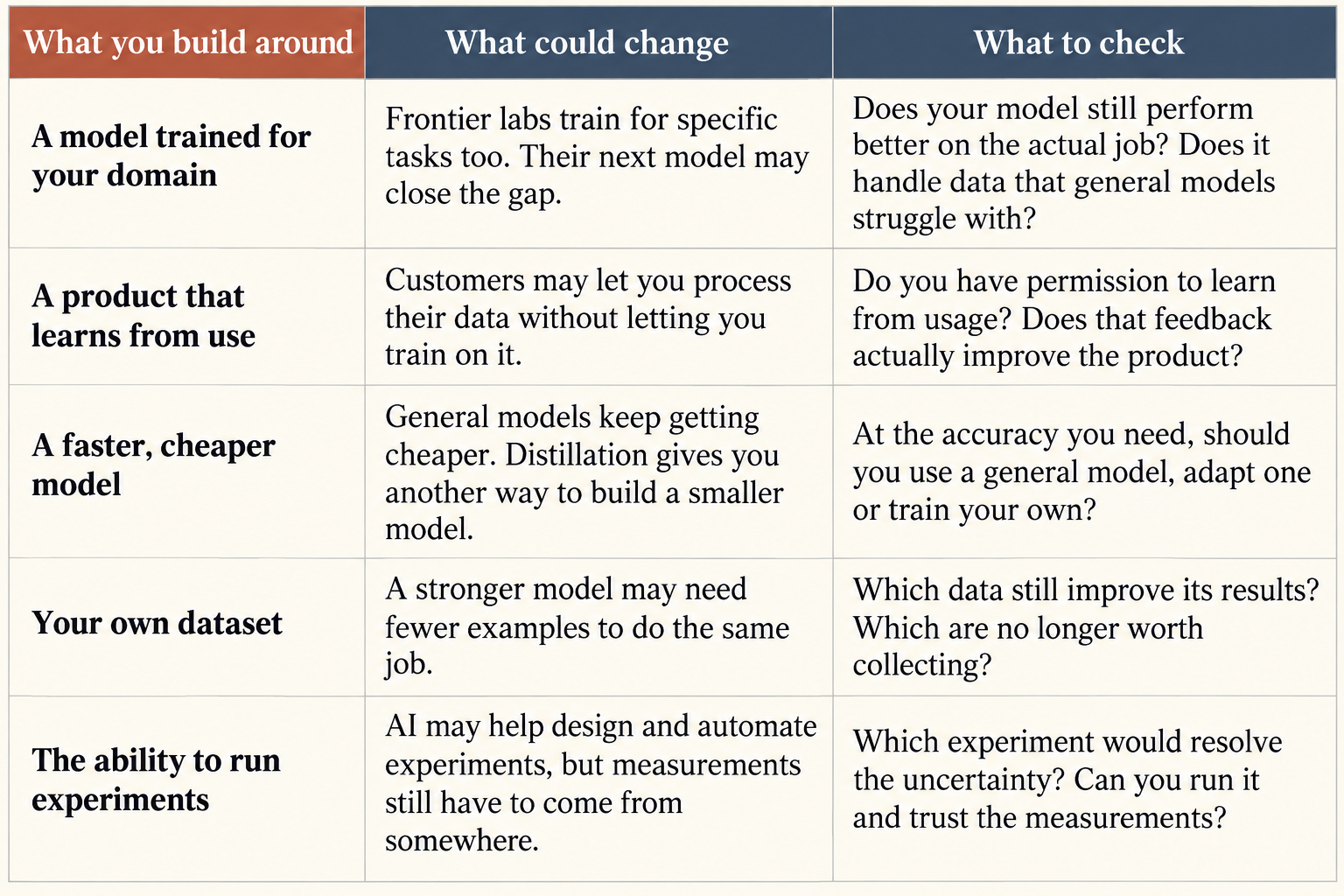
The investor at the board meeting feared that general models would soon replace the specialists he had backed. I now want to ask a more specific question of each company: as general models improve, which parts of its work can they take over, and what must the company still build? A general model might plan the analysis, a specialised model interpret the scientific data, and a harness connect them to the right tools, context and checks. Better general models could change that division of work substantially.
The answer depends on the task, the available data, the strength of the underlying theory and the feedback we can obtain. Reinforcement learning needs reliable feedback. A simulator can provide it cheaply, provided it captures the features that matter to the task. Otherwise, success in simulation may not survive an experimental test. I would not assume that progress on a well-described physics problem carries over to a living system, or that predicting a material’s bulk properties settles how its surface behaves. The measurements, assumptions and deployment requirements have to be assessed for each task.
For anyone building or backing these companies, the question is: what do they contribute as the models available to everyone get better? The answer might be a model, but it might also be an experiment, an evaluation method, or the expertise to make these tools work together.
This essay introduces How Machines Learn the World. The three parts that follow examine what transfers, which data we still need, and who can produce them:
Part I: What Should a General Model Know? Before asking which data will remain valuable, we need to understand what a stronger general model can learn without them. That is where Part I begins.
Part II: The Last Bit Has to Come From the World asks what better reasoning cannot replace: which new measurements or experiments are still needed, and how to choose them.
Part III: Why There Is No AWS for Biology takes the question into the physical world: who will build the labs, hardware and services that generate those data, and where could a lasting business advantage emerge.

Footnotes
-
ARC-AGI stands for Abstraction and Reasoning Corpus for Artificial General Intelligence. The ARC Prize guide explains the grid-based tasks. François Chollet’s On the Measure of Intelligence (2019) sets out the aim: measuring skill-acquisition efficiency while accounting for prior knowledge and experience. ↩
-
The discussion on generalisation draws on discussions with Jules Pondard and on the following papers: Algorithmic information theory (2008), Zhang et al., Understanding deep learning requires rethinking generalization (2017), and Belkin et al., Reconciling modern machine learning practice and the bias-variance trade-off (2019). Vapnik and Chervonenkis, On the Uniform Convergence of Relative Frequencies of Events to Their Probabilities (1971), is a foundational source for these generalisation guarantees. VC dimension measures a model class’s capacity, not simply the number of input dimensions. These results relate that capacity to the amount of data needed for generalisation guarantees. Zhang and colleagues later showed that networks capable of memorising random image labels could still generalise when trained on correct labels. This did not invalidate the earlier bounds; those bounds were often too loose to explain the observed performance. Kolmogorov complexity, mentioned in the discussion with Jules, is the length of the shortest program that generates a given sequence. The classical setting assumes training and test examples are sampled independently from the same distribution; it does not establish transfer between different domains. Jules also mentioned that Jared Kaplan was deeply interested in information theory, with the equations in Scaling Laws for Neural Language Models (2020) following a broader reflection on learning - his famous paper which measures how performance changes with model size, data and compute. ↩
-
OpenAI, “An OpenAI model has disproved a central conjecture in discrete geometry”, 20 May 2026. Includes the proof, external mathematicians’ assessments and the quotation from Tim Gowers. ↩
-
OpenAI, “On the Navier-Stokes Millennium Prize Problem”, 8 September 2026. The announcement describes the forced formulation and reports roughly 10,000 concurrent agents in the successful group, with 88 hours of search followed by 17 hours of Lean formalisation and verification, or 105 hours in total. Lean checks the formal proof; mathematicians still need to check that its statement matches the intended problem. The 130 billion output tokens concern the Navier-Stokes effort; the broader search across several problems used about 300 billion. Cost comparison, calculated on 13 October 2026: 130 billion output tokens / 1 million × $50 = $6.5 million, using GPT-6 Astra’s standard output price for short-context requests. This excludes input tokens, tools, training and staff. The research used an unreleased model; its hardware use and internal cost are not disclosed. An API price includes commercial pricing and is not a measure of production cost. ↩
-
OpenAI’s mathematics repository, checked 12 October 2026: 719 manuscripts in 372 families of related results. Verification is ongoing; manuscript counts are not counts of independently verified discoveries. The catalogue listed 722 manuscripts when checked again on 13 October. Duminil-Copin’s remarks are reported in Le Monde, 12 October 2026, following his 8 October talk for the Société Mathématique de France. The report describes one entire programme, not all his research programmes. ↩
-
François Chollet, “OpenAI o3 Breakthrough High Score on ARC-AGI-Pub”, ARC Prize, 20 December 2024, with subsequent updates. The evaluated system had trained on public ARC tasks; no comparison with an ARC-untrained version was available in that evaluation. ↩
-
[Context] Classical physics predicted that a hot body would radiate an infinite total amount of energy, contradicting measurements. Planck’s work on black-body radiation in 1900 introduced energy quanta, helping lay the foundations of quantum theory. The problem was not simply a shortage of data: the theory needed revising. American Physical Society, historical account. ↩
-
[Disclosure] I have backed Prior Labs, the company behind TabPFN, which competes with TabICL. ↩
-
[Context] See Scientific American’s initial reporting on the dispute and its follow-up, “OpenAI’s blockbuster Navier-Stokes proof isn’t what we thought it was” (13 October 2026). In its updated account, OpenAI states that its investigation ruled out any influence from Buckmaster’s Codex prompts over the preceding two months, including through training. The dispute does not establish that private prompts were used. ↩
← Return to the series overview: How Machines Learn the World