
The Case for Humanist Techno-Progressivism
The Case for Humanist Techno-Progressivism
A map drawn on power, technology and planetary limits gives six political positions, and the most desirable one is empty.
I have never much wanted to write about politics here. The longer I spend trying to nudge the direction of things, the harder it becomes to keep the two apart, since every question about what gets built turns sooner or later into a question about who decides. That question has run through most of what I have written on institutions and the distribution of power, and through the evening at Bercy on sovereignty and French economic governance, without my ever giving it a frame.
What has shifted is the frame rather than the subject. The spectrum I grew up with was organised around a single question, liberty against equality, and that question is a dispute about how power should be distributed. It has not stopped working. It is the vertical axis of the map below. What it cannot do on its own is place anyone on the two forces that now separate positions just as sharply, the relationship to technology and the relationship to natural resources.
I came back to this reading a Guardian interview with Gil Durán, a journalist and former political strategist whose The Nerd Reich traces what he calls the rise of tech fascism.1 What I wanted from it was a compass, something that would tell me where effort should go, and what it offers is a thorough map of one corner.
Power on one axis, technology and limits on the other
The vertical axis is the old one. Liberty against equality was always an argument about the distribution of power, so it runs from power concentrated in a few hands to agency distributed widely, and the twentieth century left and right still sit on it exactly where they always did.
The horizontal axis carries the other two. Technology and natural resources become one question as soon as you put it to people who want to build. Do the planetary limits bind, or not. Ecologists have been asking that since the 1970s, and none of it is mine. What has not happened is anyone treating it as an axis of political argument, level with the argument about power. Restrain or accelerate looks like the whole of it, and accelerate needs splitting in two.
Positions that look alike from outside, because they all want to build, turn out to disagree about whether the ecological ceiling is a design constraint or a bill to be settled afterwards. That disagreement separates people who are otherwise allies, and it is invisible on any left and right diagram.
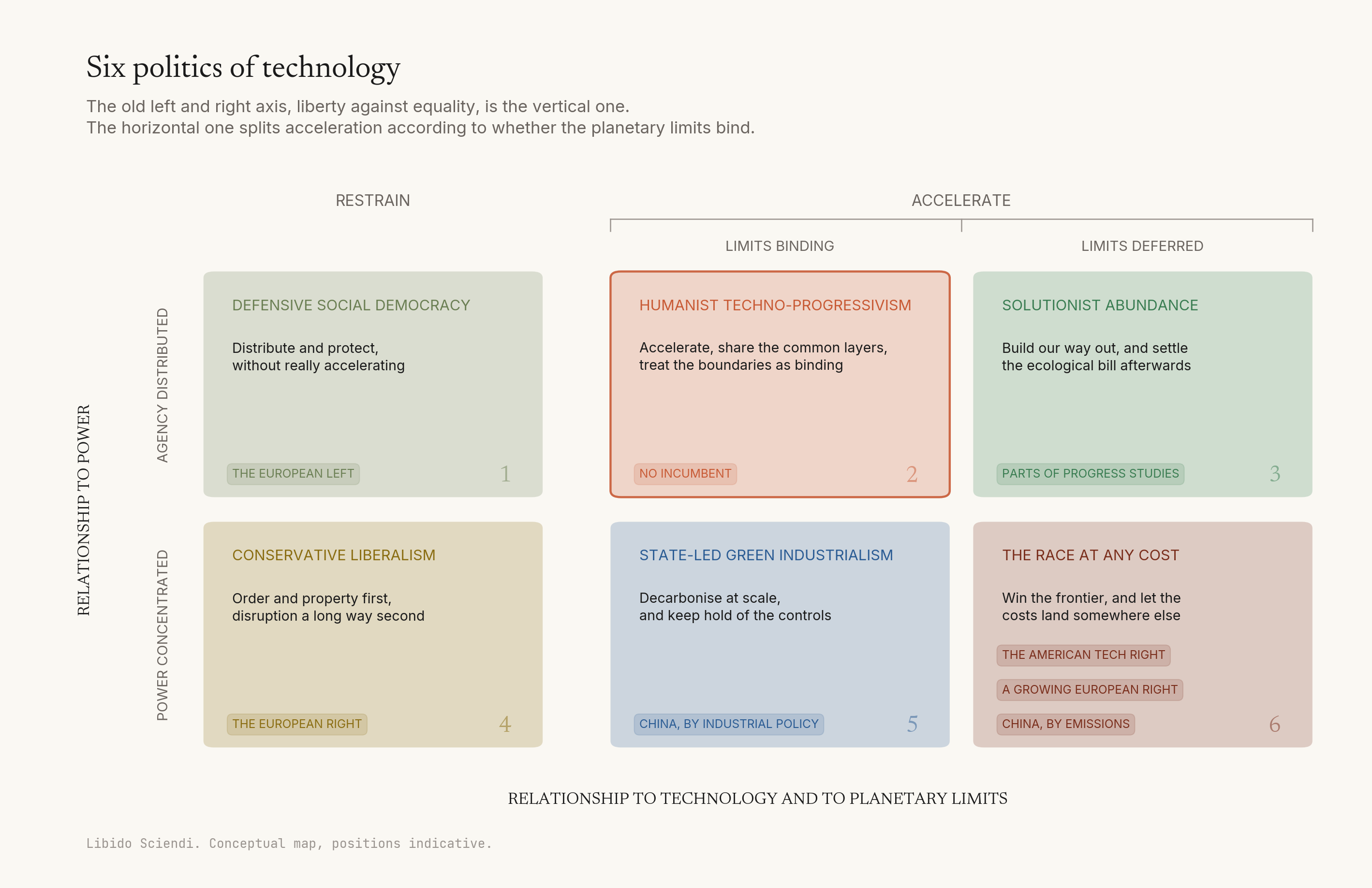
Six positions
1. Defensive social democracy, top left. Distribute and protect, without really accelerating. The European left holds it, with degrowth as its most explicit version, and it offers no account of the future that anyone under thirty finds exciting. Its failure shows in the General Data Protection Regulation, a rule aimed at the largest data firms that left the vendor market 17 per cent more concentrated within a week.2 Compliance cost is a fixed cost, and fixed costs concentrate.
2. Humanist techno-progressivism, top middle. Accelerate, share the substrate, treat the boundaries as binding. No occupant.
3. Solutionist abundance, top right. Build, spread the results widely, and assume the ecological ceiling will be handled by whatever gets built. Much of progress studies belongs here.3
4. Conservative liberalism, bottom left. Order and property first, disruption a long way second. Agricultural protection, planning by veto, the defence of incumbent industries. The European right sits here, with an ethos close to the older aristocratic conservatism, minus the aristocracy.4
5. State-led green industrialism, bottom middle. Decarbonise at scale, and keep the controls with the state. China on the direction of its industrial policy, and box 6 on its emissions.5
6. The race at any cost, bottom right. Win the frontier, and let the costs land somewhere else. The American tech right holds the only working reading list of the six, from The Sovereign Individual in 1997 through Curtis Yarvin to Peter Thiel and Balaji Srinivasan, and the genealogy stops short of Saint-Simon in 1821.6 The fastest growing wing of the European right is moving here, along the bottom rather than upwards.7
Europe will not lead from the bottom row, having neither the private capital formation behind box 6 nor the state form behind box 5. Box 2 is the one left, and nobody is standing in it.
What humanist techno-progressivism commits you to
Box 2 asks for two commitments that the other five treat as opposites. Build much faster. Spread the resulting power much more widely.
Holding both is hard because they run on different clocks, which is the distinction between speeding a civilisation along its road and altering where the road goes that I worked through in the previous entry.8 A movement built for speed reads deliberation and ecological ceilings as friction. A movement built for direction reads speed as a reason for suspicion.
Only one of those clocks should be wound faster. Construction gains from speed. Attention, judgement and the weighing of consequences do not compress the same way, and treating them as latency is how a build programme loses the consent it needs.9
In practice that means signing five things at once.
- Treat the planetary boundaries as binding. They constrain how things get built rather than how much, and that constraint is the entire difference between box 2 and box 3.
- Accelerate for real. Artificial intelligence, biotech and techbio, meaning biology run as an engineering and data discipline, abundant energy including nuclear, robotics, new materials, advanced agriculture, infrastructure. Naming what should get built this decade is what separates box 2 from box 1, and it takes entrepreneurial energy and a plan at the same time. Entrepreneurs run the search. Plans set the direction and buy the first units, and plans are back.
- Share the layers everyone builds on. Public research, open standards, open weights where feasible, public compute, shared reference data. This is not the public sector’s department. The largest commons in software were built and are maintained by private firms, because a shared layer was worth more to them than sole ownership of it.10 A commons is defined by its governance as much as by its access, so the people who depend on a layer get a say in its rules, and cooperation becomes the default on the layers whose costs everyone carries.
- Build a capable state. Procedure exists to make treatment equal and decisions reproducible, and both are worth keeping. The task is to buy agility without paying for it in fairness, using technology to make treatment faster and more even, and keeping people where judgement belongs. Efficiency is one lens among several, as any public hospital makes obvious.
- Treat democracy as an error-correcting system. Plural and contestable institutions give a society many places to spot a mistake and many routes to reverse it. Karl Popper judged a political system by whether its rulers could be removed without violence. Where they can be, mistakes get corrected. Where they cannot, they pile up until the physical world corrects them instead.11
In one line, maximum acceleration with maximum distribution of agency, inside the limits. The rule that holds the five together is that economic success buys more resources to experiment with and never the right to set the rules.
Why the limits argue for speed
The Stockholm Resilience Centre, where Johan Rockström’s team defined the planetary boundaries framework in 2009, assessed seven of the nine boundaries as transgressed in its 2025 Planetary Health Check, ocean acidification joining the list for the first time. Only ozone depletion and aerosol loading remain inside the safe zone.12
Read from the left column, that finding calls for contraction. Read from the middle, it calls for speed. Ten billion people cannot live inside those boundaries on current technology, and no arrangement of restraint gets them there. Staying inside requires abundant clean electricity, agriculture with a smaller land and nitrogen footprint, substitutes for the materials whose extraction is doing the damage, and industrial heat that does not come from burning carbon. Every one of those is a build problem.
The distributional half applies here too. A planet kept habitable by technologies that a handful of firms own is a planet held on licence, and habitability works as a protected value only when the means of maintaining it are widely held.
The feedback arrives either way. A society that will not read a model ends up reading a burnt summer. France set a modern record for burnt area this July, and more than a third of a million people were moved out of the path of fires in south-western Europe.13 That moves markets as much as governments, since demand for anything that holds production inside the limits will rise faster than any policy timetable, and the pressure to act will rise with it. Organisations only decide whether the lesson comes early and cheaply, or late and at full price.
Condorcet held it whole
Proscribed with the Girondins in July 1793, Condorcet wrote the Esquisse d’un tableau historique des progrès de l’esprit humain in hiding, and was found dead in the prison at Bourg-la-Reine in March 1794.14 He thought scientific progress had no ceiling and he thought ordinary people were competent to govern themselves, having proved in 1785 that a large assembly of moderately reliable voters converges on the right answer.15 For him these were one project, and what joined them was public instruction, the plan for which he submitted to the Legislative Assembly in April 1792.16
The equivalent question now is what spreads the capacity to build. Open weights, public compute, open standards and open science are the candidates, and each of them is currently argued for by people who are not talking to the other two. The box is empty, which is the only reason Europe has a chance of reaching it first.

Footnotes
-
[Source] Gil Durán, The Nerd Reich: Silicon Valley Fascism and the War on Democracy, Avid Reader Press, 18 August 2026. He calls the result fascism, a weaker instrument than it looks, since his own formulation has the word describe a coalition. ↩
-
[Source] Garrett Johnson, Scott Shriver and Samuel Goldberg, “Privacy and Market Concentration”, Management Science, 2023, on a panel of more than 27,000 top websites. The aggregate effect faded by the end of 2018 but persisted among advertising vendors. ↩
-
[Definition] A loose movement formalised by Patrick Collison and Tyler Cowen in 2019, arguing that the causes of scientific and industrial progress deserve a field of their own. Its institutional home is the Roots of Progress Institute. ↩
-
[Caveat] The box is unflattering and parts of the European right are genuinely pro-business and pro-building. The claim concerns where its resistance to change is most consequential. ↩
-
[Counter] China deploys more clean generation, batteries and electric vehicles than anyone, and it remains the largest emitter and continues to commission coal capacity. Either single placement would be a false precision. ↩
-
[Context] Du système industriel, 1821, proposed that France be run by its producers and its savants, the government of men giving way to the administration of things. Comte kept the means and shed much of the egalitarian end. ↩
-
[Context] Musk’s endorsement of the AfD ahead of the February 2025 German federal election and Vance’s Munich Security Conference speech the same month are the visible markers of a longer alignment. ↩
-
[Crossref] The speed-up and trajectory-change pair originates in Nick Beckstead’s 2013 Rutgers thesis, and I worked through MacAskill’s version of it in the preceding entry. ↩
-
[Caveat] The asymmetry is the humanist half of the position. Deployment gains from speed. Deliberation and judgement lose from it, and a programme that compresses both ends with neither. ↩
-
[Source] Hoffmann, Nagle and Zhou, The Value of Open Source Software, Harvard Business School, 2024. Recreating the widely used pieces once would cost about $4.15 billion, against roughly $8.8 trillion of value drawn from using them. ↩
-
[Source] The Open Society and Its Enemies, 1945. Popper also argued against redesigning a whole society at once, which tells against running a country as a firm quite as much as against central planning. ↩
-
[Source] Planetary Health Check 2025, Stockholm Resilience Centre and Planetary Boundaries Science, September 2025. Three boundaries were assessed as crossed in 2009, four in 2015 and six in 2023. ↩
-
[Source] Carbon Brief, drawing on the European Forest Fire Information System, August 2026. Burnt area across the EU stood second only to 2022 for that point in the year, with France at a modern record. ↩
-
[Source] Condorcet, Esquisse d’un tableau historique des progrès de l’esprit humain, published posthumously in 1795 by Daunou and Sophie de Condorcet. Drafted in hiding after the proscription of the Girondins. The cause of his death was never established. ↩
-
[Definition] The jury theorem, from the 1785 Essai sur l’application de l’analyse à la probabilité des décisions. If each voter is more likely than not to be right, a large majority converges on the correct answer. ↩
-
[Source] Rapport et projet de décret sur l’organisation générale de l’instruction publique, presented to the Legislative Assembly on 20 and 21 April 1792. ↩