
The Moat That Cannot Be Coded: Nvidia, Frontier Labs, and Defensibility in the 21st Century
Tacit knowledge, CUDA as institutional memory, and who captures AI value when models commoditise.
- Part 0 · Series overview
- Part 1 · Nvidia, or the Repricing of a Watt
- Part 2 · The Moat That Cannot Be Coded you are here
- Part 3 · Pareto Frontiers and Lock-In
- Part 4 · The Return of the Real World
- Part 5 · The Job and the Task
- Part 6 · A Note on China
- Part 7 · Drawing the AI Stack
Andy Grove’s only the paranoid survive has rarely felt truer than today. The question of what holds against displacement haunts everyone in the AI economy: large corporations watching new entrants reshape their markets in months, service providers watching their offerings dissolve into the next foundation model release, startups facing the possibility that their entire product becomes a public feature of a platform, investors trying to underwrite multi-year theses against quarterly capability jumps.
In our earlier framework on AI moats, we put displacement risk at the heart of the problem. The framework laid out the four-level hierarchy that AI companies need to think through: technical foundation, product depth, market positioning, sustainability. We named the major defences: domain delta and velocity dynamics at the technical layer, workflow embedding and execution autonomy at the product layer, capability thresholds and market structure at the positioning layer, and three sanity checks at the sustainability layer. We showed why traditional SaaS valuation tools systematically miss what creates and erodes AI value. And we argued that single moats erode quickly: sustainable advantage requires compound layered defences.
The current paper extends one specific dimension that the framework treated more briefly than it deserved: institutional tacit knowledge and the relationships it travels with. The accumulated practice that lives in the people of an organisation (engineers, commercial teams, operations, regulatory affairs, clinicians, support staff), in the processes they have refined together, and in the trusted relationships they have built with customers, suppliers, and regulators. None of this is written down in a way that could be copied, bought, or open-sourced. And the deeper reason this matters now, which we develop later in this paper, is that today’s AI works by mathematising the world: what has been turned into data falls under the scaling laws and the models will eventually outperform humans on it, but what has not been turned into data, either because it cannot be or because it has not yet been, sits structurally outside their reach. Institutional knowledge and relationships are precisely that: the part of the world that has not yet been put into equations. This is, we argue, while completely invisible and absent from balance sheets, one of the strongest defences against displacement risk that exists today, and probably the most under-appreciated. Nvidia is the most visible illustration.
There is an apparent paradox here that we should name immediately, because it shadows the rest of the paper. If institutional knowledge and relationships make such a strong moat, why does innovation almost always come from the outside? Microsoft did not build OpenAI from within. Google had to chase a lab it largely failed to commercialise. And the broader pattern is older than the AI cycle: even the most innovative tech companies have built much of their current product portfolio through acquisition rather than internal R&D (Alphabet1, Amazon2, Apple3, Meta4, Microsoft5). Across waves and across firms, large incumbents have been refreshed by entrants more often than by their own R&D. We come back to why this happens later in the paper. The short version, which the rest of this piece works towards, is that the paradox is only apparent.
What this paper extends in the existing moat conversation
A short word on where this paper sits relative to the existing moat conversation, and why we are not aiming for exhaustivity. Every general-purpose framework, from Porter’s five forces to Helmer’s 7 Powers to our own AI moats hierarchy, will name slightly different defences in slightly different ways. The same family of canonical objections gets recited and dismissed across all of them:
- Proprietary data, but everyone now reasons that scraping and synthetic generation will erode any data moat.
- Network effects, but the argument goes that they presuppose a stable user-to-user value loop that AI compresses or bypasses, since a single agent can replace many of the interactions a network used to mediate.
- Brand, but the dominant view is that brand is no defence against a step change in capability, and brand itself can be built quickly through aggressive hiring of creative talent and large marketing spend.
- Switching costs, but APIs have made switching almost trivial.
The list could go on (scale economies, regulatory barriers, ecosystem effects, etc.). The pattern is the same in every case: a real defence is mentioned, then waved away by a generic argument that often turns out to be too quick. Each of these defences deserves its own dedicated treatment, and we will probably write more of those over time.
The argument of this paper is not that those classical defences have collapsed. It is that one specific defence, institutional tacit knowledge and the relationships it travels with, is structurally stronger than most of the others against displacement, and the most under-appreciated. The rest of this paper uses Nvidia as the cleanest illustration to work the thesis out, then extends it across the AI economy. Nvidia defends a 75% gross margin three years into the AI build-out, with its lead widening rather than narrowing. Something is resisting the supposed commoditisation. The question is what exactly, and what the answer says about everyone else.
Nvidia as a case study: CUDA is institutional knowledge
Start with the cleanest illustration. Why can’t hyperscalers simply build their own GPU stack, given that they have the engineering budgets and the strategic motivation? Huang, Nvidia’s founder and CEO, uses a metaphor. A CPU, he says, is a Cadillac. Almost anyone can drive it at highway speed. An Nvidia accelerator is an F1 car: almost anyone can also drive it at a hundred miles an hour, but pushing it to its actual limit is a different sport.
The metaphor answers the question that has shadowed Nvidia’s margins since the first ASIC6 announcements: if hyperscalers can write their own kernels7, isn’t CUDA’s moat just inertia?
Writing kernels that run is not the same as writing kernels that saturate the hardware. Nvidia engineers, when they get inside a partner’s stack, have publicly delivered 2x or more on a meaningful share of kernels and up to 4x throughput in joint optimisation efforts8. Hyperscalers can technically build their own software. They cannot easily reproduce the engineers who have spent twenty years learning the racing line.
This kind of advantage has a name in the strategy literature. Hamilton Helmer, in 7 Powers (2016), calls it process power: an embedded set of company-specific activities that produce superior outputs as a result of long-term commitment to a process that competitors cannot shortcut even if they understand it perfectly. Helmer’s paradigmatic example is the Toyota Production System. CUDA is the software-stack equivalent. The code is open in many parts. The papers describing the techniques are public. What is not transferable is the layered intuition of thousands of engineers who have, over twenty cycles of GPU generations, learned which optimisations matter for which workload, which pitfalls to avoid, which non-obvious refactors unlock disproportionate gains.
The deeper concept here comes from the philosopher of science Michael Polanyi, who in The Tacit Dimension (1966, ★★★★★) coined the formula that has anchored a half-century of thinking on knowledge transfer: we know more than we can tell. The skilled worker knows things in their hands and their attention that they cannot articulate. The skilled engineer knows patterns of code-architecture interaction that they cannot fully document. This tacit dimension is what survives commoditisation, because commoditisation works on what can be specified. What cannot be specified cannot be commoditised.
The connection to AI specifically is sharper than it first appears. Today’s frontier models work by mathematising the world and throwing massive compute at it: the scaling laws9 demonstrated by Kaplan et al. (2020) and refined by Hoffmann et al. (2022) show that as you increase model size, training data, and compute together, model performance keeps improving in a predictable, smooth way, provided the world has been turned into trainable tokens. What can be numerised, formalised, characterised, becomes training data, and the models then beat humans at it. But everything that has not been characterised, either because it has not yet been (the institutional case) or because it cannot be (the tacit case in Polanyi’s strong sense), sits outside the scope of the scaling laws by construction. Institutional knowledge is precisely the part of reality that has not yet been converted into trainable data, and therefore the part of reality where compute scaling cannot help. The moat lasts as long as the asymmetry between what is numerised and what is not. Andler’s distinction maps onto this directly: a problem, once formalised, is in principle a candidate for training data; a situation, by definition, has not yet been formalised. Institutional knowledge lives on the situation side of the line.
Andler pushes the analysis one step further by reaching back to Bertrand Russell’s distinction between knowledge by acquaintance (direct, embodied contact with a thing) and knowledge by description (knowing a thing through propositions about it). Humans use both. AI uses only the second. Most of the time, description suffices for intelligent action. What acquaintance buys is the ability to investigate: to walk around the thing, ask follow-up questions, notice what the description omitted, update it. AI cannot investigate because it does not know where to look, and knowing where to look requires the kind of situated common sense that comes from acquaintance. This is the deeper cognitive root of the institutional moat: insiders of a domain (clinicians, breeders, defence operators, semiconductor engineers) hold acquaintance with their object, not just descriptions of it. They know where to look when the description fails, which is precisely what frontier models structurally cannot do. I unpack this distinction in detail in Andler on Problem and Situation, and it is one reason why These Strange New Minds matters as a complementary read rather than a contradiction.
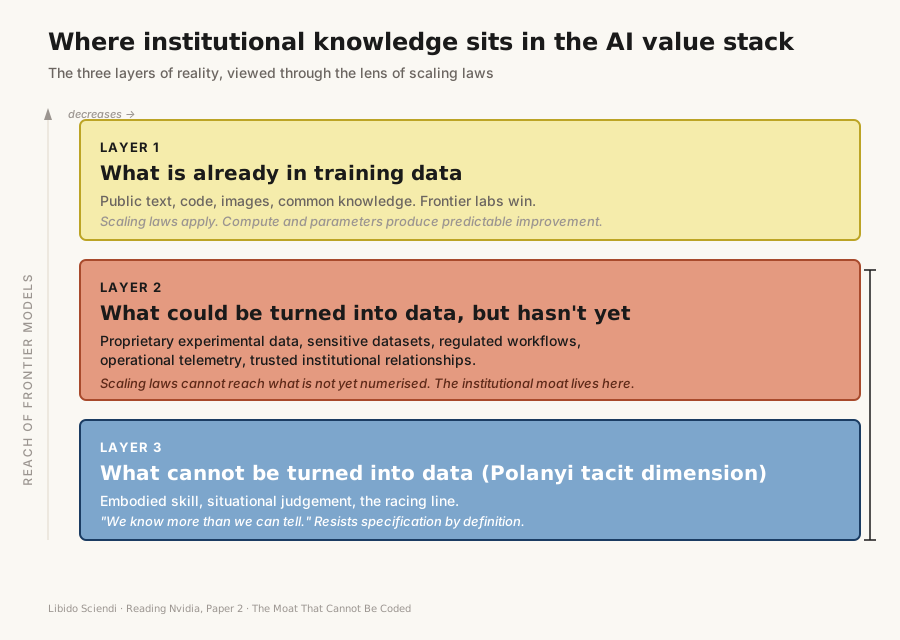
Coming back to our strategic framework for AI: this is precisely the kind of defence that survives the Reset Test10. Open-sourcing a model displaces nothing about Nvidia’s position, because Nvidia does not sell models. Designing a better-on-paper ASIC displaces little, because the bottleneck is not the silicon but the tacit ability to extract its full performance. A 10x capability jump in foundation models leaves Nvidia’s gross margin intact, because the moat does not live at the model layer at all. Tacit knowledge is the defence that cannot be routed around, because there is no formalism to attack. Where most moats erode by being specified and then replicated, this one resists specification by definition.
Why the frontier labs will not conquer the (entire) world
The same logic, applied outside Nvidia, leads to a thesis that runs against the current consensus. The story most VCs and analysts tell right now goes like this: the frontier labs (OpenAI, Anthropic, Google, Meta, xAI) will capture most of the AI value, because they own the most capable general models, and everything downstream becomes a commodity layer on top of them. The implicit conclusion, repeated in every VC partnership, is that vertical AI startups are precarious, because the labs will eventually subsume their use case.
Our institutional-knowledge thesis says the opposite.
A general model, however capable, has to be integrated into a specific use context to create value. As we showed above, the situation in Andler’s sense is precisely where institutional knowledge and relationships live. The illustrations below are deliberately chosen in industries where this asymmetry is at its starkest, where regulation, ecosystem closure, or physical sensitivity make the data hard to reach by default. There is a paradoxical observation hiding here, worth signalling honestly: in the open-data, open-API world that the AI wave is also accelerating, regulated and structurally closed industries may turn out to be unusually well-positioned. It is not just that their data is closed to scraping. It is that their entire culture of closeness and selective secrecy compounds institutional knowledge and trusted relationships into a moat that being an outsider cannot replicate, regardless of how much compute or how many models you bring to bear. We will dedicate a future paper in this series to that tension specifically.
- Human biology. A frontier model that reasons brilliantly across published clinical literature still depends, for any genuinely new prediction, on proprietary experimental data the major labs do not have access to, but also on the institutional know-how to produce and interpret that data: which controls matter, which artefacts to discard, how to design the next experiment so it actually answers the question. This is why techbio companies cannot operate with AI talent alone: they need biologists who carry the tacit understanding that no published paper fully captures. As we showed in our piece on foundation models hitting the noise floor in biology, even the best perturbation-prediction models converge toward the irreducible experimental noise of the underlying biology. The moat is the loop: companies that own both the experimental infrastructure and the modelling layer can keep pushing that ceiling down. This is probably why Anthropic has begun to acquire in health. Companies like OneBiosciences11 (clinical-grade single-cell tumour profiling) and Raidium12 (the first radiology foundation model, trained on 130TB of real-world imaging) build precisely on that combination of data and human expertise.
- Plant biology. The same logic applies in agritech, where the value sits not only in proprietary germplasm (the genetic material of cultivated plant lines, accumulated by seed companies and research institutions over decades) and matching multi-environment phenotyping data, but also in the long-running contractual relationships with breeders and research stations that produce that data, and in the institutional know-how to translate genomic signals into commercially relevant traits. Breeding cycles still run on multi-year horizons (8 to 12 years for major commodity crops, faster for vegetables like tomatoes), which makes the accumulated institutional position structurally hard to bypass. Living Models13 has built BOTANIC, a foundation model trained on 1,600 plant genomes across 43 species, designed to make this knowledge accessible to regional breeders and underserved crop systems (sorghum, cassava, millet) where climate adaptation matters most.
- Defence and dual-use. The moat here lives in highly sensitive datasets that no public actor can access (sensor recordings, mission telemetry, sovereign-controlled training data), in the institutional relationships with procurement agencies, integrators, and operational forces that take years to establish, and in the operational know-how needed to build systems that work under extreme robustness, multi-modal sensor fusion, edge inference, and adversarial conditions. None of this is reachable by a frontier lab trained on internet-scale text and code. Harmattan AI14 is building in this space, where the contextual barriers are stark and the moat lives in mastering them.
These three are vertical plays sharing the same structure: deep contextual data and know-how that the labs cannot reach. As a side note before moving on, the vertical lens is not the only one that works. A startup can also compete with frontier labs across many verticals at once, provided it brings two things the labs do not: a specialised non-LLM architecture and proprietary data the LLM training corpus does not contain. PriorLabs15 has built TabPFN, a tabular foundation model that learns causal relationships from synthetic data and matches tuned tree-based ensembles at industry scale16. The same logic could apply to advanced manufacturing intelligence (AMI) or to world models for robotics and physical simulation. In each case, the moat lives in specialised technical know-how rather than in the customer’s situation, but the underlying logic is the same: the value sits where the model is not, and where the labs cannot reach.
There is a second reason the frontier labs are structurally constrained, and it follows from the same thesis. The labs cannot accumulate the institutional knowledge that captures the most defensible value, because their structure forces them to compete on horizontal model capability rather than vertical situated expertise. They can certainly ship multiple specialised models (OpenAI runs GPT-5 alongside lighter variants, Anthropic ships Opus and Sonnet in parallel, Google fields multiple Gemini configurations), and they can use mixture-of-experts architectures internally. What they cannot do is route across competitors’ models, the way a vertical actor can pick Claude this quarter and GPT-5 the next. And their fixed costs (training runs in the hundreds of millions, talent compensation in the millions, datacentre commitments in the billions) force them toward horizontal massive deployment, which is precisely the territory where institutional knowledge is shallowest and price compression hardest. Meanwhile a vertical AI startup with a tenth of the capital can pick the best model for its workload every quarter, between Claude, GPT-5, Gemini, Llama, Chinese open-weights models like GLM and Qwen, and the next open-source release. The labs are forced to compete on commodity tokens and short-lived frontier capability; the vertical actors are free to build institutional moats the labs cannot reach. The labs themselves understand this, which is why Anthropic Claude for Government and OpenAI for Healthcare and similar verticalisation efforts are accelerating. They know commoditisation leaves them with no moat unless they build vertical institutional knowledge of their own.
This is not an argument that frontier labs will fail. They will not. Their general models will become essential infrastructure, like AWS in cloud or Intel in chips at peak. But like AWS and Intel, they will become commodity layers in someone else’s value stack, and the supernormal economics will live wherever vertical institutional knowledge meets general capability. To be noted, our argument holds under two conditions of validity17, which correspond to the world we currently observe: multiple competing labs, and no runaway capability gap between them.
Why mobility beats coercion
If the moat is institutional knowledge, the next question is where it circulates best. Counter-intuitively, the strongest ecosystems are not those that protect knowledge through legal coercion, but those that let it circulate. AnnaLee Saxenian’s Regional Advantage (1994) showed why Silicon Valley pulled ahead of Route 128 in the 1980s: California’s non-enforcement of non-competes (in place since 1872) meant engineers could leave one employer and join another the next morning, while Massachusetts protected individual firms at the cost of ecosystem dynamism. Each Boston company was more defensible. The Boston ecosystem compounded knowledge slower.
Talent mobility functions as an immune system that maintains the health of an entire ecosystem. Tacit knowledge migrates with the humans who carry it; each person changing jobs every three years (engineers, but also operators, regulatory specialists, commercial leaders, clinicians) carries years of accumulated practice into a new combination, where it compounds with what was already there. The same dynamic made medieval Venice the wealthiest city in Europe through its commenda contracts, and later destroyed it when the serrata of 1297 closed access to a hereditary elite (we worked this case study out in our digest of Why Nations Fail). Strict non-compete enforcement is the modern serrata.18 The collective moat is more defensible than the individual moats that erode through circulation.
The ultimate edge: combining institutional knowledge with continuous renewal
If institutional knowledge and relationships accumulate in people, then old companies should win mechanically because they have more memory. But that is emphatically not what we observe. Even the most technically sophisticated incumbents fail to innovate from within and have to acquire startups to refresh their position19. They are not worse than non-tech incumbents on this point; they are essentially in the same situation, despite the structural advantage one would expect from their software leverage.
Microsoft has effectively bought OpenAI. Google had DeepMind for over a decade and still had to rebuild much of its AI position with Gemini. IBM missed AI cloud entirely. Cisco has been buying its way into every adjacent technology for two decades. Why do most large tech companies have to outsource their innovation to startups they later acquire?
A first observation: the displacing startups themselves are rarely from scratch. Anthropic was founded by senior OpenAI alumni. Mistral grew out of Meta’s FAIR lab. Strong vertical AI companies are typically founded by former operators of the verticals they target, and they aggressively recruit from incumbents to capture operational knowledge, customer relationships, and regulatory savvy. Innovation does not arrive from outside the institutional knowledge base; it arrives from outside the institutional structure that was holding it captive.
David Teece’s Dynamic Capabilities and Strategic Management (1997) gives the frame: operational capabilities (doing well what you already know how to do) versus dynamic capabilities (reconfiguring competences in response to a changing environment). Most large companies excel at the first and atrophy on the second. The rare companies that combine both, Apple, Nvidia, and to some extent TSMC, share two structural traits:
- They operate under a deep-tech metabolism that forces organisational memory to compound. As we developed in our deployment series, the deep tech paradox (long feedback loops, slow iteration, deep interconnections, low reversibility) is not just a constraint, it is a strategic metabolism that rewards firms able to compress learning within physical limits. Each tape-out at Nvidia costs $50M and 3 years; TSMC’s fabs do not forgive approximation; Apple ships products customers hold in their hands. The cost of forgetting becomes prohibitive, and organisational memory compounds in ways that fast-iterating software shops structurally lose, against the dominant velocity-over-everything doxa in tech. The pattern weakens for the more software-anchored frontier firms (Meta primarily, Google and Microsoft sitting in between because of their hyperscale infrastructure), which is consistent with their heavier reliance on acquisition.
- They have a governance structure that lets them go beyond the innovator’s dilemma. Christensen’s The Innovator’s Dilemma (1997) showed that incumbents are structurally incapable of investing in innovations that cannibalise their current revenues, because every internal incentive pushes against it. The flip side, for new entrants, is sustaining a daring direction that contradicts dominant beliefs and available data, the “this is undoable, yet done” posture. Apple, Nvidia and TSMC have managed both forms over time. The presence of a founder still in operational command (Huang at Nvidia, Tim Cook carrying the Jobs lineage at Apple, Morris Chang at TSMC into his eighties) is one mechanism, but not the only one: long-term concentrated ownership, dual-class structures, mission-clarity at the board level can play a similar role.
Maintaining dynamic capabilities seems to require deep-tech metabolism plus a governance structure that authorises sustained reallocation against current consensus.
Conceptual toolbox
| Concept | What it means | Why it matters |
|---|---|---|
| Institutional knowledge and relationships | The accumulated practice that lives in people, processes, and trusted relationships with customers, suppliers, and regulators; not codifiable, not transferable. | The strongest defence against frontier-model displacement, because it sits where the data has not yet been numerised. |
| Process power (Helmer) | An embedded set of company-specific activities that produce superior outputs through long-term commitment to a process competitors cannot shortcut. | Names the mechanism behind CUDA, the Toyota Production System, and moats that compound through repeated practice rather than through scale or IP alone. |
| Polanyi’s tacit dimension (★★★★★) | We know more than we can tell. Embodied skill and situational judgement that resist full specification. | The hardest layer of institutional knowledge to displace. Frontier models cannot train on what cannot be cleanly formalised. |
| Andler’s problem vs situation | A problem, once formalised, is in principle a candidate for training data. A situation, by definition, has not yet been formalised. | The frontier of AI capability is at the boundary between formalised and not-yet-formalised contexts; institutional knowledge lives on the situation side. |
| Russell’s acquaintance vs description | Knowledge by direct embodied contact (acquaintance) versus knowledge through propositions (description). Humans use both; AI uses only the second. | AI cannot investigate because it does not know where to look. Domain insiders hold acquaintance with their object, not just descriptions of it. |
What this means for Nvidia
Nvidia checks all three conditions: CUDA as institutional knowledge accumulated over twenty years, a deep-tech metabolism that forces continuous actualisation, and a governance configuration centred on Huang that lets the company keep reallocating against current margins. Each condition reinforces the other two, which is probably the single best explanation of why Nvidia has not been displaced despite enormous incentives to displace it. But the strategy is not free. The roughly $250 billion in implicit purchase commitments to TSMC, the HBM makers, and the ODMs (a number documented by SemiAnalysis) is the price of staying anchored in the physical: an industrial commitment that does not appear on the P&L but constrains free cash flow exactly as if it did. The institutional moat is not gratuitous; it is financed by industrial inflexibility. Whether that trade-off remains rational depends on Nvidia’s strategic decisions in an environment of multi-dimensional trade-offs and lock-in, which is the question we turn to next.
“We know more than we can tell.”
Michael Polanyi, The Tacit Dimension, 1966, ★★★★★.

Footnotes
-
[Context] Alphabet has built a substantial part of its current product portfolio through acquisition: Maps (Where 2 Technologies, Keyhole, ZipDash, 2004), Android (2005), YouTube (2006), DoubleClick (2007), Waze (2013), Looker (2019), Fitbit (2021), and many infrastructure layers underneath Gmail, Google Docs (originally Writely, 2006) and Google Spreadsheets (originally 2Web Technologies’ XL2Web, 2006). ↩
-
[Context] Amazon’s portfolio includes Audible (2008), Zappos (2009), Kiva Systems (2012, now Amazon Robotics), Twitch (2014), Annapurna Labs (2015, the silicon team behind AWS Graviton and Trainium), Whole Foods (2017), Ring (2018), MGM Studios (2022), and iRobot (announced 2022, abandoned 2024). ↩
-
[Context] Apple has acquired the foundations of much of what users perceive as native: Siri (2010), Beats (2014), Shazam (2018), Workflow (2017, which became Shortcuts), and most of the silicon design lineage that became the M-series chips (P.A. Semi 2008, Intrinsity 2010). ↩
-
[Context] Meta’s most strategically important products are acquired: Instagram (2012), WhatsApp (2014), Oculus (2014, the foundation of its VR strategy), and CTRL-Labs (2019). ↩
-
[Context] Microsoft has been one of the most acquisitive frontier tech companies: Skype (2011), Mojang (2014), LinkedIn (2016), GitHub (2018), Nuance (2022), Activision-Blizzard (2023), and the deep equity-and-cloud arrangement with OpenAI (2019 onwards) that has functionally made OpenAI a Microsoft business unit. ↩
-
[Context] ASIC = Application-Specific Integrated Circuit. A chip designed for one workload (rather than a general-purpose GPU which can run many). In AI, the most prominent ASIC programmes are Google’s TPU, Amazon’s Trainium, Meta’s MTIA and Microsoft’s Maia. ASICs typically achieve better performance per watt on their target workload, in exchange for far less flexibility. ↩
-
[Context] A kernel is a small piece of code that runs on the GPU and performs one specific computation, such as a matrix multiplication or an attention operation. Models are built by chaining thousands of these kernels. The same model running on the same hardware can be two to ten times faster or slower depending on how the kernels are written. ↩
-
[Source] Cursor / Nvidia collaboration on Blackwell kernel optimisation (October 2025) reported a 38% geometric mean speedup across 235 production kernels, with 2x or more achieved on 19% of them. A separate vLLM / Nvidia collaboration delivered up to 4x throughput improvement at similar latency between Hopper and Blackwell. ↩
-
[Source] Kaplan et al. (2020), Scaling Laws for Neural Language Models, and Hoffmann et al. (2022), Training Compute-Optimal Large Language Models (the Chinchilla paper). Together they established the empirical relationships that govern how much performance improvement to expect from a given investment in model size, training data, and compute. ↩
-
[Reminder] The Reset Test is one of the three sanity checks proposed in our AI moats framework. It asks: if a frontier model launches tomorrow with 10x better capabilities, what protects you? Valid protections include proprietary data unavailable to new models, deep workflow lock-in, regulatory barriers, trust capital, and network effects. Invalid protections include “we are ahead today” or “we know the industry better”. ↩
-
[Disclosure] I am an investor in OneBiosciences via Galion.exe. ↩
-
[Disclosure] I am an investor in Living Models via Galion.exe. See also the AgTechNavigator coverage of Living Models’ BOTANIC foundation model. ↩
-
[Disclosure] I am an investor in Harmattan AI via Galion.exe. ↩
-
[Disclosure] I am an investor in PriorLabs via Galion.exe. ↩
-
[Source] See PriorLabs’ technical reports, including the TabPFN-2.5 Model Report (November 2025), which substantially outperforms tuned tree-based models and matches the accuracy of AutoGluon 1.4 (a complex four-hour tuned ensemble) on industry-standard benchmarks with up to 50,000 data points and 2,000 features. The December 2025 Scaling Mode report extends the model to millions of rows. ↩
-
[Caveat] First, as long as competition between labs remains real: if a single lab were to lock in dominance, the pricing and bargaining power dynamics that make labs commodity-like would disappear, and the capture story would invert. Second, as long as no recursive self-improvement loop allows one model to reach escape velocity and leap into something approaching superintelligence ahead of competitors. We do not believe this scenario is realistic in the way it is sometimes framed in current AI discourse, both because of how generalisation actually works in current models and because real-world constraints (compute, energy, data acquisition, regulatory frameworks) make catch-up plausible across multiple labs. The conditional matters: the analysis in the body holds in worlds with multiple competing labs and no runaway capability gap, which is the world we currently observe. ↩
-
[Caveat] One could object that contemporary China, despite its political controls, manages effective sectoral mobility through intense internal competition between state-affiliated actors. That is probably true. The difference with the USSR, which had heavy industrial capex without that internal competition, suggests that the critical condition is not the political system but the effective circulation of knowledge and competitive selection. This is a thread we explore further in a later entry of this series, dedicated specifically to the China question. ↩
-
[Note] One might expect tech companies to have the structural advantage here, since software is precisely the leverage that translates institutional knowledge into compounding capability (codified workflows, reusable infrastructure, automated decisions). The fact that even tech-native incumbents systematically fail to innovate from within suggests that institutional knowledge alone, however technically sophisticated the carrier, is not enough. What seems to matter is the combination of institutional knowledge with a governance configuration that authorises sustained reallocation against current consensus, which we explore further below. ↩