
The 84% Gap: What Climate Investment Actually Requires
Europe's climate funding gap vs AI capex—same capital pool, different clocks.
- Part 0 · Introduction
- Part 1 · Energy and Civilization (Smil)
- Part 2 · Power Density (Smil)
- Part 3 · The 84% Gap (Subran) you are here
- Part 4 · The New Map (Yergin)
- Part 5 · The Synthesis
The 84% Gap: What Climate Investment Actually Requires
In Investing in a Changing Climate (2023), Allianz’s chief economist calculates that Europe’s climate legislation falls four years behind the trajectory required for 1.5°C. Closing the gap demands EUR 480 billion of additional annual investment through 2030.
This is Part 3 of a five-part Libido Sciendi series on Essential Reads for Energy, Technology, and Investment. Energy and Civilization (Smil, 2017) established the 50-year rule for energy transitions. Power Density (Smil, 2015) mapped the land constraints on decarbonisation. This instalment turns to the capital allocation question: how much money must flow where, how fast. The hidden story of that gap, unpriced in 2023 when the book went to print, is that AI infrastructure is now absorbing capital at a scale that competes directly with what the climate transition needs1. Part 4 will turn to Daniel Yergin’s The New Map on energy geopolitics, and Part 5, “Jevons Meets Jensen”, will close the series on the rebound effect and the nuclear revival.
TL;DR
Subran and Zimmer write from inside the institutions that finance and insure the transition, which makes this book unusually concrete: it is less a manifesto than an investment ledger for what decarbonisation actually costs, where the capital must go, and how quickly deployment has to accelerate.
Where Parts 1 and 2 established the physical constraints on energy transition, Subran and Zimmer work through the capital ledger. The EU’s Fit for 55 legislation commits to 55% emissions reduction by 2030 relative to 1990, but falls four years short of a 1.5°C-consistent pathway. Closing that gap requires EUR 480 billion of additional annual investment through 2030, above what Fit for 55 already envisages. The authors frame this as investment needing to be 84% higher than currently envisioned2. US hyperscalers are announcing AI capex of a similar order of magnitude per year, allocated to a different problem entirely.
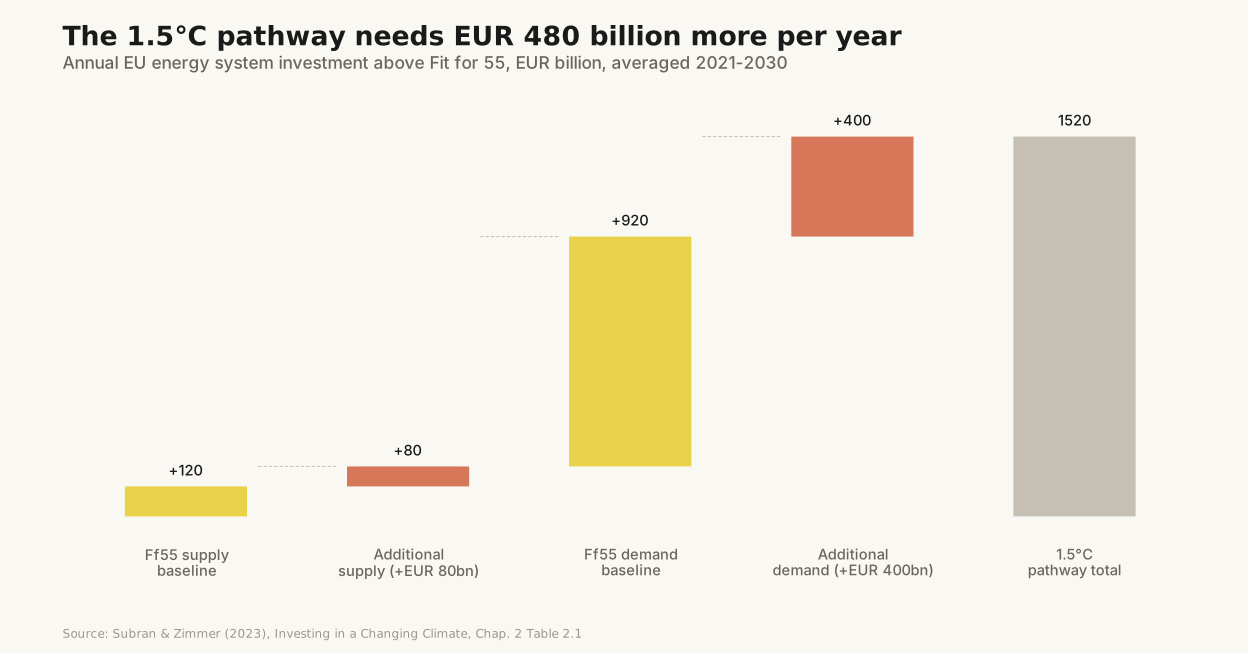
The authors frame this extra effort as investment needing to be 84% higher than currently envisioned. See The 84% Gap below for the denominator question.
How large is EUR 480 billion annually? Close to Austria’s entire GDP. Every year, the EU must mobilise additional investment equivalent to building 15 Channel Tunnels. Every European citizen, from infant to retiree, would need to contribute an additional EUR 1,000 per year in climate investment. European household savings exceed EUR 30 trillion. The money is there. Whether it flows to the right places, at the right speed, is the real constraint.
A word on the 1.5°C target. The Paris Agreement established 1.5°C of warming above pre-industrial levels as the threshold beyond which climate impacts become significantly more severe: coral reef destruction, extreme weather intensification, agricultural disruption. We have already reached approximately 1.5°C of warming; 2024 was the first calendar year on record to breach that threshold on an annual average. The cumulative carbon budget3 for a 50% probability of staying below 1.5°C stood at roughly 500 gigatonnes past 2020 and is now effectively exhausted at current emission rates. Even if investment flowed tomorrow, some amount of overshoot is now baked in, which is why the carbon removal question has moved from optional to load-bearing (see below). On why the true cost of this accumulation is far larger than standard models assumed, see our companion analysis of Bilal and Känzig’s work.
Net Zero Is Not 1.5°C
Ludovic Subran is chief economist at Allianz SE, Europe’s largest insurer. Markus Zimmer heads climate economic research and contributes to both the Network for Greening the Financial System (NGFS) and the Glasgow Financial Alliance for Net Zero. They write from within European climate finance institutions, with access to data most analysts do not see. Subran publishes weekly macro and climate analysis at Ludonomics, his Substack newsletter.
The book’s spine is a distinction most policy frameworks conflate. “The two goals, 1.5°C maximum warming and Net Zero, are not one and the same. In fact, reaching Net Zero by 2050 will not be sufficient to stay below 1.5°C.” The difference is the difference between a balance sheet and a budget:
- Net Zero describes a balance: emissions equal removals at some future date.
- The 1.5°C target describes a budget: a cumulative total that depletes with every tonne released, regardless of eventual balance.
Current trajectories consume the 1.5°C budget years before Net Zero arrives. That is the four-year implementation gap the book quantifies, and it is a gap in time, not in ambition.
The 84% Gap
The number that names this article deserves to be unpacked before it lands. Under Fit for 55, annual supply-side investment averages EUR 120 billion through 2030: power grids, generation capacity, fuel distribution. Demand-side investment averages EUR 920 billion: industry, buildings, transport. Total: roughly EUR 1 trillion annually. The 1.5°C pathway requires EUR 480 billion more per year on top of that: EUR 80 billion additional on supply, EUR 400 billion on demand.
The authors frame this extra effort as investments needing to be 84% higher than currently envisioned over the rest of this decade, just to close the four-year implementation gap. The figure sits between the two arithmetics that bracket it: 480 over the full 1,040 baseline reads as 46%, while 480 over the portion of Ff55 that still needs to be deployed in the second half of the decade reads higher. The book does not fully reconcile the denominator, but the direction is what matters. Whichever denominator you pick, the effort has to nearly double from where Fit for 55 already sets the bar.
Where the Money Must Go
First, coal phase-out in the six laggard nations. Poland, Germany, Czech Republic, Romania, Bulgaria, and Slovenia have not committed to exiting coal before 2030. Germany initially targeted 2038, then announced 2030 “ideally”, still lacking full commitment. Together these six nations require EUR 96 billion in cumulative investment for replacement capacity, 73% of the total additional coal-exit funding across the EU4. Germany needs EUR 35 billion; Poland EUR 34 billion. Phasing out coal by 2030 requires approximately 100 GW of additional wind and solar capacity across the EU, plus 15 GW of flexible gas-fired plants to manage intermittency5. As established in Power Density, at solar power densities of around 10 watts per square metre, 100 GW of additional solar capacity implies roughly 10,000 km² of land, an area the size of Cyprus. Land, not capital, sets the binding constraint on pace.
Second, grid infrastructure must expand faster than generation capacity. The power density argument from Power Density explains why: renewable generation is spatially dispersed. A solar farm at 10 watts per square metre needs vastly more land than a coal plant at 1,000 watts per square metre. Transmission lines must connect distant solar and wind farms to urban demand centres. Storage must buffer variability. From Subran and Zimmer’s scenarios, roughly 40 to 50 percent of electricity sector investment goes to infrastructure rather than generation6. “Without such infrastructure,” they write, “it would be difficult to attract the capital needed for investments in renewable energy projects.”
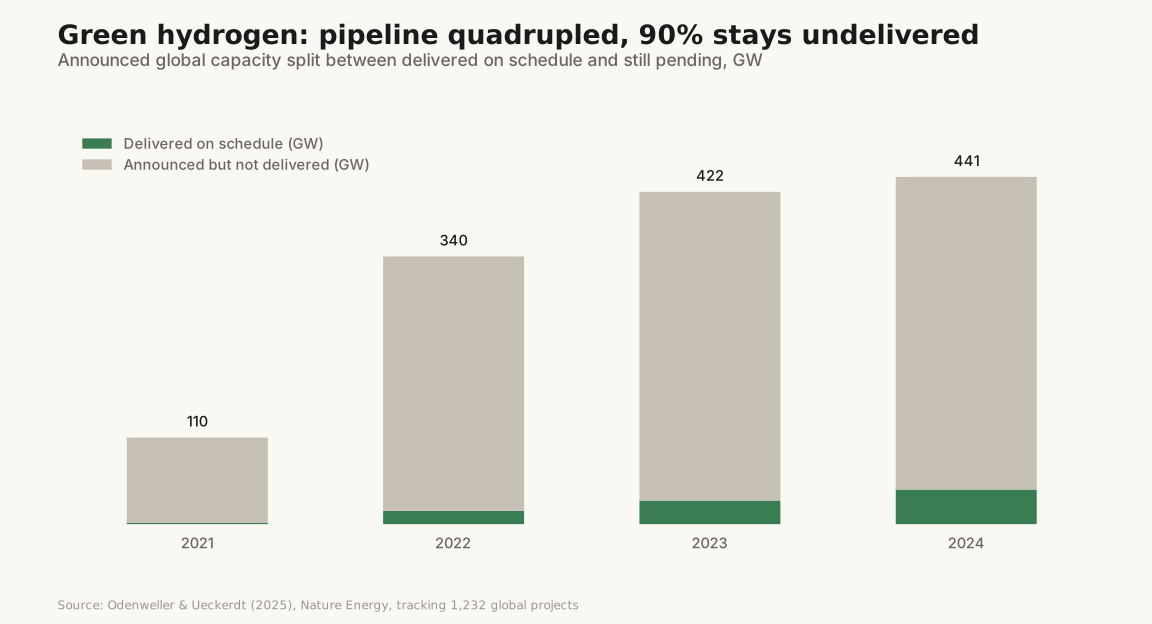
Third, hydrogen. Green hydrogen appears throughout the book as the proposed solution for decarbonisation problems that electrification cannot address. Steel production needs it as fuel and reducing agent. Ammonia synthesis requires it for fertiliser and increasingly for maritime fuel. Aviation synthetic fuels combine hydrogen with captured CO2. Heavy road transport and seasonal storage may require it where batteries prove insufficient. The EU hydrogen market could reach EUR 820 billion by 2050, with EUR 60 billion needed by 2030 for infrastructure. Current green hydrogen production stands at roughly 0.1% of the 90 million tonnes produced globally. The EU’s 2030 targets require a scale-up of at least two orders of magnitude; full global replacement would require three. A growing body of academic work suggests these timelines may prove difficult to meet7. Worth keeping in mind when reading projections that announce capacity alongside capacity that has actually been delivered.
Sector Arithmetic
Subran and Zimmer work through each major emitting sector with a granularity absent from most climate reports, which round to convenient billions. They zoom into the three biggest emitters: transportation, industry, and buildings. Other dimensions (agriculture, land use, international bunkers) fall outside their frame.
1. Transportation
Accounts for the largest implementation gap across the three sectors.
- Road transport must add roughly 1 million electric vehicles annually in Germany alone to reach 14 million by 2030. Charging infrastructure was required to quadruple by 2025, a deadline that has passed with significant shortfall across most member states. EUR 13.4 billion of annual investment needed across the EU through 2050.
- Aviation and shipping present the harder problems. Sustainable aviation fuels account for under 0.05% of current jet fuel consumption and must reach 70% by 2050 under proposed mandates. Subran traces exactly why SAF deployment remains so far below what targets require in a recent Ludonomics analysis on aviation decarbonisation. Production capacity requires EUR 15 billion annually, with two-thirds flowing to synthetic fuel facilities after 2030.
- Maritime shipping needs USD 1.4 to 1.9 trillion globally for complete decarbonisation, 87% financing land-based infrastructure for hydrogen and ammonia.
2. Industry
Divides into the addressable and the intractable.
- Cement, steel, and chemicals together account for three-quarters of EU industrial emissions.
- Process emissions, those arising from chemical reactions rather than combustion8, constitute 25 to 50% of the total in these sectors. They cannot be eliminated through electrification. Making cement releases CO2 from limestone regardless of how you heat the kiln.
- Residual emissions: “Only three-quarters of these emissions are expected to be eliminated” even in net-zero scenarios, the authors note. The remainder requires carbon capture or offsets from other sectors.
3. Buildings
Where the book flips the intuition.
- 95% of the EU building stock standing in 2050 has already been built, and only around 1% of existing stock is newly constructed each year.
- The renovation rate weighted by actual energy savings is closer to 1% for residential and 0.5% for non-residential. This needs to at least double to meet climate targets.
- Renovation, not new construction, is the sole path to 1.5°C for buildings. Energy and Civilization documented this civilisational inertia from the supply side; here it appears from the demand side of the same equation.
- The rebound effect is the caveat the authors flag: energy savings from efficiency gains get partially consumed by higher usage once bills fall. Physical upgrade is necessary but not sufficient; the incentive structure around usage has to move in parallel.
What Has Changed Since 2023
1. Capital flows have re-sorted. Renewable energy projects faced a cost of capital roughly 15 percentage points below fossil fuel equivalents when the book went to press. The spread has widened since. ESG-driven capital reallocation (the withdrawal of institutional money from stranded-asset-heavy sectors under environmental, social, and governance mandates) continues, and bank reluctance to finance long-dated fossil exposure has intensified. In some project finance markets, new fossil capacity struggles to secure long-tenor financing at competitive spreads9. This does not mean fossil equities as an asset class are unattractive; the distinction is between new capacity on the one hand, and cash returns from existing assets on the other.
2. US policy has become more uncertain. The Inflation Reduction Act (2022) committed roughly USD 370 billion to clean energy, the largest climate investment in American history. By July 2025, the Trump administration’s “One Big Beautiful Bill Act” began accelerating repeal schedules for most renewable energy tax credits, eliminating EV incentives, and compressing deadlines for projects to qualify. Most IRA investments, however, flowed to Republican districts (nearly 80% of the USD 289 billion in clean tech manufacturing), creating political resistance to full repeal. The core investment tax credits for solar and wind appear likely to survive in some form, though EV credits face elimination. This introduces volatility into transatlantic investment calculations that the book could not anticipate.
3. China’s renewable deployment has accelerated beyond projections. China installed 277 GW of solar capacity in 2024 alone, more than the United States’ entire cumulative solar fleet combined. Wind and solar combined overtook coal capacity in early 2025. Chinese state direction and vertically integrated supply chains are producing an energy build-out that does not match the 50-year rule Smil derived from market economies10. Chinese manufacturing dominance in solar panels and batteries has deepened in parallel, increasing European supply chain exposure that the book flags but does not resolve.
4. A new baseline for climate damage costs. Research published in 2024 has revised the damage estimates underlying the policy frameworks this article discusses. Adrien Bilal (Stanford) and Diego Känzig (Northwestern)11 find that 1°C of global warming reduces world GDP by over 20% in the long run, six to twenty times larger than the Nordhaus damage estimate that shaped the Paris Agreement and the Fit for 55 framework. The implied Social Cost of Carbon exceeds USD 1,200 per tonne. More consequentially for European policy, their follow-up paper calculates a Domestic Cost of Carbon12 for the EU of USD 216 per tonne, above the marginal cost of decarbonising more than 80% of economic activity using current technologies. For the EU, the EUR 480 billion annual gap pays for itself before counting any climate benefit: the domestic economic return on acting exceeds the cost, independent of what the US or China choose to do. The game-theoretic paralysis that has blocked climate coordination for three decades does not hold under this arithmetic. This also has implications for the EU ETS13, which Subran analyses in detail in a recent Ludonomics issue: if the true domestic cost of carbon is USD 216 per tonne for the EU and ETS prices trade at EUR 65 to 75, the system is pricing carbon at roughly 30% of its verified domestic damage cost. Full analysis of the Bilal and Känzig findings in our Climate Change May Cost 6x More Than the Nobel-Winning Estimate journal entry.
Two Dimensions Worth Revisiting
Two dimensions of the book deserve a 2026 update. On AI, the authors note the emergence of datacentre energy demand but went to press before the hyperscaler capex cycle reshaped the capital landscape at hand. On carbon removal, the book treats CCS, BECCS, and Direct Air Capture in depth, with Fit for 55 scenarios modelling 5.4 gigatonnes of captured CO2 cumulatively by 2050. The framework is sound; the gap that has opened is between the modelled deployment and what industry has actually built.
1. The AI Wildcard
The book mentions artificial intelligence and datacentre electricity consumption only briefly, estimating ICT at 1.8 to 2.8% of global GHG emissions in 2020. It went to press before the hyperscaler capex cycle took off. The numbers have moved substantially.
Global datacentre infrastructure spending reached USD 290 billion in 2024, with Alphabet, Microsoft, Amazon, and Meta alone investing nearly USD 200 billion in capital expenditure. In 2025, announced foreign direct investment in datacentres exceeded USD 270 billion globally, according to UNCTAD. Datacentres now account for more than one-fifth of global greenfield project values. Datacentres accounted for around 1.5% of global electricity consumption in 2024, or 415 TWh, roughly equivalent to France’s total electricity consumption. The IEA projects this will double to 945 TWh by 2030, approximately Japan’s current annual consumption.
In 2025, Meta, Microsoft, Alphabet, and Amazon spent approximately USD 575 billion in combined capital expenditure on AI capabilities; Subran’s Allianz Research team projects a further 50% increase in 202614. Technology leaders in the US have pledged up to USD 500 billion to build datacentres domestically. The datacentre pipeline is on track to double to approximately 200 GW by 2030.
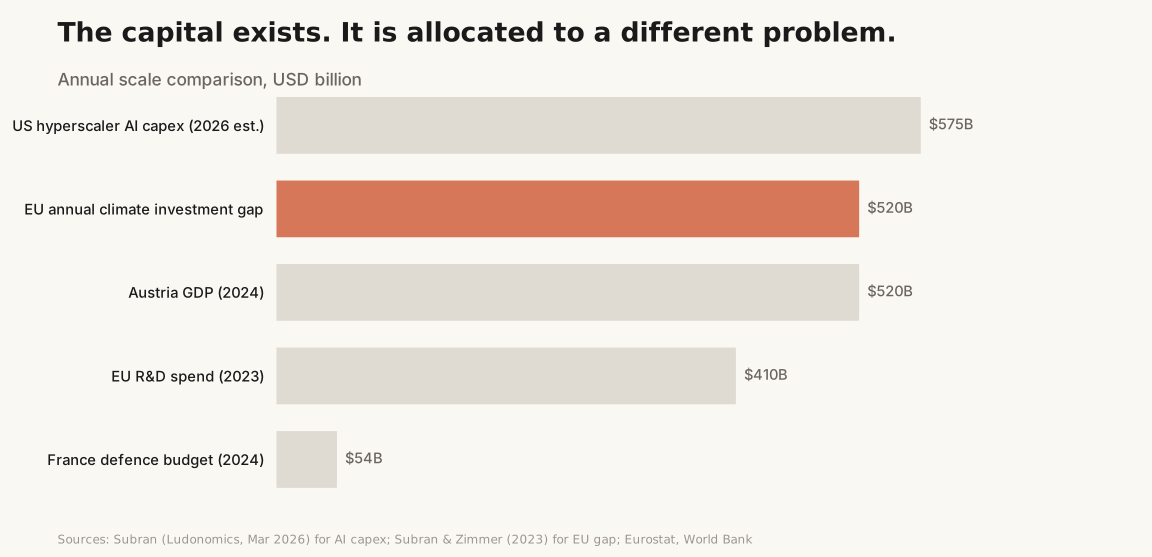
The comparison with the EU climate investment gap is worth doing explicitly. EUR 480 billion of additional EU climate investment per year is the same order of magnitude as US hyperscaler AI capex in 2026. The capital exists. It is allocated to a different problem, by different principals, under different incentive structures. Every euro that clears the EU’s climate gap has to come from somewhere currently financing something else. The scarce resource is not money but the institutional capacity to direct it.
In the US, natural gas remains the largest source of additional supply for datacentres through 2030, adding over 130 TWh of annual generation. Renewables follow, adding 110 TWh. Coal, with a near 70% share in China, dominates Asian datacentre electricity supply. Between 2024 and 2030, coal adds nearly 90 TWh to Chinese datacentre supply alone, roughly Belgium’s annual electricity consumption. A 500 MW datacentre campus cannot rely on intermittent supply; it needs firm power, 24/7. Microsoft signed to restart Three Mile Island’s undamaged reactor. Amazon purchased a nuclear-powered campus in Pennsylvania. Google announced procurement of SMRs (Small Modular Reactors: factory-built nuclear plants of 50 to 300 MW, designed for faster deployment than traditional gigawatt-scale reactors). Nuclear is returning, pulled by the physics of high-density loads meeting low-density supply15.
Europe faces a strategic choice the book does not address. ING estimates US datacentre investment could be fivefold higher than European levels. If Europe under-invests in AI infrastructure to meet climate targets while the US and China surge ahead on fossil-backed power, does Europe gain climate virtue or lose technological sovereignty? Europe has not answered this question. Neither, for what it is worth, has anyone else.
2. The Carbon Removal Question
Subran and Zimmer discuss carbon removal extensively. Their Fit for 55 scenarios rely on 5.4 gigatonnes of captured CO2 cumulatively by 2050, split across CCS on industrial combustion sites, BECCS (bioenergy combined with carbon capture), and direct air capture. The framework is there. What has changed since the book went to press is how far the industrial deployment lags behind the modelled trajectory.
1. Direct Air Capture (DAC)
Extracts CO2 directly from ambient air. The technology works but remains expensive, and lags far behind the scale targets set by climate pathways.
- Cost: purchase prices in 2024 ranged from USD 100 to USD 2,000 per tonne, with the average around USD 490. The EU carbon price hovers around EUR 80 to 100 per tonne. DAC currently costs 2 to 6 times more than the carbon price it must compete against.
- Capacity: global DAC capacity stood at roughly 59,000 tonnes per year at end of 2024. With the Stratos facility in Texas coming online in late 2025, capacity is projected to reach 569,000 tonnes annually.
- Scale gap: the IPCC indicates we need to remove 2 to 20 gigatonnes annually by 2050. Reaching the low end of that range would require roughly 4,000 facilities the size of Stratos.
- Flagship projects: Climeworks’ Mammoth project in Iceland has a nameplate capacity of 36,000 tonnes per year16. 1PointFive’s Stratos facility in Texas, backed by Occidental and BlackRock, will capture 500,000 tonnes annually when fully operational.
- Public and private capital: the US Department of Energy committed USD 3.5 billion to DAC hubs in Texas and Louisiana, though funding continuity under the current administration remains uncertain. Microsoft has purchased over 80% of all high-durability engineered carbon removal credits to date. The Frontier advance market commitment has pledged over USD 1 billion to carbon removal by 2030.
2. Carbon mineralisation
Offers an alternative pathway.
- Mechanism: accelerate the natural process by which certain minerals react with CO2 to form stable carbonates, compressing centuries into hours. The output becomes building material, turning construction from carbon source to carbon sink.
- Flagship project: Rotterdam-based Paebbl raised USD 25 million in 2024 from investors including Amazon and Holcim, and opened the world’s first continuous CO2 mineralisation demo plant in Rotterdam in early 2025. Promising, early-stage.
3. Nature-based solutions
Offer lower costs but face permanence questions.
- Reforestation and soil carbon sequestration are the most familiar approaches. Both face real constraints: trees burn, soils release carbon when disturbed, and verification remains challenging.
- Ocean ecosystems and trophic rewilding point to carbon sinks with potential magnitudes that current frameworks barely capture17. Blue carbon ecosystems can sequester at rates per hectare that exceed tropical forests; restoring keystone species populations may add gigatonnes to annual removal.
Carbon removal technologies show genuine promise but operate today at scales irrelevant to current emissions. The scale-up required, from hundreds of thousands of tonnes to multiple gigatonnes annually, is without industrial precedent. Investing in their development is warranted. Counting on them to substitute for near-term emissions reduction is not. They are the insurance for what front-loaded investment cannot prevent, not a substitute for it.
Conceptual Toolbox
| Concept | Definition | Excerpt | Implication |
|---|---|---|---|
| Implementation gap | Temporal lag between policy commitment trajectory and 1.5°C-consistent emissions pathway | ”A 4-year implementation gap will open up from 2030 between a 1.5°C-consistent and the proposed Ff55 pathway” | Policy compliance is not climate target achievement |
| Front-loading | Capital deployment concentrated in early years to preserve cumulative carbon budget | ”Investments will need to be 84% higher… over the rest of this decade” | Delayed investment cannot recover cumulative emissions already released |
| Process emissions | CO2 from chemical reactions, not combustion; resistant to electrification | ”Only three-quarters of these emissions are expected to be eliminated” | Cement, steel, chemicals require CCS or offsets beyond net-zero |
| Blended finance | Capital structures with public or multilateral first-loss tranches reducing private investor risk | ”Multilateral lenders could lower risks by taking mezzanine positions” | Emerging market transition needs risk transformation, not just capital availability |
| Carbon contracts for difference | Government guarantees covering gap between carbon price and strike price for green investment | ”CCfDs will play a central role… covering additional costs to convert production to climate neutrality” | OpEx support complements CapEx subsidies for industrial transition |
| Energy leapfrogging | Developing economies skipping fossil phase to build directly on renewables | ”Africa could leapfrog towards the world’s first hydrogen-based economies” | Infrastructure deficit becomes opportunity when clean tech costs decline |
Closing Note
Smil would note that no energy transition in history has achieved the velocity these numbers require. The Allianz team would respond that no previous transition had this much capital seeking deployment, nor this much scientific clarity about the consequences of delay. Both are right. The scarce resource is not money but the institutional capacity to direct it: which capital, governed how, deployed where, by when.
The two dimensions worth revisiting frame what that direction looks like from here. On AI, the test is whether Europe finds a way to build its compute layer without either mortgaging climate targets or ceding technological sovereignty; the question has no precedent to lean on. On carbon removal, the test is whether the pilots of 2025 mature into gigatonne-scale capacity before the overshoot window closes; that one is a physics-and-industry race against a clock Subran and Zimmer quantified precisely.
The primary plan remains front-loaded mitigation, at the 84% rate the book describes. Carbon removal is the insurance. Neither the European gap nor the overshoot are accidents of scarcity: they are the shape that a thousand daily allocation decisions18 take when the incentive structures upstream do not price what is at stake.

This is the third article in a five-part Deep Digest series on Essential Reads for Energy, Technology, and Investment:
- Vaclav Smil, Energy and Civilization: A History — The 50-year rule and why energy transitions cannot be rushed
- Vaclav Smil, Power Density — Why land, not cost, constrains the energy transition
- Ludovic Subran and Markus Zimmer, Investing in a Changing Climate (this article) — The 84% gap and where capital must flow
- Daniel Yergin, The New Map — Energy geopolitics and the realignment of power in the transition era
- Jevons Meets Jensen — The rebound effect and the nuclear revival in the age of AI compute
Sources
- Subran, L. and Zimmer, M. (2023). Investing in a Changing Climate: Navigating Challenges and Opportunities. Springer Nature.
- IEA (2025). Energy and AI. International Energy Agency. https://www.iea.org/reports/energy-and-ai
- Bilal, A. and Känzig, D. (2024). The Macroeconomic Impact of Climate Change: Global vs. Local Temperature. NBER Working Paper 32450. Forthcoming, Quarterly Journal of Economics. https://www.nber.org/papers/w32450
- Bilal, A. and Känzig, D. (2025). Does Unilateral Decarbonization Pay for Itself? AEA Papers and Proceedings 115. https://www.aeaweb.org/articles?id=10.1257/pandp.20251035
- Odenweller, A. and Ueckerdt, F. (2025). The green hydrogen ambition and implementation gap. Nature Energy 10, 110-123. https://www.nature.com/articles/s41560-024-01684-7
- Subran, L. et al. (2026). AI capex cycle: war-proof for now? Allianz Research. https://ludovicsubran.substack.com/p/ai-capex-cycle-war-proof-for-now
- Global Witness (2026). Oil majors profit $467bn since Russia’s Ukraine invasion. https://globalwitness.org/en/campaigns/fossil-fuels/
- AGORA Energiewende (2021). Phasing out coal in the EU’s power system by 2030.
- EIA (2025). China’s solar capacity installations grew rapidly in 2024. https://www.eia.gov/todayinenergy/detail.php?id=65064
- Latitude Media (2025). On the ground at Climeworks’ biggest DAC project. https://www.latitudemedia.com/news/on-the-ground-at-climeworks-biggest-dac-project/
- Libido Sciendi (2026). Climate Change May Cost 6x More Than the Nobel-Winning Estimate. https://libido-sciendi.com/journal/2026-04-06-bilal-climate-economics
- Subran, L. (2025). Aviation’s Quest for Climate Neutrality. Ludonomics. https://ludovicsubran.substack.com/p/aviations-quest-for-climate-neutrality
Footnotes
-
[Expansion] The AI capex surge is not climate-neutral: hyperscalers are driving new fossil generation (gas in the US, coal in China) and stressing grids, water, and critical materials. IEA, Energy and AI (2025): https://www.iea.org/reports/energy-and-ai. Datacentres are projected to add 945 TWh globally by 2030, much of it served by firm fossil supply in markets where renewable build-out cannot match the speed of compute demand. ↩
-
[Expansion] The 84% figure is the authors’ own framing against “what is currently envisioned” for the rest of the decade, a baseline the book does not precisely reconcile with its Fit for 55 Table 2.1 figures (Ff55 total EUR 1,040 bn per year, of which EUR 480 bn represents the additional gap above Ff55). The arithmetic does not multiply out cleanly (480/1040 ≈ 46%), but the direction and order of magnitude hold. ↩
-
[Definition] The total cumulative CO2 emissions compatible with a given temperature target at a given probability. The budget is a physical limit, not a regulatory one: past emissions cannot be recalled, and overshoot deepens with every year of delay. ↩
-
[Source] AGORA Energiewende (2021), Phasing out coal in the EU’s power system by 2030, cited in Subran and Zimmer, Chap. 3. Breakdown: Germany EUR 35 bn, Poland EUR 34 bn, plus Bulgaria, Czech Republic, Romania, Slovenia. ↩
-
[Context] German energy planners face recurring “dark calm” periods: extended stretches of low wind and minimal sunlight coinciding with peak winter heating demand, sometimes lasting several days. These are the binding constraint on coal phase-out timelines. Batteries help for hours, not weeks. The 15 GW of hydrogen-ready gas plants are built knowing they will run at low capacity factors, essentially paying for insurance against intermittency. Until storage technology matures substantially, dispatchable generation remains essential. ↩
-
[Source] Odenweller and Ueckerdt (2025), The green hydrogen ambition and implementation gap, Nature Energy (Potsdam Institute for Climate Impact Research, tracking 1,232 global projects). Only 7% of capacity announced for 2023 was delivered on schedule. Realising all announced projects by 2030 would require ~USD 1 trillion in additional subsidies, far exceeding what has been committed. Their 2022 companion paper estimates green hydrogen will likely (>=75%) supply less than 1% of final energy through 2030 in the EU and through 2035 globally. See https://www.nature.com/articles/s41560-024-01684-7. ↩
-
[Definition] CO2 released by the chemical transformation itself, not the energy used to drive it. In cement production, calcium carbonate decomposes to calcium oxide and CO2 regardless of how the kiln is heated. Electrification cannot remove these emissions; only carbon capture or material substitution can. ↩
-
[Counter] The narrative of “fossil failing on return arithmetic” applies mainly to new long-dated project finance, not to cash generation from existing assets. Global Witness (February 2026) finds the five oil majors recorded combined profits of USD 467 billion since Russia’s invasion of Ukraine, returning USD 444 billion to shareholders via buybacks and dividends; BP and Shell spent on average ten times more rewarding shareholders than investing in low-carbon alternatives. See https://globalwitness.org/en/campaigns/fossil-fuels/oil-supermajors-profit-nearly-half-a-trillion-dollars-since-russias-ukraine-invasion/. The cost-of-capital divergence is real on new capacity; it coexists with record equity returns on the existing book. ↩
-
[Crossref] Smil’s 50-year rule for energy transitions was derived from liberal-democratic market economies. China’s 277 GW of solar additions in a single year invites the question whether the rule is a function of institutional form rather than physics. State direction, integrated supply chains, and willingness to mandate grid build-out change the rate constants of the system. See Part 1: https://libido-sciendi.com/deep-dives/energy-civilization-smil. ↩
-
[Source] Bilal and Känzig (2024), The Macroeconomic Impact of Climate Change: Global vs. Local Temperature, NBER WP 32450, forthcoming Quarterly Journal of Economics. Follow-up paper: Bilal and Känzig (2025), Does Unilateral Decarbonization Pay for Itself?, AEA Papers and Proceedings 115, 369-373. ↩
-
[Definition] The economic damage a country sustains within its own borders from emitting one additional tonne of CO2, accounting for global warming’s effect on that country’s economy. Distinct from the global Social Cost of Carbon, which measures worldwide damage per tonne. ↩
-
[Definition] The EU Emissions Trading System, the bloc’s cap-and-trade market for industrial carbon. Issues tradeable EU Allowances (EUAs), each representing one tonne of CO2. Prices have oscillated in a EUR 50-98 per tonne corridor since 2022 and fell approximately 24% in the first two months of 2026 (Subran, Allianz Research, March 2026). ↩
-
[Source] Subran et al., AI capex cycle: war-proof for now?, Allianz Research, March 2026, summarised at https://ludovicsubran.substack.com/p/ai-capex-cycle-war-proof-for-now. Key findings: hyperscaler capex ~USD 575 bn in 2025 with +50% expected in 2026; the datacentre pipeline is on track to double to approximately 200 GW by 2030; the capex super-cycle is partly decoupled from near-term AI adoption because orders are anchored in tangible infrastructure. Energy volatility may reshape allocation rather than overall scale. ↩
-
[Crossref] Nuclear, SMRs, and the datacentre-nuclear nexus will receive dedicated treatment in Part 5 of this Libido Sciendi series, on energy infrastructure and technological sovereignty. ↩
-
[Source] Nameplate capacity per Climeworks press release, 8 May 2024. Actual 2024 capture of approximately 105 tonnes first reported by Heimildin (Iceland) and confirmed in Latitude Media, June 2025. Only 12 of 72 planned collector containers are operational. Climeworks laid off a quarter of its workforce in 2025. The gap between nameplate and actual capture is the binding constraint on DAC’s current industrial relevance. ↩
-
[Expansion] Ocean carbon sinks absorb roughly 31% of all anthropogenic CO2 emissions (NOAA). Blue carbon ecosystems (mangroves, seagrass, salt marshes, kelp forests) sequester carbon at rates per hectare that can exceed tropical forests by an order of magnitude. Trophic rewilding adds another lever: a 2023 Nature Climate Change paper by Schmitz et al. estimates that restoring robust populations of nine keystone species (wolves, wildebeest, sea otters, musk oxen, African forest elephants, American bison, baleen whales, sharks, marine fish) could sequester an additional 6.41 gigatonnes of CO2 per year, roughly 95% of the annual removal required to stay within 1.5°C. The Yale-led Global Rewilding Alliance has begun quantifying these effects: 170 European bison reintroduced across 48 km² of Romanian grassland are estimated to sequester an additional 54,000 tonnes of CO2 per year, roughly ten times the baseline. Whales are a notable case: living whales fertilise phytoplankton blooms through nutrient-rich waste, and their carcasses sink to the deep ocean carrying carbon with them. A single great whale is estimated to sequester carbon equivalent to thousands of trees over its lifetime, though the IMF-cited USD 2 million per-whale valuation remains contested (Frontiers in Marine Science 2022 notes measurement challenges that make whale contributions difficult to integrate into formal offset markets). ↩
-
[Context] The book devotes a chapter to Africa. Under a 1.5°C pathway, annual energy investment across Africa’s ten largest economies must reach USD 120 billion by 2030 (sixfold the 2020 baseline), with cumulative investment through 2050 exceeding USD 7 trillion. The authors argue Africa could leapfrog toward hydrogen-based energy systems. For investors the opportunity is real but the risk transformation required through blended finance, multilateral guarantees, and mezzanine positions (subordinated debt tranches absorbing first losses before senior investors) has never been attempted at this scale. ↩