
AgeTechX Berlin: Waiting for the Breakout
AgeTechX Berlin: Waiting for the Breakout
A day in Berlin with care operators, investors and the people building robots small enough to move through the brain.
Yesterday, I spent the day at AgeTechX1 in Berlin, at the Pfefferberg Theater in Prenzlauer Berg. A restored beer hall, an intimate auditorium, sunshine between sessions and unlimited coffee. The organisation was excellent, down to the visual identity. A conference about getting older (OK, that may not be the precise agenda) can apparently look rather damn good.
Brian Daly, the founder of AgeTechX, deserves a particular thank-you: warm, approachable and a very energetic moderator. He brought together care practitioners, founders, investors and researchers. The operators brought a welcome dose of reality, explaining what happens to a promising product when someone actually tries to use it.
In April, I wrote A Greying World, and a Continent Asleep at the Wheel2. Europe has the patients, the clinical expertise and the institutions to build serious, innovative companies around ageing. Yet we have been slow to fund them and get their products into use, even as AI and robotics make more things possible. I went to Berlin partly to see whether I had been too harsh.
The programme covered pension capital, surgical robotics and ageing biology, with parallel sessions throughout the day, including a German-language track (leider war mein Deutsch ein bisschen zu schlecht, um alles zu verstehen).
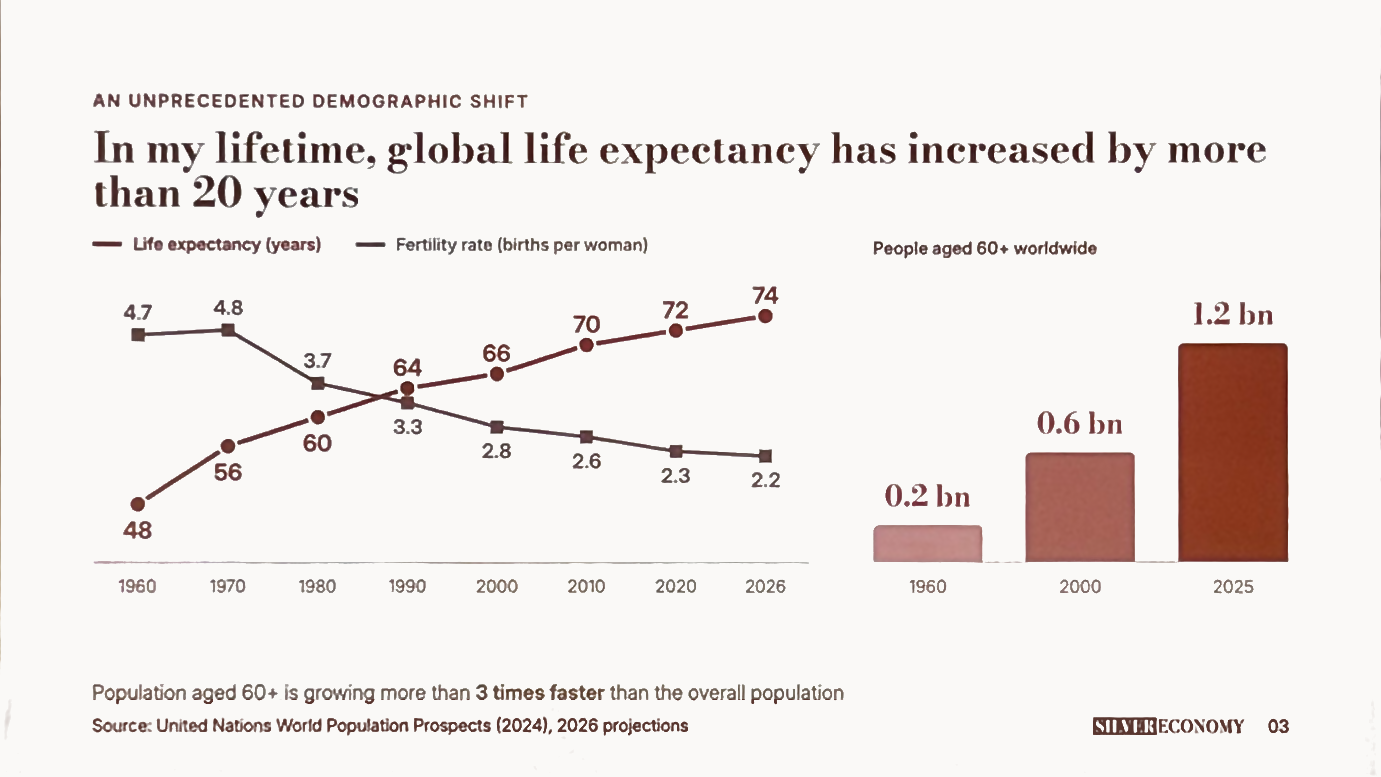
Global life expectancy and the population aged 60+. Slide presented by Pedro Ros, Silver Economy. Source: United Nations World Population Prospects (2024), with 2026 projections.
AI meets the care provider
The morning panel on AI in care, moderated by Lina Chong of HV Capital, brought together Sievert Weiss of AMBOSS, Oriol Fuertes Cabassa of Qida, and Rachael Crook of Lifted.
One panellist brought the AI discussion down to earth: we talk about frontier AI and robotics while some hospitals still lack Wi-Fi. Rachael Crook followed with a related problem: the technology on offer can be far removed from what care providers need day to day, and providers who pay for it may not receive the savings it creates elsewhere in the health system3.
Crook also spoke about her mother, who was diagnosed with dementia at fifty-six. She loved familiar nursery rhymes, but a care worker needed to know which particular rhymes she enjoyed. That knowledge could make a real difference to her mood and to the time they spent together.
Her example raises a useful question for AI in care: can it help a changing team build on what each person has learned about a patient? The value would lie in continuity: retaining everyone’s preferences and making them useful in the next interaction.
A robot that can turn corners
Later, Skander Garroum of PROTOTYPE interviewed Bertrand Duplat, co-founder of Robeauté, about microrobots for the brain. This was the technology discussion I remember best.
Duplat described a robot about 1.8 millimetres in diameter that moves through brain tissue, rather than through blood vessels. Its ability to follow curved paths is the crucial differentiator: conventional rigid instruments are constrained to straight lines. The robot could reach and sample several locations that don’t sit along the same trajectory.
His ambition is to connect diagnosis with precisely targeted treatment. Different parts of a tumour can have different molecular profiles; sampling several sites could help reveal those differences. Duplat described returning to the relevant locations to deliver treatment directly, on the brain side of the blood-brain barrier4, which could give therapies a way to reach their target that systemic delivery struggles to provide.
Duplat pointed to two developments behind the robot: a better understanding of mechanics at millimetre scale, where viscous forces dominate and inertia matters little5, and laser-based micro-manufacturing. Much of their research has focused on how the device interacts with soft brain tissue and how to minimise damage.
However splendid the capabilities, the development timeline is worth remembering, for us impatient investors. After roughly a decade of development, Robeauté’s technology remains preclinical6 and is not approved for clinical use.
Scientific diligence needs scientific expertise
On the ageing-biology panel, Hannah Payette Peterson of JUNI moderated a discussion with Manuel Grossmann of Amino Collective and Victor Bustos of Refoxy. Bustos explained that researchers can study what protects younger people from disease, then try to recover some of that protection in older patients. He also brought the discussion back to what a development programme needs: a specific disease, patients to treat, and evidence that the treatment is safe and works.
Peterson raised the risk of capital flowing into longevity without enough expertise to evaluate the science. Grossmann acknowledged the hype, but also warned against European complacency: stronger science alone may not beat the ambition, funding and talent gathering around US companies. His point was that scientific quality and the resources to develop it have to meet.
That leaves a question for Europe’s still-developing VC community. Many investors lack a scientific background, which isn’t necessarily a problem if their investment process brings in the right expertise, asking scientists, clinicians and relevant Key Opinion Leaders7. Deal momentum squeezes time, networks may be thin, and habits carry over from software investing, where intuition about founders and distribution can carry more weight. In biology, that judgement needs to be challenged by people who understand the scientific constraints.
What the market numbers actually mean
After lunch, Pedro Ros gave the talk I had particularly wanted to hear: The Silver Economy by the Numbers: 2026 and Beyond. He described coming to the field from market research and finding huge numbers with unclear definitions and shaky sourcing. His team’s response was to work out what belonged in each market before trying to measure it.
Ros put annual spending by people aged sixty and over at roughly $19 trillion, across all consumer categories. Silver Economy estimates the markets specifically serving later-life needs at $4.5 trillion, and AgeTech at $286.4 billion across thirteen segments. Its forecast for AgeTech is 10.4% annual growth in real terms between 2026 and 20318. These figures depend on the team’s definitions, explained in Silver Economy Markets 2026 and AgeTech Market Report 2026.
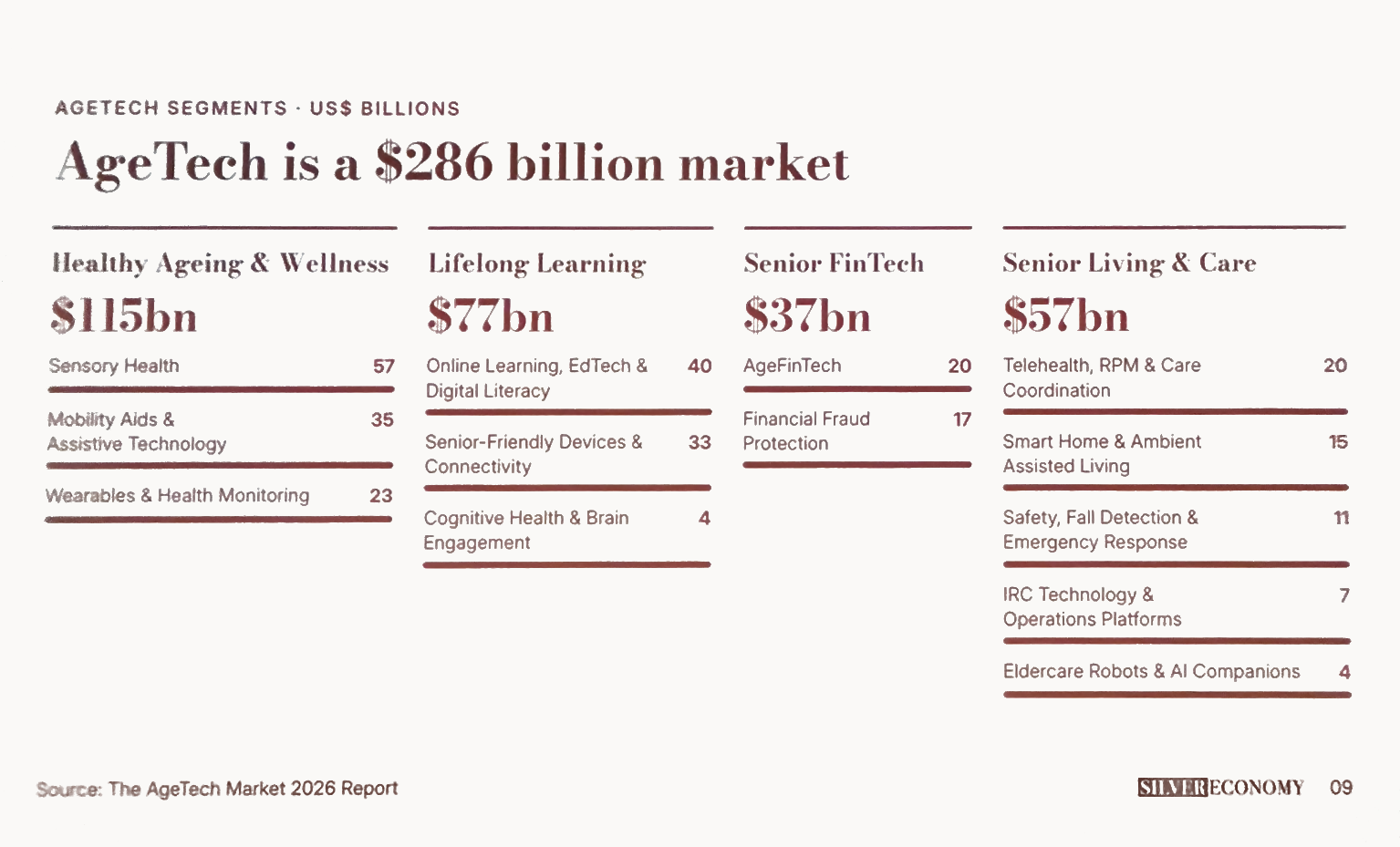
AgeTech segments in US$ billions. Slide presented by Pedro Ros. Source: The AgeTech Market 2026 Report. Figures rounded on the slide.
The $19 trillion headline is less useful for investment decisions than Ros’s segmentation. Housing and care, health, finance and tourism have different buyers, margins and routes to market. A sixty-five-year-old planning twenty active years and an eighty-five-year-old needing daily support belong to the same demographic category, but represent very different commercial propositions.
Ros’s point about who pays will be familiar to anyone working in digital therapeutics or medical devices that depend on reimbursement9. The user, the buyer and the beneficiary of any savings may be different parties. The route to payment needs to be designed alongside the product: which budget it fits, what evidence the payer requires and how long approval will take.
The useful investment question is where technology can capture value within those markets: a large pool of spending on older adults does not, on its own, tell us which businesses can earn attractive margins or build a repeatable route to customers.
Start with what people enjoy
On the next panel, Juliana Emmanuelli of LSE Generate moderated a discussion with Hemanshu Jain of Khyaal, Ilonka Jankovich of Rubio Impact Ventures, and Richard Hector of Amara.
Jain described building Khyaal’s communities in India around interests such as cooking and hobbies, using familiar tools like WhatsApp to bring people in. Interest groups developed into clubs, with competitions giving members another reason to participate. His commercial sequence was to build distribution first, then develop services that members or their families will pay for.
That is more interesting than treating community as a marketing channel. Regular participation creates opportunities to learn what customers want before deciding what to sell them.
Where could the next winners emerge?
European AgeTech needs more clear winners: companies that can grow despite long sales cycles and regulated buyers, and disprove the assumption that older adults are not a scalable customer base. There are already businesses worth examining beyond the conference.
Some already operate at considerable scale. In the US, Honor acquired Home Instead in 2021, combining its technology and operations platform with an established home-care franchise network. Honor reported that the global Home Instead network delivered more than 60 million hours of care annually in early 2025. In the UK, Cera reports three million home visits a month, using digital care records and AI tools to flag risks to its care teams10. These are substantial care businesses, although their scale alone does not establish software-like economics. The question is how much technology can improve the cost, consistency and capacity of care delivered by people.
The gap between technical capability and deployment is still a big topic. An agent may identify a patient’s deterioration, but acting on that warning requires reliable data, integration with existing IT systems and a care team able to respond. Buying the tool involves another set of constraints: procurement, budgets and evidence requirements. Better prediction alone does not resolve those problems.
Where, then, could AI change the economics most? Perhaps in the short term by reducing the work of documenting care, reconciling fragmented records or coordinating follow-up. The investment question is which bottleneck a product removes, and whether the organisation paying for it (“clients” is sometimes a bad word in the market) can turn that improvement into more capacity, better care or lower costs.
More successes would give investors evidence to underwrite the next generation of companies, give buyers confidence to adopt their products, and attract people who know how to build, sell and deploy them. Berlin showed how much work is going into overcoming these barriers.
So I would soften part of my April article.11 There are clearly Europeans awake to this, building companies and putting money behind them. Brian brought a good number of them to Berlin.
Next year, I’d like to hear how the early deployments have gone. I would happily return to Pfefferberg for that. The coffee arrangement can stay exactly as it is.

Conceptual Toolbox
| Concept | What it means | Why it matters |
|---|---|---|
| AgeTech | Technology products and services built for older adults and the people who care for them | Silver Economy sizes it at $286.4bn across thirteen segments, a fraction of the headline |
| Silver economy | All spending by and for people aged sixty and over | The $19tn figure is a demographic total, too broad to underwrite |
| Continuity of care | Knowledge about a person that survives staff rotation (Crook’s nursery rhymes) | A plausible first place for AI in care to earn its keep |
| Wrong-pocket problem | One budget pays for an intervention while another collects the savings | Why care providers hesitate to buy tools that mainly help hospitals |
| Blood-brain barrier | The sealed lining of brain vessels that keeps most drugs out of brain tissue | Robeauté’s case for delivering treatment on the brain side |
| Low Reynolds number | A regime where viscous forces dominate and inertia barely counts | The physics a millimetre-scale robot has to be designed for |
| Scientific diligence | Expert review of whether the biology and the trial plan hold up | Software intuitions about founders do not transfer to biology |
| Community-first distribution | Build engaged interest groups, then sell services to members (Khyaal) | Participation reveals what customers want before you price it |
| Deployment gap | The distance between what a tool can detect and what a care team can act on | Better prediction does not fix data, integration or procurement |
AgeTechX Berlin 2026 was convened by Brian Daly, with a welcome reception at Clärchens Ballhaus on 5 October and the full-day forum at Pfefferberg, Prenzlauer Berg, on 6 October 2026. Quotations and paraphrases are rendered from my notes; the two charts reproduce slides from Pedro Ros’s talk.
Further reading: Silver Economy, Silver Economy Markets 2026 and AgeTech Market Report 2026; United Nations, World Population Prospects 2024; and on this site, A Greying World, and a Continent Asleep at the Wheel.
Footnotes
-
[Context] AgeTechX is an invite-only conference series on ageing and longevity technology. The 2026 Berlin edition ran over two days, a welcome reception on 5 October and a full-day forum with parallel rooms on 6 October. ↩
-
[Crossref] The April entry argued that the world has passed peak child, that AI and robotics are maturing fast enough to help care for ageing societies, and that Europe, which needs them most, was barely in the race. ↩
-
[Context] Health economists call this the wrong-pocket problem. A care home may fund a tool whose main benefit is fewer hospital admissions, savings that land in the hospital’s or the insurer’s budget rather than its own. ↩
-
[Definition] The tightly sealed lining of the brain’s blood vessels, which keeps most circulating molecules, including many drugs, out of brain tissue. ↩
-
[Definition] Physicists call this a low Reynolds number regime, where the ratio of inertial to viscous forces is small. A device stops almost the instant it stops pushing. Edward Purcell’s 1977 lecture Life at Low Reynolds Number is the classic account. ↩
-
[Context] Preclinical means the technology has not yet been tested in patients. In Europe, a device of this kind must pass clinical investigations and a conformity assessment under the EU Medical Device Regulation before clinical use. ↩
-
[Definition] In life-science investing, Key Opinion Leaders are clinicians and researchers whose standing in a field makes them reference voices on whether a scientific claim or a trial design holds up. ↩
-
[Caveat] These are Silver Economy’s estimates, not official statistics, and they move with where its definitions draw each market’s boundary. “Real terms” means growth net of inflation. ↩
-
[Context] Germany’s DiGA pathway, created by the 2019 Digital Healthcare Act, lets digital health applications listed by the BfArM be prescribed and reimbursed by statutory insurers. It shows how strongly evidence requirements shape the product. ↩
-
[Caveat] The Honor and Cera figures are company-reported. Hours and visits measure the volume of care delivered, not margins or the share of value created by the technology. ↩
-
[Disclosure] I write as a general partner investing in technology companies, and I hold no financial position in the companies named here. ↩