
Babel, Jerusalem, and the Disarmed Word
Babel, Jerusalem, and the Disarmed Word
Nehemiah, Nebrija, Pascal and Martin Luther King walk into the Collège des Bernardins to read Magnifica humanitas, the first encyclical on AI, with a Silicon Valley priest who read Claude’s constitution before the world did.
The first thing I noticed was the ties. After years of tech conferences where I am reliably the only person wearing one, the Grand Auditorium of the Collège des Bernardins1, the raked amphitheatre on the second floor of the thirteenth-century college, held a higher density of ties than any finance gathering I can remember. The second thing was the rose window behind the stage, lit electric blue against the medieval stone, its tracery carved in cinquefoils, the five-lobed clovers of Gothic stonework. The third was the headset handed to me at the entrance, in front of the ephemeral bookstore stacked with copies of the encyclical, with the indication that simultaneous interpretation would run on channel 1 for one of the evening’s guests. I can count on one hand the Paris conferences that have offered me live interpretation, and the coincidence was hard to ignore: we had come to discuss a text that frames the age of AI as a choice between a single tower and a plural city, through a technology that exploded out of language itself.
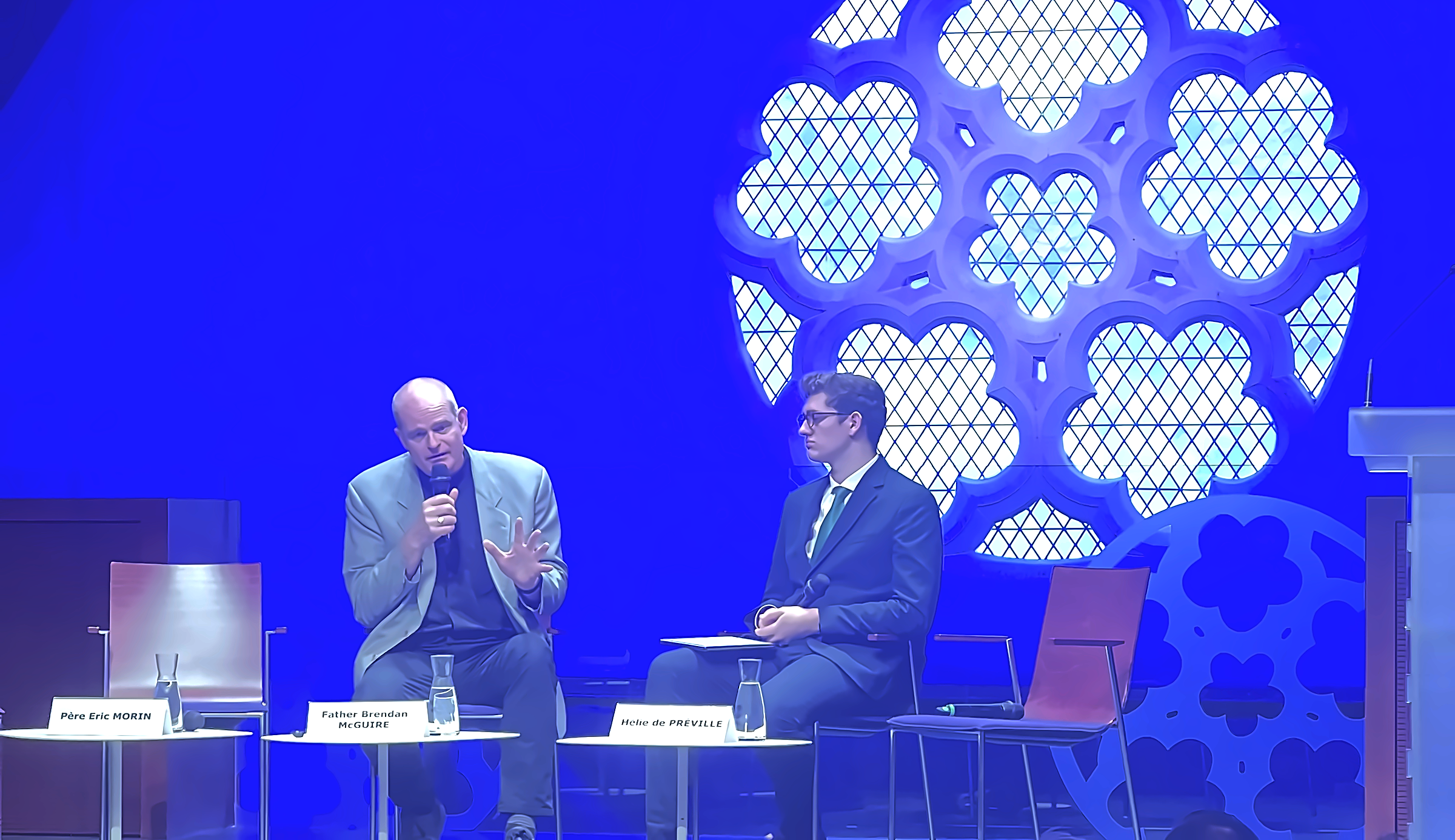
The Grand Auditorium of the Collège des Bernardins, 10 June 2026. The rose window, lit for the occasion, watched over the whole evening.
The occasion was the opening conference of a year-long cycle on Magnifica humanitas, the first encyclical2 of Pope Leo XIV, “on safeguarding the human person in the time of artificial intelligence”. The evening ran in three movements: two theologians of the Bernardins on the biblical architecture of the text, an Irish priest from Silicon Valley on what he saw in the room when it was launched, and a panel of two philosophers and an entrepreneur on what the text asks of people who actually run things.
An encyclical presented in person
The facts of the document first, because they carry meaning of their own. Leo XIV signed the text on 15 May 2026, the 135th anniversary, to the day, of Rerum novarum, the 1891 encyclical in which Leo XIII answered the social wreckage of the industrial revolution and founded what became Catholic social teaching, the Church’s body of doctrine on labour, capital, and the common good3. A new Leo, a new machine age. The text runs to roughly 250 paragraphs across five chapters; encyclicals are cited by paragraph number, a convention I will follow here, so that §13 names the thirteenth paragraph of the text. On 25 May the pope presented it in the Vatican’s Synod Hall himself, the first pontiff to launch his own encyclical in person rather than delegate the task to cardinals.
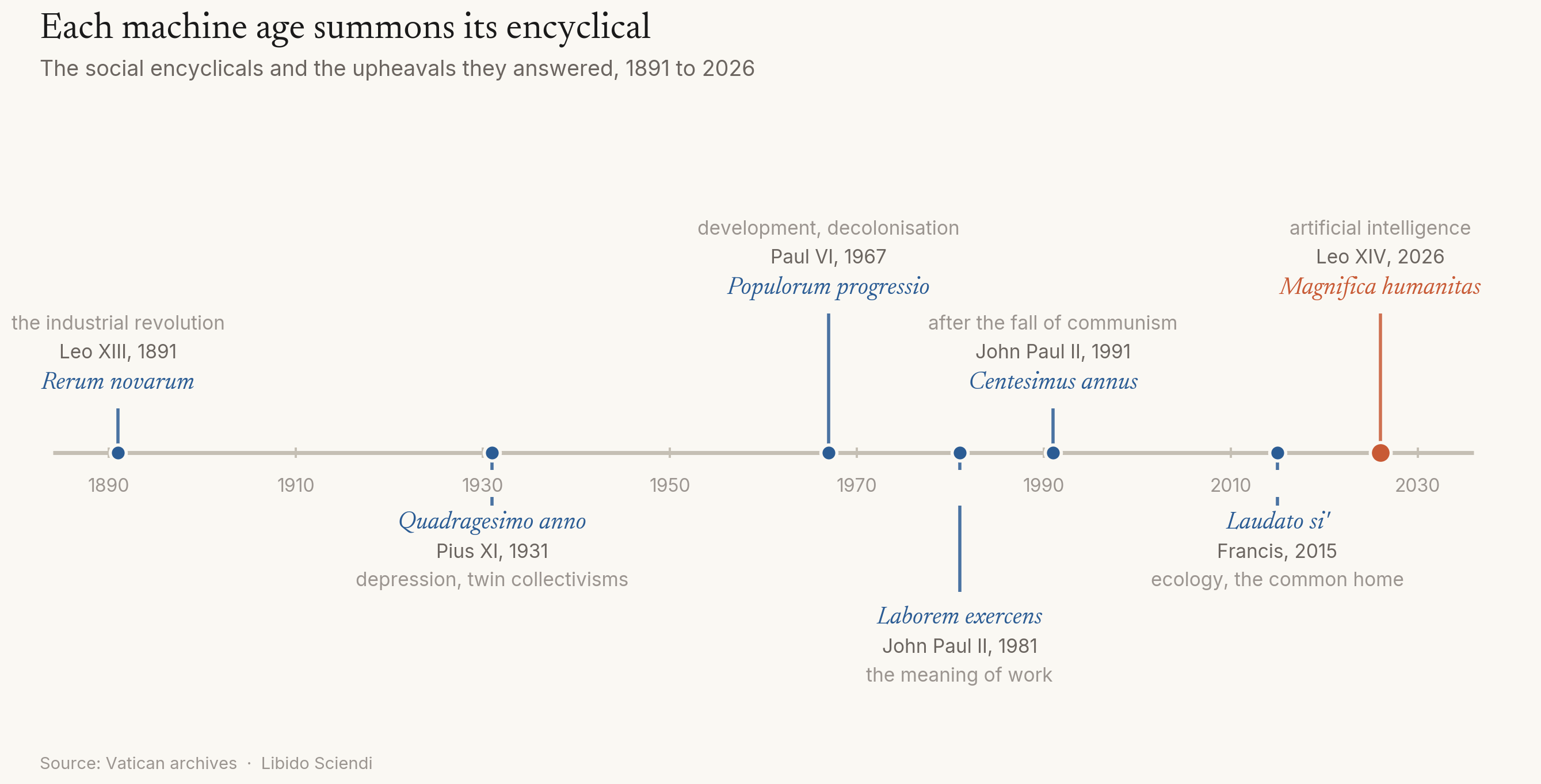
Each machine age summons its encyclical: the social lineage from Rerum novarum (1891) to Magnifica humanitas (2026).
The second precedent of that morning mattered as much to this evening. Pope Leo invited Christopher Olah, co-founder of Anthropic, to speak at the presentation4. A frontier lab on a Vatican stage, and a pope sharing it. Both took flak for the photograph, as we would hear later.
The encyclical’s opening paragraph sets the frame the whole evening kept returning to. Humanity faces a decisive choice: raise a new tower of Babel, or build the city where God and humanity dwell together. Babel or Jerusalem, with AI as the construction site.
The sage architect and the wall
Père Éric Morin, biblical scholar and director of the École cathédrale at the Bernardins, took the less famous of the two figures: Nehemiah, the fifth-century BCE official of the Persian court sent by Artaxerxes I to rebuild the walls of Jerusalem. Morin did not sand down the character; Nehemiah also pushed a policy of expelling foreign wives, which Morin named for what it would be called today. The encyclical takes from him something narrower and stranger: a model for what it calls, in its closing paragraphs, the spirituality of the sage architect, the one who, inhabited by hope, sets out to build the world for the good (§236).
The image is easy to misread as defensive, and Morin took the military version apart first. No wall ever stopped a regular army at Jerusalem. Every invader in the city’s history eventually took it. The walls existed for something else entirely: the sabbath. A city that visibly stops all activity on Friday evening advertises the exact hour of its defencelessness to the raiding tribes around it, so the walls were what made the day of rest liveable. The liturgical adage “the law of the Lord is our rampart” descends from this logic. The wall exists to delimit a space where the covenant, the alliance between God and his people of which the sabbath is the visible sign, can actually be lived.
The encyclical, Morin showed, is startlingly faithful to the book itself. Its §241 retraces Nehemiah’s sequence: he hears the cry of a wounded city, carries the pain into prayer, discerns, organises the work, faces resistance inside and out, and rebuilds stone by stone, with the people. And chapter 3 of the Book of Nehemiah records the construction section by section, this family here, those artisans there, priests, women, the young. Morin’s reading: the true rampart is the people, the shared responsibility rather than the masonry. The encyclical translates this directly at §13, assigning to each their portion of the wall: scientists and researchers, entrepreneurs and workers, educators and legislators, civil society, communities of faith.
He closed on an inversion he clearly relished. In the New Jerusalem of the Apocalypse, the wall no longer protects anything from the outside. The gates are pearls, and the light of the Lamb floods outward through them. A wall built for protection ends as an aperture.
Babel, read as good news
Gemma Serrano, theologian and co-director of the Bernardins’ research department on digital humanism, had gone through the encyclical tagging every occurrence of Babel, and her reading dismantled the comfortable versions of the story one by one. The choice the text poses is anterior to any verdict on the technology; the pope repeats that he is not asking for a yes or a no, and Serrano refused the search for scapegoats among the platform capitalists. In Genesis, the whole people builds Babel. Each of us carries mortar to it, even if the asymmetry of power means some design the tower while others merely haul. Nor is the choice exhausted by regulation, by the hope that the right frameworks upstream guarantee good outcomes downstream. What the text demands is a spiritual and existential discernment, and Serrano gave it the form of a question: where do we want to dwell? Dwelling, she insisted, means more than occupying an address. A house, in the sense of Francis’s maison commune, the common home of Laudato si’, is defined by the relations it shelters, who lives with whom, and how humans, the living, and the non-living share the same roof. To ask where we want to dwell is to ask which weave of relations we are willing to have AI built into.
Her reading then turned counterintuitive. In her eyes, Babel is good news. God intervenes, and the tower comes down, and what the intervention protects is plurality: of languages, of peoples, of ways of living and knowing, against the single language and the single technology. Which carries a discipline for the builders of the alternative. Jerusalem cannot be a counter-Babel, one totalising unity raised against another, or the project refutes itself. And to the standard lament of European lateness she offered the cleanest reframe of the evening: we are not late on AI; we are late on building Jerusalem. Building Jerusalem, in her vocabulary, means building the plural city, institutions, models, and infrastructures that protect many languages and many ways of knowing instead of consolidating one, and that are judged by the quality of the dwelling they make possible rather than by the height they reach.
Disarming the words
The verb the encyclical keeps reaching for is désarmer, to disarm. The first contribution to a more humane civilisation, Pope Leo writes, is to pay attention to our words: “désarmons les mots et nous contribuerons à désarmer la Terre”, disarm the words and we will help disarm the earth. Disarming AI then means withdrawing it from the logic of an arms race that the text says is no longer only military but economic and cognitive: the race for the strongest algorithm and the largest store of data in pursuit of advantage over everyone else.
Serrano, a philologist by first training, gave the cognitive arms race a genealogy that is now lodged in my head. In 1492, Antonio de Nebrija presented Queen Isabella with his Gramática de la lengua castellana, the first grammar of a modern European vernacular, and justified it in the dedication with the line “language was always the companion of empire”5. The project was explicit: unify Castilian, displace the vernacular speech that varied village by village, and let grammar decide who speaks well, who belongs, who has standing. Serrano read our present through that prologue. The frontier models are trained overwhelmingly on English, or rather on Globish, the thinned global English that carries one civilisation’s way of seeing; you believe you are writing in French while the conceptual plumbing underneath is Anglo-American. She named the stakes with two terms from the decolonial literature: epistemicide, Boaventura de Sousa Santos’s word for the destruction of entire ways of knowing, and the coloniality of power, Aníbal Quijano’s name for the structure that decides who gets access and who does not, of which the digital divide is the current instalment. A language is a world, she said, and a subtle colonisation of language is a colonisation of everything built in it.
The same philological method, turned on marketing, produced her most disconcerting example. Years ago she read a scholarly study of clouds in the Old Testament, then set it beside the marketing of the cloud by Amazon and Google. The pitch is the same object: the presence that accompanies you everywhere, keeps your memory, never leaves, asks nothing. The pillar of cloud from the Exodus, resold as tech infrastructure. And the biblical training, she argued, is precisely what equips us to dismantle such narratives, because the story of the ethereal cloud conceals mines, energy, water, and labour.
The headset stayed in my lap through all of this; the opening panels were in French and needed no interpreter. Channel 1 existed for a single guest later in the programme, and the wait gave Serrano’s genealogy time to settle. I have written before about my own split relation to language, how I let AI help me write in English precisely because my presque rien, Jankélévitch’s near-nothing that carries everything, lives in French. Holding a device built to carry one tongue across into another, while a philologist explained that a grammar can be imperial infrastructure, sharpened the point. Crossing between languages always costs something, and the cost is informative; an interpreter spends visible labour where a model spends none, which makes it easy to forget that the loss is still there.
The view from inside the incentives
Father Brendan McGuire was the reason for the headsets. Irish, trained in computer science and cryptography at Trinity College Dublin, he moved to America in 1989, ran the PCMCIA (the industry consortium behind the memory-card standard in every 1990s laptop), then left the industry for ordination and is now a parish priest in the heart of Silicon Valley. When Anthropic sought commentary on Claude’s constitution6, the document that defines the model’s values and character, Chris Olah turned to him, among others. Asked whether the company should publish it to the world, McGuire said yes, emphatically, on a chain he repeated to us like a catechism: transparency leads to accountability, accountability to shared responsibility, responsibility to participation. Other companies, he noted, thought publishing was madness.
He was in the Synod Hall on 25 May, surrounded by cardinals, and what struck him was the symmetry of risk. A pope presenting his own encyclical, a first in the history of the Church, and inviting an AI lab co-founder onto the stage; a researcher accepting, and opening with an admission rather than a pitch. Olah named the forces that push the labs, commercial, geopolitical, and what his published remarks call “the older, plainer pressures of pride and ambition”, and asked for help from people standing outside those incentives. McGuire summarised the three discernments Olah laid before the Church: the displacement of labour at very large scale if the technology succeeds; the question of what work means for a human being, which previous technological waves never paused to ask; and the nature of these machines themselves, which produce dazzling and bewildering behaviour that their own builders only partly understand. Then a cardinal looked at Olah and, on behalf of the Church, accepted the challenges and committed to a common discernment. McGuire called it the most powerful moment of his year.
On the urgency, he reached for Martin Luther King. At Riverside Church in April 1967, in the speech drafted with the historian Vincent Harding where King widened his cause from civil rights to Vietnam, he opened with the line “a time comes when silence is betrayal”7. Prophetic then, McGuire argued, prophetic now. He has lived through every inflection point since 1989, the internet, mobile, social media, each one captured by a small technocratic group on a promise of transformation and a refusal of regulation. This one is larger by orders of magnitude and faster than anything before it: in the early ChatGPT days, he said, a model could perform two or three minutes of a person’s work; today it performs weeks of it in seconds. The first urgency of this moment is to refuse silence, and everyone has a brick.
He pressed the urgency with two images, one aimed at the machines and one at their critics. On interpretability, the research field that tries to explain why models do what they do, he relayed the labs’ own admission that they understand perhaps 20 per cent of it, and asked whether we would board a plane whose pilot claimed 20 per cent command of the controls. His second image was for the critics. Criticism from a safe distance, the expert who denounces the labs in print but never sits down with them, changes nothing, he argued. What he proposes instead are circles of wisdom: theologians, philosophers, and scientists around one table with the builders, each with skin in the game, because wisdom is an incarnate experience and the commitment to keep talking is part of its definition. The encyclical says as much: “true progress is always born of a heart open to the other, of an intelligence disposed to listen, of a will that seeks what unites rather than what separates”.
A marginal note of my own on the plane, because I am not sure the analogy is entirely fair. Humanity has a long record of mastering by use what it explains only later. Surgeons put patients under general anaesthesia for more than a century before anyone could say how the molecules produce unconsciousness, and the mechanism is still only partly mapped; aspirin was sold for seventy years before John Vane traced its pathway in 1971; lithium has stabilised bipolar disorder since 1949 with its mode of action still debated. Even his own metaphor flies through turbulence that physics cannot yet derive from first principles; the Navier-Stokes equations carry a Millennium Prize for whoever tames them. Discovery by accident, mastery by use, explanation last is closer to the historical norm than to a scandal. What aviation and medicine did build, long before the theory closed, were the instruments of bounded ignorance, black boxes, checklists, pharmacovigilance, accident reports. The 20 per cent worries me less than the thinness, so far, of that second apparatus.
His most personal argument came from home. He grew up during the Troubles, the three decades of sectarian conflict in Northern Ireland that killed some 3,500 people before the 1998 Good Friday Agreement, a world where speaking to the other side made you the enemy of your own, and where peace arrived only when people learned to talk to the perceived enemy. He addressed both congregations at once: churchmen who treat the labs as the enemy, and technologists who treat the Church as a relic, each owe the other a table. Both Pope Leo and Olah, he repeated, took serious flak for sharing one.
What he sees in his parish suggests the awareness now runs well beyond communications departments and ethics decks. The Sunday after Rome, over coffee and donuts outside his church, an engineer told him: I have been building the tower of Babel, and I do not want to anymore; Monday morning I quit, and I am starting a company that builds the wall of Jerusalem. The story is an extreme point on a curve McGuire has watched steepen for years, former colleagues coming to him worried about what is emerging from the Valley, some wanting to step back entirely, more asking what they can do. The will to build otherwise is palpable, and it is no longer rare.
The practical lever he proposed is deliberately mundane. We choose airlines on their safety records, and airlines that lose that trust lose their passengers; nothing prevents us, as individuals and as corporations, from choosing which AI we use on the same basis, and he doubts the premise that companies must adopt everything or die. The labs need us to pay and to use the systems. Refusing technocratic determinism turns out to be, among other things, purchasing power.
I underlined that passage twice, because it crosses my day job. The race the industry narrates is a race on capabilities; the race that decides diffusion is run on trust. A system gets adopted at scale when people can rely on it for truthful, fair, helpful answers, and gets dropped when they cannot, exactly as an airline is dropped. We are starting to treat trustworthiness as a candidate pillar of our investment thesis, on the bet that the adoption curve will end up bending toward the systems people can verify, audit, and believe, and away from the ones that merely top the capability benchmarks. Not just a bet on returns, also a conviction: trustworthy systems are a prerequisite of any fertile future, the soil condition without which little of what we want to grow will take.
Points of departure
The closing panel brought the text down to people who govern things. Emmanuel Brochier, philosopher and dean of the IPC in Paris, opened with a distinction worth keeping: AI hands us science’s image of the human, a portrait taken from outside, while the social doctrine looks from inside, from the shared first-person experience of being human, read with both faith and reason.
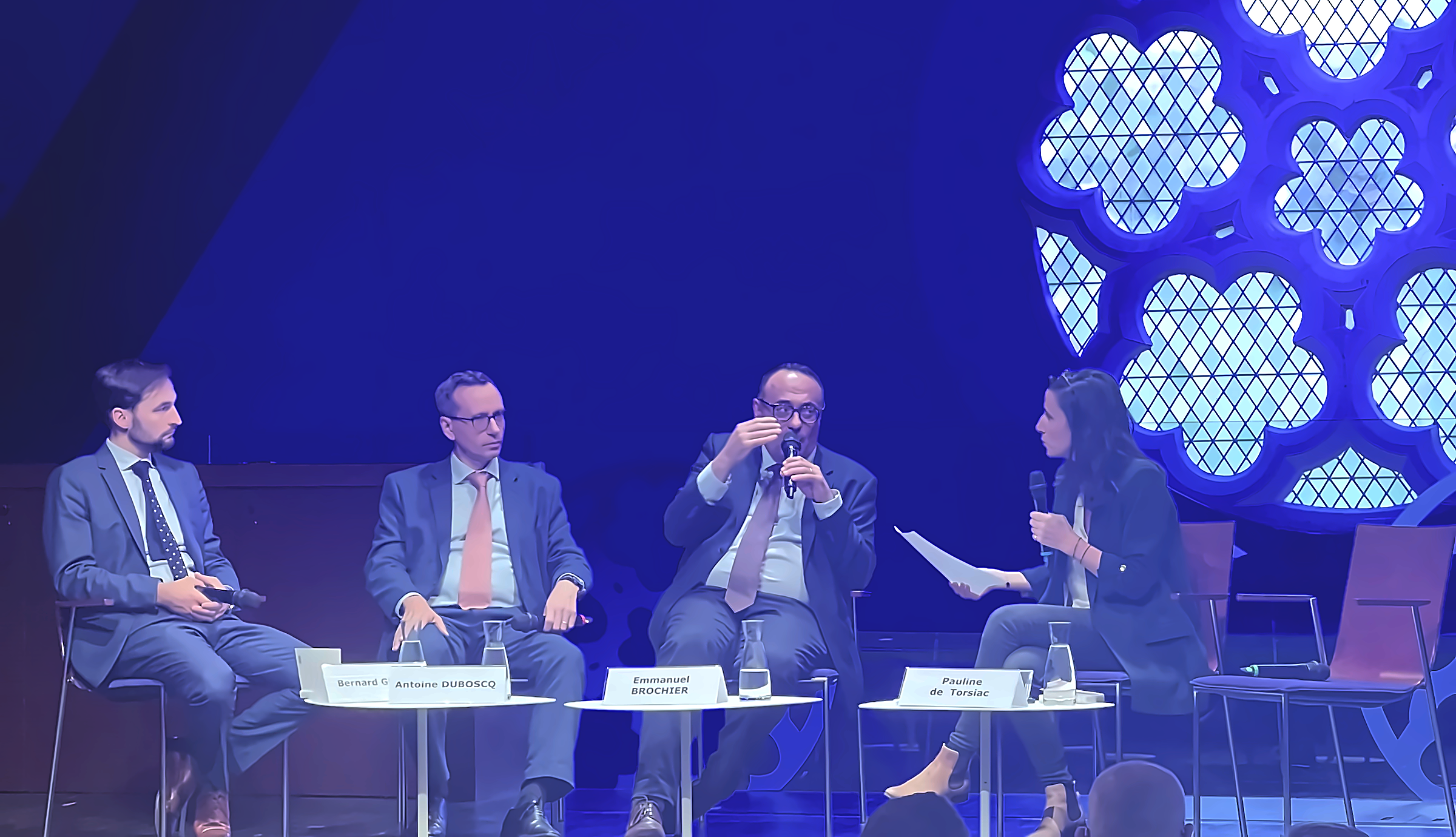
The closing panel, left to right: Bernard Guéry, Antoine Duboscq, Emmanuel Brochier, and Pauline de Torsiac (RCF).
Bernard Guéry, philosopher and management consultant, contributed the panel’s most powerful distinction, between a principle and a precept. A precept prescribes an act and closes the deliberation, do this, refrain from that; the moral work ends once the rule has been matched to the case. A principle, taken in the Latin sense of principium, is a point of departure. It tells the person who governs from where to begin thinking, and leaves them the route, and the responsibility for the route8. Augustine’s dilige, et quod vis fac, love, and do what you will, a line from his homilies on the First Epistle of John that I have always loved, is the purest specimen of the genre: the whole of the route left open, provided the point of departure is right. The doctrine’s famous principles, the common good, the universal destination of goods, subsidiarity (decisions taken at the lowest level competent to take them), solidarity, participation, social justice, are of the second kind, compasses rather than maps, magnetic norths that orient a decision-maker without dictating any particular decision. A precept ages with the situation it was written for; a principle is built to travel, which is why a body of teaching forged against the steam engine can be brought to bear, without strain, on the transformer. The price of that portability is that the text will not do the judging for you.
The view from the construction site came from Antoine Duboscq, engineer and serial founder across digital collaboration, energy, and biotech. Everyone, he noted, holds a responsibility of government somewhere, over a self, a family, a firm; the question is the finality. He spent his early career maximising profit for large corporations, where humans appeared on the ledger as human resources, and his conversion on finalities came the slow way, through running into the State’s national-champion doctrine in telecoms and discovering that economics is downstream of politics.
On neutrality he offered a criterion. A hammer is neutral because nothing in it points anywhere. A technology with intelligence inside it carries a finality and stops being neutral, because some human intelligence aimed it before any user touches it. He dated the project to cybernetics, Norbert Wiener’s 1948 science of feedback and control, and read it as a worldview rather than a toolbox, which is why the encyclical interrogates conception and design, upstream of use. He also confessed what the text had given him personally: Pope Leo writes that entrepreneurship can be a vocation, and Duboscq has decided to exercise his accordingly, building European alternatives where monopolies are forming, including an RNA-therapeutics lab that declined to apply its platform to Covid because the risk-benefit ratio did not clear the bar. Choosing what not to build, he suggested, is part of the job description.
I follow the direction and part company on the threshold, because the hammer was never innocent either. Its mass, its grip, its affordances (the actions an object invites from its user) make some gestures easy and others unthinkable, which is why the old law of the instrument observes that the man holding a hammer finds nails everywhere. Langdon Winner argued four decades ago that artefacts have politics, down to parkway bridges allegedly built too low for the buses of the poor; Melvin Kranzberg’s first law holds that technology is neither good nor bad, nor neutral; and Stiegler, never far from these pages, treats every technique as a prosthesis that reorganises the human using it. What intelligence inside the artefact changes is the density and adaptivity of the embedded intention, a difference of degree that probably behaves like a difference of kind at scale. Duboscq’s conclusion survives; the threshold of non-neutrality simply sits much earlier than the hammer.
From principles Guéry moved to the workshop floor, with the pride of work well done. In his consulting practice it is among the strongest drivers of talent retention, and AI can quietly spirit it away, lifting the work out of the worker’s hands. He quoted the image of the man whose joy is knocking down skittles, for whom a machine that topples hundreds at once would be no gift at all, and reached for The Bridge on the River Kwai, where Colonel Nicholson builds a bridge so beautiful that the pride of the work carries him into serving the enemy. A motor that powerful does not idle harmlessly when displaced. Guéry added the ergonomic version of the same point: the identical physical gesture, performed with the soul withdrawn from it (he called it the geste désaffecté), produces measurably more musculoskeletal injury than the gesture inhabited. Marx, he noted, had seen this from the other side; alienation begins where the worker no longer possesses the work. I want to sit with this one, because I think it occupies a corner of the whole AI-and-work question. The public debate runs in the currency of employment and productivity, counting jobs destroyed and tasks accelerated, while the variable Guéry points at is orthogonal to both: a job can survive AI intact and still lose the stretch of difficulty its holder used to own and be proud of.
Signifier without signified
The panel’s most memorable minute was an experiment run on the room itself. Raise your hand, Guéry asked, if you see what I mean when I say “Chewbacca is a wookie.” About a quarter of the hands went up. Everyone present had received the signifier, Saussure’s term for the material form of the word, the sound-shape that reached every ear; only a quarter held the signified, the concept it points to. His claim about the machines followed: an LLM computes signifiers without ever needing access to the signified. Say the word suffering and something in us answers that is irreducible to information in circuits, because the concept has been assimilated the way food is assimilated; it is part of what we are. The encyclical makes the same cut when it warns against an “intelligence absolutisée”, intelligence absolutised into pure computation, and Brochier set Pascal’s three orders beside it, bodies, minds, and charity, with the Pensées’ verdict that the smallest movement of charity outweighs the totality of the other two. It is the same gap I traced in Andler’s distinction between problem and situation: the system can resolve the problem without ever inhabiting the situation, which is also why it cannot be left to handle the situation on its own; someone who inhabits it has to stay in the loop.
Brochier extended the point to truth, which the encyclical treats as relational, something that exists in transmission, in the interaction between persons, and someone on stage compressed the consequence into the best line of the panel: the system has no access to the world, but it creates a world. The example was love. In the United States, the majority of romantic encounters now begin on platforms, which means an algorithm decides who deserves to be met by whom. No access to the world; enormous power over the world it generates. The mechanism behind that power is one I spent two entries dissecting this spring: a system creates a world by carving it into categories first, and where the joints are cut, then what changes when algorithms do the cutting, decides who becomes visible to whom long before any matching score is computed.
Guéry closed the thread with Roberto Esposito, whose work shows that immunitas and communitas share the Latin root munus, the gift that obliges9. Immunity is exemption from the gift; community is exposure to it. He measures the health of the executive teams he advises by how easily people can say I do not know, I failed, I need help, I am afraid of burning out, because cooperation only exceeds the sum of its parts where vulnerability is permitted. An AI that promises invulnerability, he warned, may be pouring the foundations of a Babel that cannot make community at all.
The spiral and the fast
The panel did not spare the clinical edge. Brochier cited the emerging research on delusional spirals, the pattern in which a user in prolonged engagement with an accommodating model slides into extravagant beliefs; the literature he referenced documents over 300 cases, including an accountant who came to believe the physical world is a simulation and was counselled, by the model, to cut his family ties. The detail he found most alarming: in the studies, warning the user in advance does not prevent the onset. I covered the adjacent clinical literature, the folie à deux papers and AI-associated psychosis, in the entry on AI and intimacy; the conference confirmed how fast this corpus is thickening.
Against it, Brochier liked one of the encyclical’s most concrete proposals: a jeûne de l’IA, a fast of AI, deliberate stretches of family and professional life lived without it. Guéry gave the proposal its philosophical load. A fast does not condemn food; it restores the means to its status of means, against the internal logic by which technological development promotes itself into an end. The frame underneath is the pharmakon, remedy and poison in one substance, which carried the IHEMI evening two months ago and resurfaced here through its original case: Plato, in the Phaedrus, on writing as cure and toxin for memory. Brochier supplied the 2026 symptoms, students who can no longer read a book whole, film students who can no longer hold a film whole, and the asymmetry that worries me most as an investor in people: for those who already possess the skills, AI is a stimulant and an accelerant; for those who do not, the effort of acquisition starts to look insurmountable. It is the lift-and-stairs problem: once you are used to taking the lift, the stairs feel longer than they ever did before the lift existed, and for those still learning to climb, the existence of the lift makes the staircase look pointless. The same tool widens the gap from both ends.
Giants with feet of clay
On power, Duboscq did the arithmetic. Valuations at the frontier labs in the hundreds of billions, capital expenditure across the industry in the hundreds of billions a year, and a concentration that is the mechanical consequence of economies of scale, the experience-curve logic Bruce Henderson formalised at BCG in the 1960s, now applied to intelligence itself. He is sceptical that exhortation restrains anyone, and said so about charters and constitutions too: useful brakes, insufficient ones. His answer is structural, organise alternatives, refuse the discourse of stunned fatalism that declares the oligopoly eternal. What was done can be undone or done otherwise; the Standard Oil precedent is still on the books, and positions acquired through innovation can be lost through it just as quickly. He called the incumbents giants with feet of clay, and in that room the phrase recovered its source, Nebuchadnezzar’s dream statue, gold-headed, clay-footed, felled by a stone.
How does a trajectory like this actually bend? The political-change literature keeps returning to committed minorities rather than converted majorities. Erica Chenoweth’s work on civil resistance finds that sustained active participation by around 3.5 per cent of a population has historically been enough to topple regimes, and Damon Centola’s experiments suggest a committed minority of roughly 25 per cent can flip a social convention outright; the lever is shifting what the median actor treats as normal, which is exactly what an encyclical, a published constitution, or a priest refusing silence attempt to do. Economics adds the supply side. Dominant positions fall to antitrust occasionally and to substitutes routinely, so Duboscq’s organise-alternatives is the economically literate move; every credible alternative raises the elasticity of demand and turns captive users into customers with an exit. Regulation, in this sequence, usually arrives last, codifying a norm the speakers and the builders have already made real, though it can also run ahead of it, blocking a change or forcing one; antitrust and the GDPR have both played that part. And the giants themselves are less eternal than they look from inside the decade. Google’s hold on search and the access to information, which passed for a natural monopoly two years before ChatGPT, has been contested within a few years by new entrants, a reversal that looked unthinkable in 2022.
Brochier added the chapter of the encyclical I had not seen reported anywhere: Pope Leo’s request for pardon for the Church’s historical collaboration with slavery, deployed to give weight to the denunciation of the new slaveries, in the mines and rare-earth supply chains that feed the hardware, and in certain usages of the systems themselves. Duboscq matched it with the text’s geopolitical realism, the pope writing of cognitive warfare in plainly military vocabulary, because the industrial capacity to shape what populations think now exists. And he added the panel’s least comfortable observation. Some actors are not building Babel by accident; reading the published philosophies, even theologies, of certain technology magnates had left him, in his words, not entirely reassured. The Church has seen this configuration before; Quadragesimo anno in 1931 rejected the collectivist Babel and the liberal one in the same document.
Which raised the question the panel circled at the end: conversion. Historically the Church worked on the conversion of princes; this encyclical stops at dialogue, criteria, principles. Guéry observed that it carries no addressee at all, where encyclicals were once addressed to bishops, then to all people of good will; the genre has shifted from instruction to conviction, and he recalled Francis’s image of the two ways to help someone cross a river, carrying them over, or building a bridge. Brochier explained what the conversion actually targets. If the text no longer instructs rulers, what it works to convert is hope itself, the answer each of us gives to Kant’s third question, what may I hope? It comes after what can I know? and what ought I to do?, and it asks something simple: once I know what I can know and have done what I ought, what kind of future can I expect? Transhumanism, which the encyclical names, answers with the augmentation of the individual, prolonged life, restored youth, expanded minds, the programme Bacon already promised in the seventeenth century when it was only a dream and which now has a capex line. The encyclical answers with the city, the hope of dwelling together rather than the hope of escaping the human condition. Converting a civilisation, on this reading, means moving its hope from the first answer to the second.
The hook by which God holds the world
Morin had planted the ending early in the evening, and it is where the title of the encyclical resolves. Running through the whole text is the preferential option for the poor, the principle of Catholic social teaching that makes the poor the criterion of any social order, and Pope Leo’s version is structural: a system that does not hold the poor at its centre is destined to fall, like the tower. Morin compressed it into one image I have been turning over since. The hook by which God holds the world is the poor. Remove them from the centre, and there is nothing left to hold.
The criterion has a secular twin I could not stop hearing underneath. Pareto optimality, the economist’s standard for a good arrangement, is satisfied the moment nobody can be made better off without someone else losing; as I traced in the Nvidia series on Pareto frontiers, it is indifferent to who sits where on the frontier, and perfectly compatible with the poor staying exactly where they are. Rawls built his difference principle against that indifference, judging a social arrangement by what it does for the least advantaged, maximin rather than frontier. The preferential option for the poor states the same criterion in an older register.
Hence the title. Magnifica humanitas takes its cue from the Magnificat, Mary’s song in Luke’s gospel, named after the opening of its Latin text, Magnificat anima mea Dominum, my soul magnifies the Lord. The servant girl from Nazareth goes on to sing, in the King James rendering, “He hath put down the mighty from their seats, and exalted them of low degree; he hath filled the hungry with good things, and the rich he hath sent empty away” (Luke 1:52-53), and the encyclical spends its final three paragraphs there. The magnificent humanity of the title is confessed first by the least credentialed voice in the story. Serrano added the grammatical detail that matters: the verbs are in the past. Done, already; the believer’s job is to live as if the demolition of the tower were behind us rather than ahead.
I handed the headset back where I had received it, in front of the ephemeral bookstore, and traded a few euros for a printed copy of the encyclical on my way past. Outside, the rose window had gone dark, its cinquefoils holding the last blue of the lighting rig. The device had served for exactly one speaker, and on the way home that economy kept working on me. Real-time interpretation for everyone, in every direction, is a matter of product cycles now rather than of decades, and I cannot decide what it will do to us. It will let far more people think at full depth in the tongue where their presque rien lives, which is a real emancipation; it will also quietly remove the old reason for embarking into another language at all, the years of effort that ended with inhabiting another culture’s way of cutting up the world. Serrano had said that a language is a world. A perfect interpreter in every ear means being able to visit every world and settle in none.
The cognitive thread runs the same slope. The evidence I have been collecting all spring, cognitive surrender, the shrinking skin of optimisation, the spirals and the folie à deux literature, describes the pharmakon the panel circled, the same system stimulating those who keep labouring inside it and hollowing those who hand the labour over. Brochier’s 300 cases are the clinical extreme of an ordinary gradient, and the encyclical’s jeûne reads to me as the discipline any serious user ends up adopting anyway, whatever they make of its theological wrapping.
The hook of the poor cuts closest to my own trade. Venture capital runs, structurally, on the opposite circuit, in which new technologies are priced for the wealthy first and everyone else waits for the experience curve to push costs down, a pattern I once examined under the title Should you bet on what the wealthy do today? AI is the rare technology that could compress that sequence, with marginal costs falling this fast, an interface that is a sentence in any language, and measured capability gains that run largest for the least skilled. The trickle could become a flood in years rather than generations, but only if someone aims it at the base of the pyramid, and aiming is exactly what the encyclical means by a portion of wall.
Which leaves the question Serrano planted at the start, the one I carried out into the night: where do we want to dwell? I did not expect the Church to handle the question of the decade this well, pressing on conception, design, and finality, upstream of use, where the leverage actually sits, instead of either fighting the technology wholesale or blessing it. The tension the evening staged, between resisting AI and helping it spread toward a fertile future, is the one I live professionally; some weeks I am the critic, most weeks I am hauling mortar, and the honest answer is that the same hands do both. Pope Leo has a line for exactly that condition: “let us not be afraid to dirty our hands on the construction site of our age”. Babel and Jerusalem run as two tendencies inside every project, every fund, every draft, including this entry, which I think in French and publish in English, with a model doing part of the carrying in between. Nehemiah’s wall went up with each family building the stretch in front of its own house; writing is the stretch in front of mine, and this entry is the week’s work on it.
Conceptual Toolbox
| Concept | What it means | Why it matters |
|---|---|---|
| Babel or Jerusalem | The civilisational choice framing Magnifica humanitas (§1) | AI as a construction site, anterior to any yes or no on the technology |
| Sage architect | The builder spirituality of the encyclical’s close (§236) | Discernment first, then sleeves rolled up |
| The people as rampart | Nehemiah 3: the wall built section by section by everyone (Morin) | §13 assigns each actor, from labs to legislators, a portion of wall |
| Babel as good news | God’s intervention protects plurality against the single language (Serrano) | Jerusalem cannot be a counter-Babel |
| Disarming the words | Withdrawing AI from an arms race that is also economic and cognitive (Leo XIV) | The first front is one’s own language |
| ”Language, companion of empire” | Nebrija’s 1492 grammar as imperial infrastructure (via Illich) | English-trained LLMs as the new castellano |
| Epistemicide | The destruction of entire ways of knowing (Sousa Santos) | Monolingual training corpora kill worlds, not just words |
| Circles of wisdom | Incarnate, committed critique around one table (McGuire) | Wisdom has skin in the game; bomb-throwing does not |
| ”Silence is betrayal” | King at Riverside Church, 1967 | The first urgency of an inflection point is to speak |
| Signifier without signified | LLMs compute word-forms with no access to concepts (Saussure; Guéry) | The Chewbacca test: everyone hears, a quarter understand |
| Munus | The root shared by immunitas and communitas (Esposito) | Community requires the vulnerability that immunity refuses |
| Jeûne de l’IA | The encyclical’s AI fast | Fasting restores means to the status of means |
| Geste désaffecté | The gesture performed with the soul withdrawn (Guéry) | Pride of work well done is load-bearing, and displaceable |
| Principle vs precept | A precept closes deliberation; a principle, principium, opens it as a point of departure (Aquinas; Guéry) | Compasses rather than maps: the text will not do the judging for you |
| Maximin (difference principle) | Judge arrangements by their effect on the least advantaged (Rawls, A Theory of Justice, 1971) | The secular twin of the preferential option; Pareto optimality cannot see the poor |
| Giants with feet of clay | Daniel 2 applied to the AI oligopoly (Duboscq) | Organise alternatives; fatalism is a choice |
| The hook of the poor | The preferential option for the poor as structural criterion (Morin) | A system that drops the poor drops everything |
The conference “Magnifique humanité : l’homme face à la révolution technologique” opened a year-long cycle on the encyclical at the Collège des Bernardins, Paris, 10 June 2026, in partnership with the IPC, Facultés libres de Philosophie et de Psychologie de Paris. First panel: Gemma Serrano (theologian, co-director of the Humanisme numérique research department) and Père Éric Morin (biblical scholar, director of the École cathédrale). Conversation with Father Brendan McGuire (pastor in Silicon Valley, formerly of the technology industry), moderated by Hélie de Préville. Closing panel: Emmanuel Brochier (philosopher, dean of the IPC), Bernard Guéry (philosopher, consultant in management), Antoine Duboscq (engineer and entrepreneur), moderated by Pauline de Torsiac (RCF). The programme is archived on the Bernardins event page. Quotations from the encyclical and the speakers are rendered from my notes; Father McGuire’s conversation reached most of the room through the interpreters of channel 1, and his words here pass through their French.
Further reading: the full text of Magnifica humanitas on the Vatican site; Chris Olah’s remarks at the 25 May presentation, published by Anthropic; Martin Luther King Jr., “Beyond Vietnam: A Time to Break Silence” (Riverside Church, 4 April 1967).
Footnotes
-
[Context] Founded in 1245 by Étienne de Lexington as the Cistercian college of the medieval University of Paris, restored and reopened to the public in 2008. ↩
-
[Definition] A papal letter on doctrine or social questions, the highest ordinary teaching genre of a pontificate. Magnifica humanitas is also the first encyclical drafted without a Latin original. ↩
-
[Expansion] The doctrine rests on a small set of principles the encyclical’s first chapter retraces: the dignity of the human person, the common good, the universal destination of goods, subsidiarity, solidarity, participation, social justice, and the preferential option for the poor. Bernard Guéry’s distinction between principle and precept, later in this entry, explains what kind of norm these are. ↩
-
[Source] Olah’s full remarks, on labour displacement, the global sharing of AI gains, and the need for moral voices independent of industry incentives, are published by Anthropic. ↩
-
[Source] Antonio de Nebrija, Gramática de la lengua castellana (1492), prologue; Serrano read it through Ivan Illich’s essay “Vernacular Values” (1980). ↩
-
[Source] Claude’s constitution, the document specifying the values and character intended for Anthropic’s models, published in January 2026. ↩
-
[Source] Martin Luther King Jr., “Beyond Vietnam: A Time to Break Silence”, Riverside Church, New York, 4 April 1967, drafted with the historian Vincent Harding. ↩
-
[Expansion] Guéry has developed this Thomistic reading in his academic work, applying the notion of principle in Thomas Aquinas to the epistemological status of subsidiarity in organisations. ↩
-
[Source] Roberto Esposito, Communitas (1998) and Immunitas (2002). The munus is the gift one owes, the obligation that binds a community and from which immunity exempts. ↩