Reading What Is Intelligence? (2): Where Does A Life Begin?
Reading What Is Intelligence? (2): Where Does A Life Begin?
Notes on Chapter 1 of Agüera y Arcas’s What Is Intelligence?, where the question of what counts as alive dissolves into a question about where we choose to draw the frame.
The first entry on this book covered symbiogenesis and the argument that evolution’s big jumps come from mergers, with mutation alone unable to account for complexification.
Agüera y Arcas’s framework is explicitly functionalist, in the tradition of Turing and von Neumann. What makes something a heart, or a cell, or a mind, is what it does rather than what it is made of. A composite pump that circulates blood on demand is a heart. A silicon system that carries out the relevant computation is a computer, whether the substrate is vacuum tubes, transistors, or ribosomes. Substrate is interchangeable; function carries the identity. The question that follows is what happens to the boundary of a living thing once substrate stops mattering.
The answer is that it has no natural boundary. Every line, around a cell, an organism, a species, a planet, is a choice about where to hold the frame still. The frame runs across just two continua, scale and time, and the chapter moves it in four directions along them.
Zoom in (scale). Roughly a thousand of the structures inside each of your cells, the mitochondria that power everything your body does, were originally free-living bacteria. Around two billion years ago they were engulfed by an archaeon, a single-celled microbe from a branch of life distinct from bacteria1, and they have been inside us ever since. Each one still carries its own circular DNA, independent of your nuclear genome, still divides on its own schedule, and still runs the Krebs cycle that keeps you upright: the chemical loop that turns the sugars and fats you eat into the energy that every cellular function depends on2. Every step a runner takes rides on that loop. Add the hundred trillion microbes in your gut3, and “you” is already a composite. Any boundary drawn around “the organism” is a choice about which bacteria to count as part of you.
Zoom out (scale). In 1983, Lovelock and Watson published Daisyworld, a toy planet populated only by black and white daisies, the common small flowering plants found in any field, each with a different albedo, the fraction of sunlight a surface reflects. Black daisies absorb more sunlight and warm their patch of ground; white daisies reflect more and cool it. Under a brightening sun, the populations shift, and the planet’s surface temperature stays within a habitable band far longer than bare rock would allow. No foresight and no cooperation required: local selection on two traits produces global regulation. If a planet can maintain its own disequilibrium through the activity of its inhabitants, the planet itself meets the functional criteria of a living system once the frame is allowed to be that wide. Gaia, read this way, names a level of organisation.
Scroll back (time). In the metabolism-first account of abiogenesis, the study of how chemistry became life, that transition happened gradually rather than as a single event. Self-catalysing loops of reactions in the porous walls of hydrothermal vents, powered by proton gradients across rock, closely resemble the reverse Krebs cycle still running inside today’s anaerobic sulfur bacteria4. In this picture, there was no single first living thing, only a gradient of increasing dynamic stability, with a name attached somewhere along the way. Some of those early loops, as Agüera y Arcas points out, may still be bubbling on the ocean floor.
Scroll forward (time). In 1776, Watt’s steam engine started consuming organic carbon at scale. Agüera y Arcas frames this as a symbiogenetic event on a par with the engulfment that produced our mitochondria. Machines began to metabolise, humans built the institutions to keep feeding them, and within two centuries the combined energy throughput of the human-machine composite exceeded anything the Krebs cycle alone had ever moved. Asking whether “machine metabolism” counts as life is asking whether a mitochondrion counts as an independent life. The two questions have the same answer, and the answer depends on where the frame is held.
So what is a life, in Agüera y Arcas’s framework? A region of matter where computation is possible, free energy5 is available, and dynamic stability can take hold. That region can be the size of a ribosome, the molecular machine inside every cell that reads genetic instructions and builds proteins, or the size of a planet. It can last a second or four billion years. Organism, species, ecosystem, biosphere are different resolutions of the same underlying pattern, chosen at the zoom level that suits the question.
Why does the frame question matter? Every ethical, legal, and scientific framework we use assumes one, and none of them flags that assumption. Linnaean taxonomy, the species-based hierarchical classification Carl Linnaeus introduced in 17356, assumes life branches cleanly into discrete, reproductively isolated categories, and that each category is a natural unit. Welfare laws operate on that branching. Conservation priorities operate on it. Everyday intuitions about “harming a life” operate on the individual-organism version of it. Once the functionalist argument is on the table, every framework that protects something at one scale can be seen to be implicitly choosing not to protect something at another, and no framework can claim the choice is neutral.
What gets overwritten in industrial animal systems, as the turbo-poulet work makes concrete, is a four-hundred-million-year-old computational pattern that evolution took that long to compress, now run through a six-week replacement cycle at scale. The climate damage Bilal and Känzig priced at more than 20% of world GDP per degree of warming is the financial accounting of a rupture in a system that meets the functional criteria of life, with all the non-linearity that implies. And the exhausting argument over whether AI is “really” alive or intelligent or conscious rests on a threshold the functionalist frame does not recognise. The usable version of the question replaces that threshold with three things that can be measured:
-
How much computation does the system perform? Living things continuously predict, model, and decide under uncertainty, which is how they anticipate and persist. The difference between a thermostat, a bacterium, and a human-machine workflow is a difference in how much computation is running, on how many variables, and how far ahead in time. This is what makes an organism more than a chemical reaction.
-
How much free energy does it flow through? Any pattern that persists against entropy has to draw power from somewhere. The scale of that flow runs across roughly twenty-eight orders of magnitude, from a single mitochondrion to the whole biosphere:
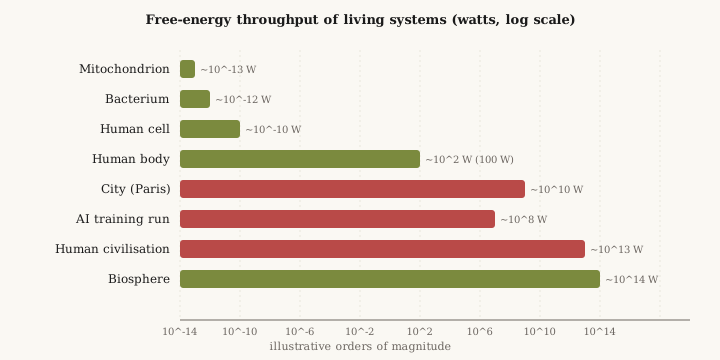
A quick guide to reading the chart.7
Any pattern that holds together over time runs on free energy, and the throughput is the simplest measure of the pattern’s size.
- How robust is it to perturbation? Dynamic stability is defined by how well a pattern holds together when the environment shifts. A bacterial colony in a stable medium is highly robust. A human is less robust than the colony but more robust than any single one of its neurons. A software pipeline that fails the moment a dependency moves is barely robust at all. Robustness is what makes the difference between a system that endures and a system that dissolves the first time conditions change.
These three operate within the two-continuum frame rather than alongside it. At any scale and any time window you choose, applying the three criteria tells you whether the region in question qualifies as alive in Agüera y Arcas’s functional sense.
Conceptual toolbox
| Concept | What it means | Why it matters |
|---|---|---|
| Functionalism | What something is depends on what it does, not on its substrate. | Moves the debate from “is it silicon or carbon?” to “does it perform the relevant computation?” |
| Frame choice (scale and time) | Boundaries around life are analytical choices across two continua: how wide and how long. | Organism, ecosystem, and biosphere become different valid resolutions of one pattern, not mutually exclusive categories. |
| Symbiogenesis as structure | Major jumps in complexity come from mergers and integrations across systems. | Recasts both mitochondria and machine metabolism as compositional events, not isolated anomalies. |
| Dynamic stability | A system remains coherent under perturbation by continuously processing information and energy. | Separates living persistence from static structure and provides a measurable criterion across scales. |
| Free-energy throughput | The usable energy flow sustaining a system against entropy. | Gives a comparable, quantitative lens from cell to civilisation for discussing life-like persistence. |
A shivery thought, to borrow Agüera y Arcas’s phrase. The mitochondrion in every cell is a bacterium engulfed two billion years ago. The Krebs cycle it runs is older still, inherited from that bacterium’s ancestors. The reverse Krebs chemistry that may have preceded biology altogether is still bubbling today in the hydrothermal vents where life likely began. Each layer we find inside ourselves is a fossil of an earlier stage of life’s history, so looking inward is a form of time travel. Widening the frame the other way reveals that we live on a planet that is itself a dynamic stability pattern, continuously maintained by the activities of its inhabitants, which is precisely why it can be broken.

Footnotes
-
Archaea are a third branch of life alongside bacteria and eukaryotes. They look superficially like bacteria under a microscope but have distinct cell membranes and genetic machinery. Many still live in extreme environments (hot springs, deep-sea vents, hypersaline lakes) that resemble the early Earth. The engulfing archaeon that became our ancestor was most likely a member of the Asgard group, which is the closest living relative of the eukaryotic cell. ↩
-
The full chain goes further than the Krebs cycle itself. Inside the mitochondrion, the sugars and fats you eat are oxidised step by step, which releases energy-rich electrons. Those electrons flow down a series of proteins called the electron transport chain, the way water flows downhill, and the energy released as they travel is used to pump protons (hydrogen ions) across the inner mitochondrial membrane. The result is a proton gradient: many more protons on one side of the membrane than the other, with a real voltage difference across it, essentially a charged battery at the molecular scale storing electrochemical energy across the two layers of the membrane. (This has nothing to do with the electrical impulses of the nervous system, which travel along the length of a neuron using sodium and potassium ions.) The mitochondrion then lets those protons flow back through a rotating protein machine called ATP synthase. Picture a microscopic engine with a shaft that physically spins as the protons pass through it, several hundred times per second, the way a hydroelectric turbine spins as water flows through it. Each turn of that shaft forces an ADP (adenosine diphosphate) molecule together with a free phosphate group, producing ATP (adenosine triphosphate), the universal energy currency of the cell. Every time one of your cells needs energy to contract a muscle fibre, fire a neuron, or copy a strand of DNA, it spends ATP by snapping the phosphate bond, turning it back into ADP and releasing the energy. The mitochondria immediately manufacture new ATP to replace it. Over the course of a single day, your body recycles through roughly its own body weight in ATP this way. Carbon dioxide and water come out of the whole loop as exhaust. ↩
-
The gut microbiome collectively carries more unique genes than your nuclear genome does, by a factor of roughly a hundred. On gene count alone, you are more microbe than human. ↩
-
Running the same chemistry backwards, taking energy in rather than releasing it, turns carbon dioxide and water into the sugars, amino acids, and nucleotides of cellular life. This is how the earliest cells are thought to have built themselves without pre-existing biological machinery. ↩
-
Free energy, in physics, is the portion of a system’s energy that can actually be used to do work, rather than being scattered as random heat. The concept matters because the second law of thermodynamics says any closed system drifts toward disorder: things fall apart, heat spreads out, gradients flatten, patterns dissolve. Life runs in the opposite direction, building and maintaining intricate order against that drift, and it can only do this by continuously drawing free energy from its surroundings and dumping disorder back out. A plant draws free energy from sunlight; you draw it from the chemical bonds in your food; a city draws it from electricity and fuel. Two systems can contain the same total energy but very different amounts of free energy. A hot spot next to a cold spot carries free energy, because the temperature gradient can be used to turn a turbine or drive a reaction. Once everything has equalised to the same lukewarm temperature, the total energy is identical but no work can be done. Living things, in this sense, are the parts of the universe that have found ways to stay unequalised: they find gradients (light, chemistry, heat) and run them. ↩
-
The seven ranks, in descending order of generality: kingdom, phylum, class, order, family, genus, species. Linnaeus added “domain” above “kingdom” later; the modern three-domain system (Archaea, Bacteria, Eukarya) was introduced by Carl Woese in 1977. ↩
-
The x-axis is logarithmic, so each tick represents a jump of ten thousand times, not just a bit more. A bar that looks twice as long as another is in fact carrying ten thousand times the power. The khaki bars are the biological systems that evolved on Earth over four billion years, from the single mitochondrion inside one of your cells (about a tenth of a trillionth of a watt) up to the entire biosphere (about 130 terawatts). The red bars are the new systems built by humans in the last two centuries: a single AI training run now draws the power of a small city, and the whole of human civilisation is within a factor of ten of what the biosphere itself moves. That last point is the one worth sitting with. The “machine metabolism” Agüera y Arcas talks about is no longer a curiosity on the side; in raw free-energy terms, it is already the same order of magnitude as life. ↩