Bestioles' Confidential Dinner: The Turbo-Chicken and What It Tells Us About Industrial Food
Bestioles’ Confidential Dinner: The Turbo-Chicken and What It Tells Us About Industrial Food
A few weeks ago I was invited to one of Bestioles’ “Dîners Confidentiels”, intimate evenings the foundation organizes to bring together people genuinely engaged with animal welfare and environmental questions. The dinner was organized by Méliane Rocher and Magdaleine Pertusier Roussay, and it gathered a room of people I was glad to spend the evening with: climate advocates, journalists, investors, scientists, entrepreneurs and policy people, all drawn together by a shared discomfort with how industrial food systems operate. The evening revolved around Axelle Playoust-Braure, scientific journalist and 2025 laureate of the Bestioles “Espoir” programme, who presented her forthcoming investigative book on the broiler chicken industry. I also left with a copy of Geoffrey Le Guilcher’s Steak Machine, a gift from the hosts that pairs unsettlingly well with Axelle’s work. Notes on both below.
The Bestioles Foundation
Bestioles is a French foundation whose mission is to identify and fund research and concrete action projects that transform our relationship with farmed animals and reduce their suffering, as well as the suffering of the humans whose livelihoods depend on exploiting them. Its annual and multi-year programmes support organizations with demonstrated track records and the potential to scale. Its “Espoir” programme specifically backs journalists and researchers pushing the frontier on these questions. If you want to support them, you can do so here.
Turbopoulets, Axelle Playoust-Braure (forthcoming, 2026)

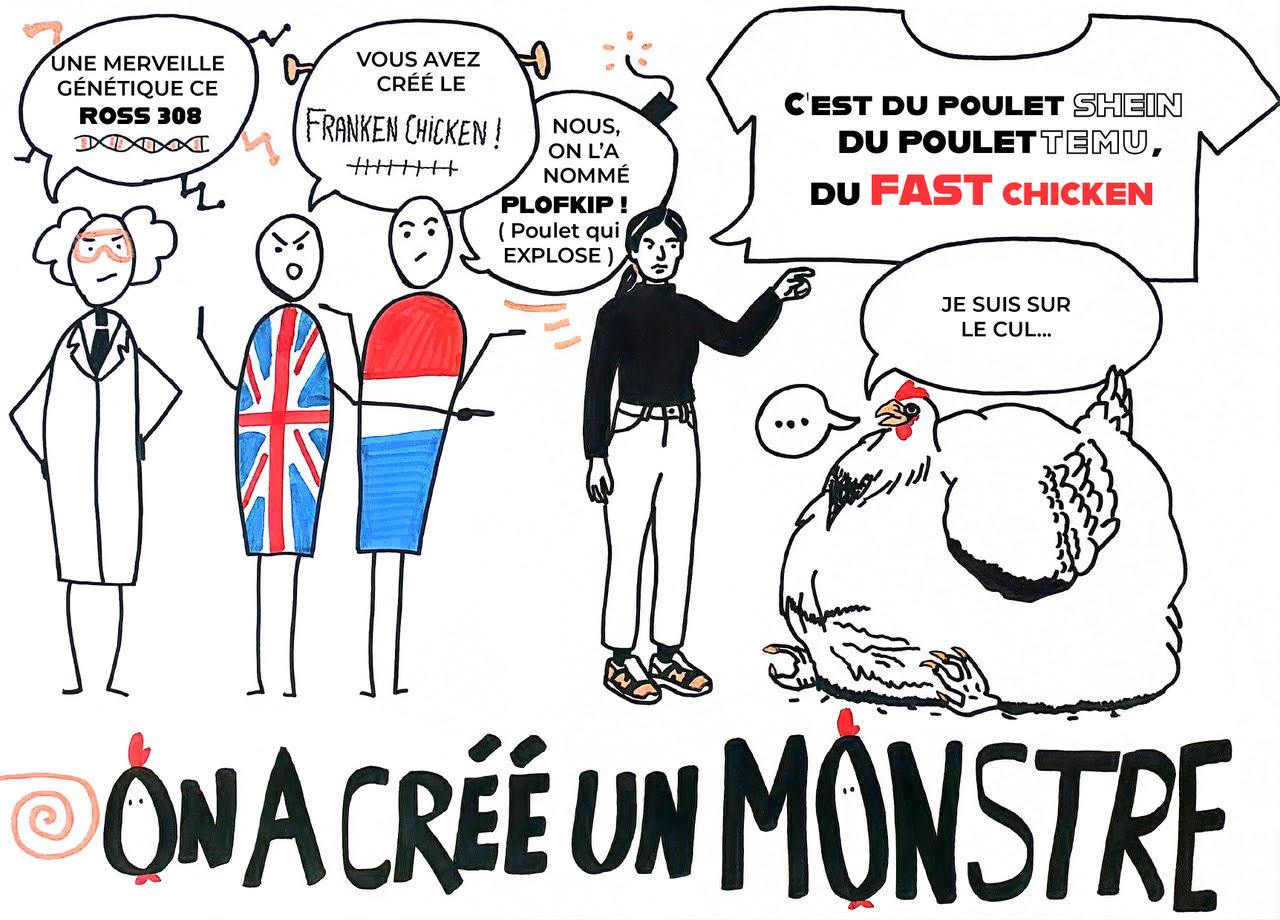
Axelle Playoust-Braure is a freelance scientific journalist who has spent years investigating animal suffering and the structural logic of industrial food systems. Her forthcoming book takes on the poulet de chair, the broiler chicken, and traces how genetics, industrial organization, and financial incentives converged to produce what is known internationally as the “frankenchicken” or, in French, the “turbo-poulet.”
(A note for French readers: several people in the room that evening noted that “turbo-poulet” almost sounds like a compliment, punchy, even admiring, like a sports car. The concept is sticky and immediately clear, which is rare. The open question is whether it carries enough negative charge: does it make people uneasy, or does it inadvertently sound cool enough to defuse the discomfort it should produce?)
Seven threads from the book’s investigation:
-
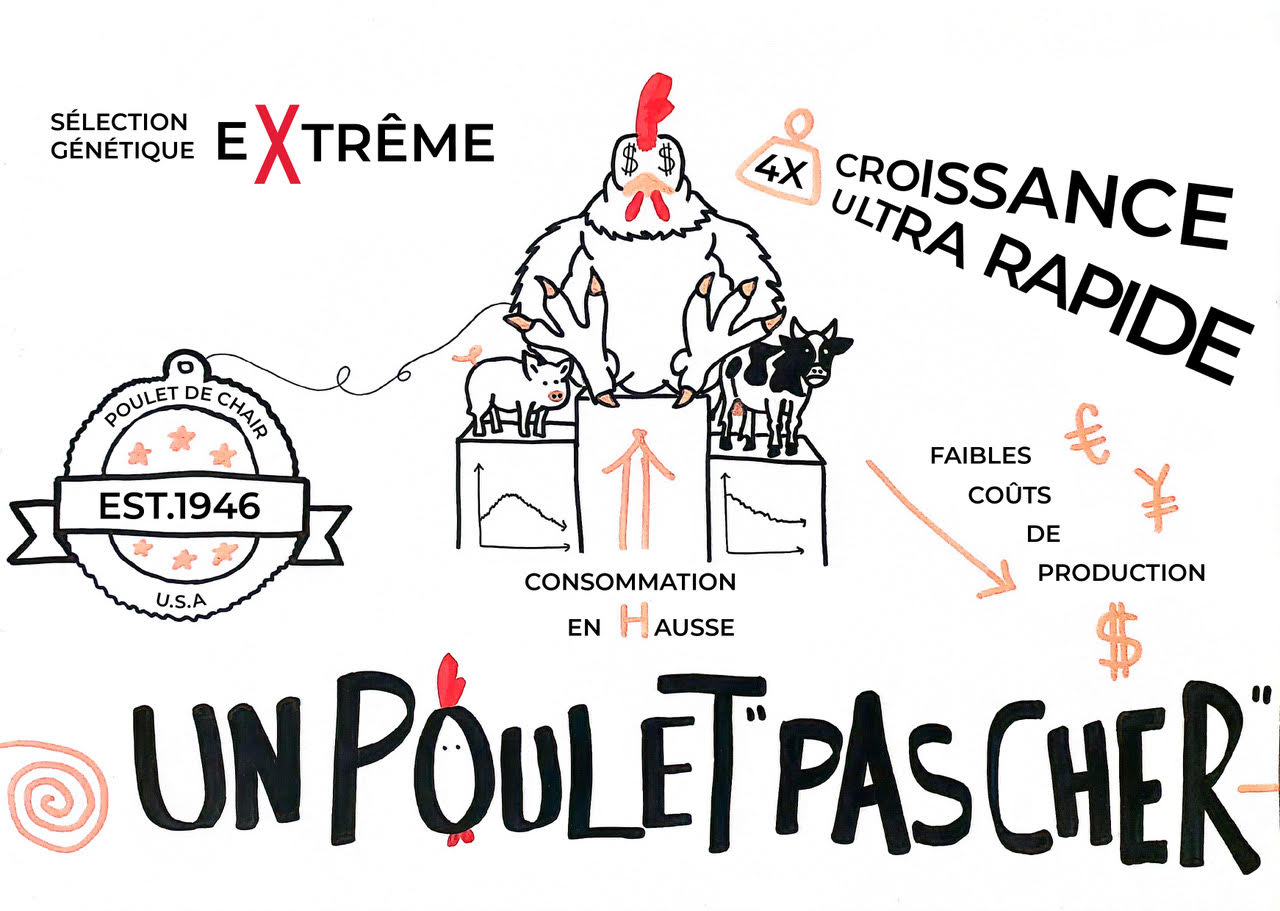
The genetics are the founding choice. Today’s broiler chickens grow four times faster than their 1950 counterparts, reaching slaughter weight (around 2.5 kg) in six weeks. That pace is not a side effect of industrial scale: it is a designed-in feature, the product of decades of relentless selective breeding now structurally embedded across the entire global supply chain. You can often spot this meat by its texture: the muscle fibres separate into pale, stringy strands, almost spaghetti-like, a defect known as “white striping” or “spaghetti meat”, caused directly by the abnormal speed of muscle growth. Nearly every restaurant chain uses this meat; every fast food outlet, without exception, serves it.
-
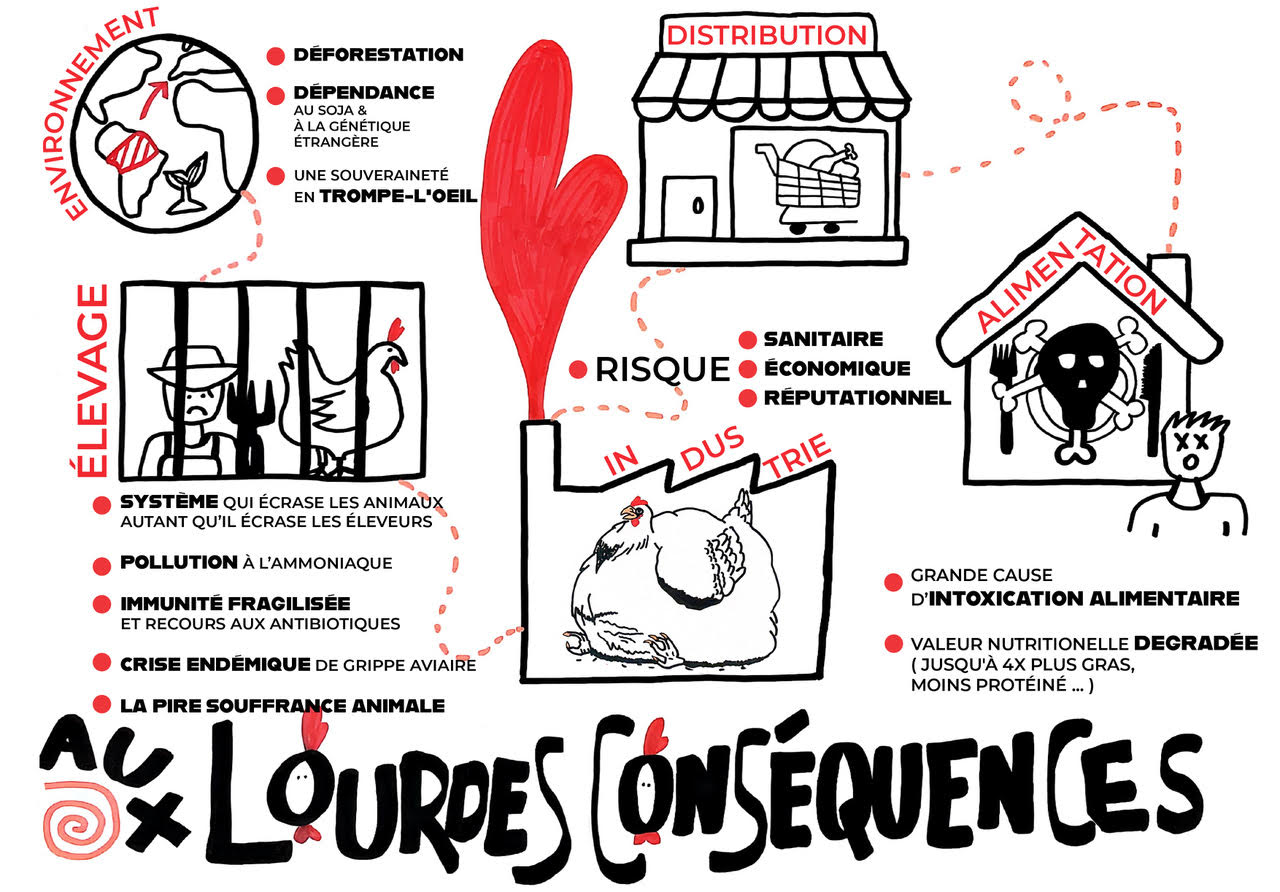
The bird’s body pays the price. The growth rate imposed on these animals causes severe and chronic suffering: skeletal disorders, heart failures, lameness so common it is a baseline expectation. France alone loses more than 30 million birds during rearing each year, not as an anomaly but as a predictable consequence of a physiology pushed far beyond what it can sustain.
-
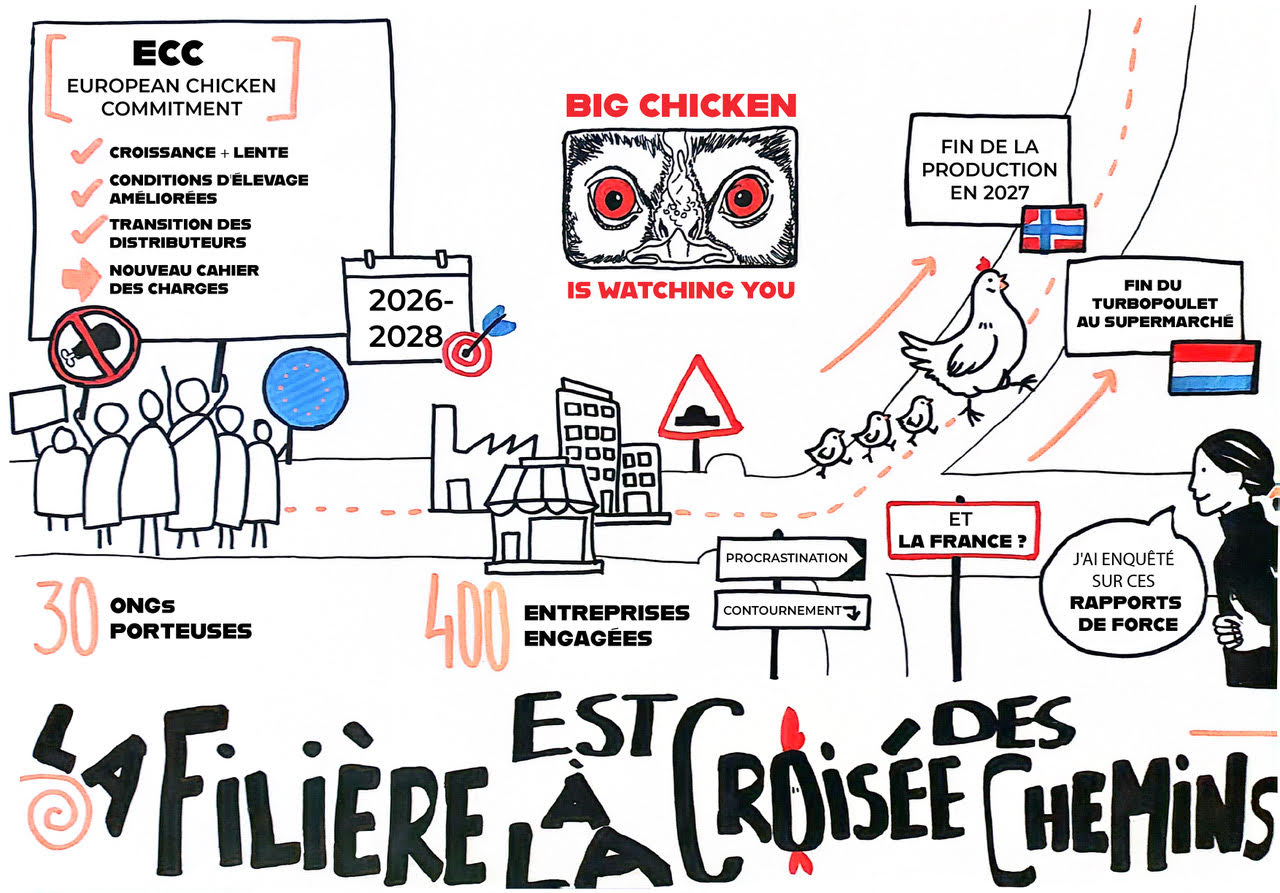
The industry knows, and manages the narrative. Axelle’s reporting shows how the sector systematically handles the downstream consequences of these breeds while promoting itself as “responsible.” Hundreds of global food brands committed to phasing out fast-growth breeds by 2026; as the deadline arrived, several found creative ways around their own pledges. The gap between public commitments and actual supply chain practice is a recurring pattern, not an exception.
-
Market concentration forecloses change. In France, LDC Groupe (Le Gaulois, Maître CoQ) controls roughly 40% of the national market and has consistently refused to move away from fast-growth breeds despite sustained public pressure. The decision is not really made by consumers, at least not to the extent that most people actively seek out slower-grown, more expensive alternatives. It is made by a handful of actors who simultaneously control the genetics, the feed companies, and the contract farming relationships. The architecture of the market makes defection from the dominant model economically punishing for anyone in the chain.
-
The book is a history as much as a report. Axelle traces how this system was built: the genetic breakthroughs, the industrial consolidation, the policy choices that accelerated concentration, the cultural normalization of cheap chicken as a default protein. Tracing that construction is what allows her to explain why reform is so grinding: the constraints are structural, accumulated over decades.
-
The triple damage logic. Animals suffer chronic pain as a designed-in feature of the system. Workers in the processing chain absorb a hidden human cost (see Steak Machine below). The environmental footprint of producing billions of broilers annually (the feed, the water, the manure, the antibiotic load) is systematically externalized from the retail price. Each of these costs falls on a different population with limited political coordination between them, which is part of why the aggregate damage remains so durable.
-
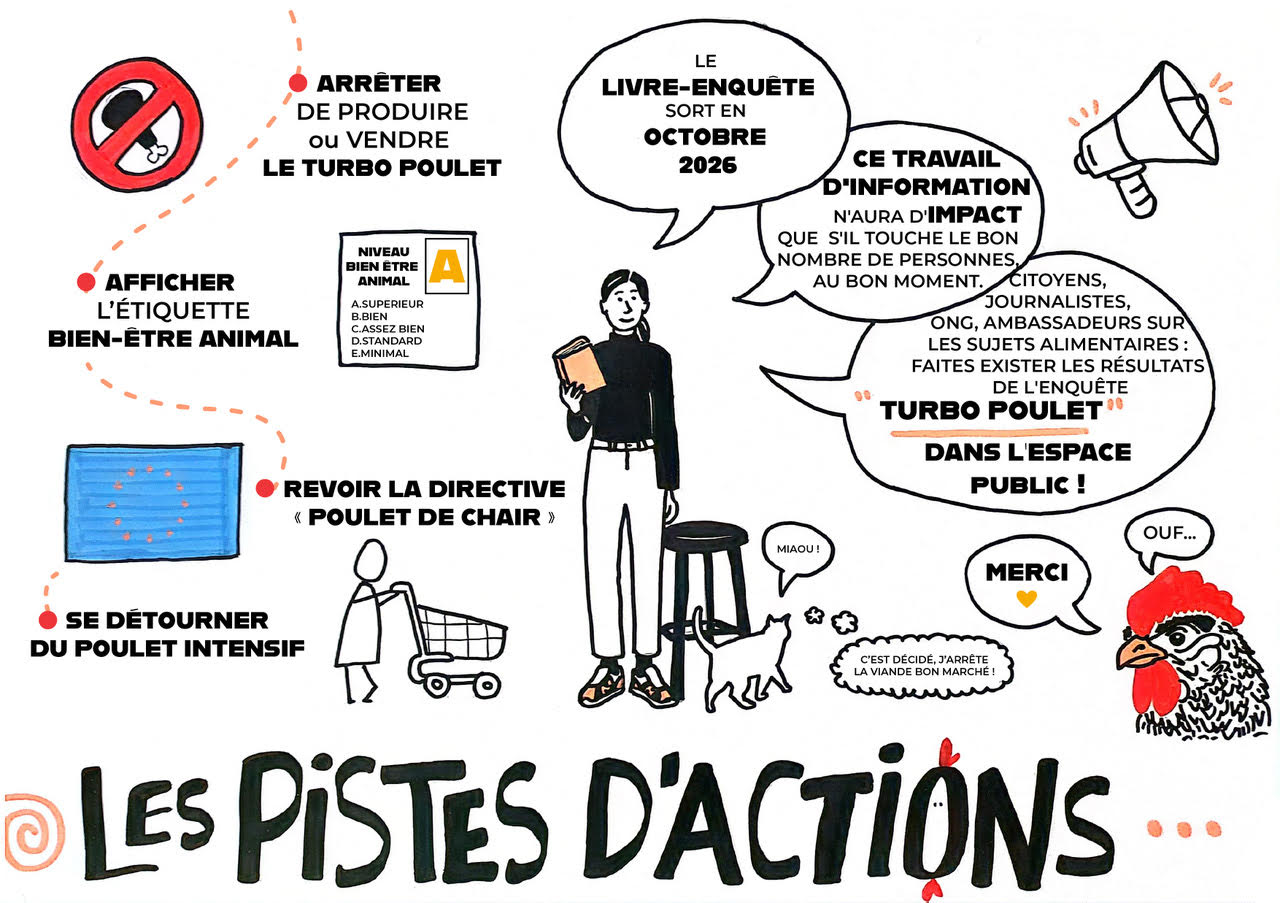
The timing is deliberate, and doubly so. The 2026 deadline for corporate commitments on fast-growth breeds is one test: which brands followed through, which found workarounds, and what the scorecard reveals about the limits of voluntary self-regulation. But the more consequential battle is legislative. The EU Broiler Directive (2007/43/EC) is currently up for revision, and EFSA issued formal recommendations in 2023 calling for a maximum daily growth rate of 50g and a dramatic reduction in stocking densities, standards that would effectively phase out turbo-chicken breeds. The Commission has not yet acted on those recommendations, despite sustained pressure from the European Parliament’s animal welfare intergroup. Axelle’s book lands precisely when the outcome of that legislative fight is still open.
Steak Machine, Geoffrey Le Guilcher (Éditions Goutte d’Or, 2017)
A companion read, and a short one. Le Guilcher spent forty days undercover as a temp worker in one of Brittany’s largest industrial slaughterhouses, a facility processing two million animals a year. Between narrative non-fiction and gonzo journalism, the book gives you the lived texture of an industry that operates in full economic visibility while remaining almost entirely socially invisible.
-
Undercover, because there was no other way in. Le Guilcher built a fake CV, changed his name, and shaved his head to get hired. That documenting a facility operating legally, at industrial scale, in a democratic country required forty days of deception says something important about how these systems manage scrutiny.
-
Workers are the second victims. The book is less about animal suffering (access to the kill floor was limited) than about what this system does to the people it employs. Repetitive strain injuries, chronic pain, nocturnal substance abuse, and a kind of psychological dissociation are not pathologies of weak individuals: they are the informal coping infrastructure that keeps the system running. The facility processes two million animals a year in part because the human cost of that cadence is borne off the balance sheet.
-
Speed is the organizing principle. The cuts-per-minute imposed on workers drives every other dysfunction in the building. It is the same logic that produced the turbo-chicken upstream: production velocity as the governing variable, from the genetics lab to the slaughter floor. The coherence between the two ends of the chain is what makes the system so hard to interrupt at any single point.
-
Immigration and disposability. The slaughterhouse workforce has historically absorbed successive waves of immigration in France. The book’s most uncomfortable observation is that the system functions precisely because its human cost is concentrated in people with limited alternatives and limited political voice.
-
Animal and human maltreatment as a single system. Le Guilcher’s core thesis is not that workers are bad people or that animals are uniquely victimized. It is that the industrial logic producing cruelty toward animals and the logic producing exploitation of workers are the same logic, running through the same institution, measured by the same metric: throughput per hour.
-
The two books are complementary, not exhaustive. Le Guilcher documents the end of the line; Axelle documents the beginning. The turbo-chicken arrives at his facility after a life designed entirely around speed of growth. Together they illuminate a system that no single investigation could fully map, which is itself telling.
What struck me most about the evening was the quality of the people in the room, and the subject matter itself. We know some of this. But knowing fragments is different from grasping the full scale of it: how many animals, how many workers, what the supply chain actually looks like end to end, and how deliberately it has been kept out of view.
The people around that table (precise, scientifically rigorous, strategically clear about what they are up against) are pushing this forward despite every institutional headwind. What gives me confidence is that they are not arguing from emotion. They are mapping the system.
And the system deserves careful mapping. What these two books illustrate is not simply that an industry behaves badly: it is that a set of mutually reinforcing feedback loops has produced a situation where harmful outcomes are the stable equilibrium, not a deviation from it. Consumers are extraordinarily price-sensitive on food, partly because wages have stagnated and partly because decades of agricultural policy have made cheap meat the default. Corporate behaviour is locked in because the actors who control genetics, feed, and contracts have no individual incentive to move. Financial markets reward short-term throughput. Regulatory capture is real, and the political cost of confronting consolidated agricultural interests is high in any electoral calendar. And the costs (animal suffering, worker health, environmental damage) are distributed across populations that share no natural political coalition.
This is not a counsel of despair. But it does mean that good intentions and consumer awareness, on their own, are not enough. The industry’s first line of defence is opacity, which is exactly why investigations like Axelle’s matter: you cannot build pressure on something people cannot see, and the industry has spent decades making sure they cannot. Beyond visibility, the most durable lever historically has been regulation: minimum standards that apply to everyone, that cannot be arbitraged away by individual actors protecting their margin. The EU Broiler Directive revision is the live example right now. That kind of change does not happen without organized, sustained citizen pressure, which is precisely what the people around that table are working to build.
Illustrations
Drawn live during Axelle's talk by Lucile Rivière.