
From 0 to €1M, 0 to 10 Clients: The B2B Founder-Led Sales Playbook
From 0 to €1M, 0 to 10 Clients: The B2B Founder-Led Sales Playbook
Most founders treat early sales as a necessary evil before hiring “real” salespeople. Jen Abel, who has built and advised multiple B2B companies through zero-to-one (xGeneral Assembly, xTheMuse), says that’s backwards. In her conversation with Lenny Rachitsky, she lays out a framework that contradicts most received wisdom: founder-led sales isn’t a sub-optimal-yet-necessary phase to rush through. It’s the moment where startups hold an unfair advantage.
TL;DR: Founder-led sales isn’t the awkward prelude to “real” sales. It’s the brief stage where founders hold an unfair advantage: their insight, their conviction, their proximity to the problem. Everything that follows (hires, decks, processes, etc.) is a translation with loss.
Jen Abel’s framework reframes selling as learning. Each outbound message is a hypothesis test, not a pitch. Each early conversation is fieldwork that narrows the gap between vision and market. And vulnerability is an effective tactic: honesty about what’s unfinished earns the feedback that shapes what comes next.
Instead of chasing logos, founders should co-author solutions with their first customers (the famous design partners), even through short service engagements that prepare the ground for software. And when a deal reaches procurement, treat it as a second sale: a test of clarity, differentiation, and project management.
Founder-led sales isn’t (just) about charisma or hustle. It should be seen as an operating system for building truth at speed (something engineers understand instinctively).
The Argument
1. The founder is the product
Founders start with no brand, no logos, no proof, half a product, and a market already drowning in cold emails from tools that look exactly like theirs. Abel’s answer is unsentimental: at that stage, the founder is the product.
Not in the LinkedIn-influencer sense. In the novel insight sense. Founders have seen something in workflows, data exhaust, regulatory friction, or behaviour that others haven’t. They’re selling that lens before they sell software.
This contradicts later-stage orthodoxy: hire a rep, train them on the deck, scale outbound. Abel calls that malpractice at zero-to-one. Only the founder catches the budding signals in calls. Only the founder can compress efficiently dozens of conversations into a sharper thesis.
Her advice is to write outbound materials like a research teaser, not a SaaS pitch. If a generic SDR could send the email, founders are hiding the only asset that matters.
2. Outbound as insight test, not mail merge
Abel’s central insight: zero-to-one sales is structured learning with a quota, not logo collection.
- Relevance: why this exact person, in this exact role, right now.
- Counter-intuition: a line that makes them stop and think “wait, what?” not “we’re 10x better.”
- Problem-first: describe the breaking system, not your features.
- Concise: fits on one mobile screen.
Her own example, “zero-to-one sales talent doesn’t exist,” does three things at once: stakes a provocative thesis, filters for founders who feel the pain, earns the right to explain.
She wants founders to test this manually. No automation. Pick 30 prospects. Invest 15-20 minutes per note. Then read the reaction and learn from the feedback. Each campaign is a prior founders are stress-testing. Scale only what provably hooks.
On first calls, she advises brutal honesty: tell prospects the team is early, the product is evolving, the founder is here to understand how the problem shows up on their side. Vulnerability works.
If buyers think everything is finished (yet unsatisfactory), they protect feelings and lie. If they see the team as early and adaptable, they give the data needed: where the problem sits in their org, what they’ve already tried, what gets measured, who else must care.
The north star isn’t “how fast can I get this Purchase Order signed” but “how fast can I converge on a repeatable pattern: who, what pain, what stakes, what buying process.” Revenue is the lagging indicator of having done that work.
4. Co-authoring and services: the Trojan horse
Abel’s playbook sits in lineage with Paul Graham’s do things that don’t scale principle that value learning over closing, but she goes further by recommending that B2B startup founders actually sell services at the beginning.
In many target accounts, especially for novel tech like AI automation, there’s no buying process, no internal playbook, no clarity on risk or data policy. Pushing pure software stalls. So she recommends a time-boxed services engagement: help them design the workflow, the evaluation criteria, the internal narrative.
Founders get paid to learn. They become the local expert who frames the category. They secure a logo and a champion. After 60-90 days, the natural next step is their product.
5. Procurement as a second sale
Once founders reach procurement, they’re no longer dealing with an enthusiastic, curious champion. They’re dealing with professional skeptics. Abel’s rules: make their job easy. Define clearly what the product does and doesn’t do.
Stay out of the bloated, comprehensive Master Service Agreement designed for giant vendors. Never assume they’ll “just pass it along.” If founders fail to differentiate, procurement routes the problem to an existing vendor, and the deal dies in a queue. If a CFO opens a contract and can’t answer “what am I signing and why now,” the deal goes back to the bottom of the pile.
This turns enterprise sales into project management. Time-to-close, ACV, and win rate are functions of how well founders run that internal gauntlet.
Abel also emphasises adjusting outbound strategies based on observed win rates and deal sizes - if conversion is too low or ACVs too small, the problem is often in targeting or messaging, not execution.
Conceptual Toolbox
Abel’s outbound formula is aggressively constrained: extreme relevance (“why you, why now”), a counter-intuitive hook that disorients the prospect just enough to earn curiosity, a problem-first framing, and the discipline to keep it short enough to read in one glance on a phone.
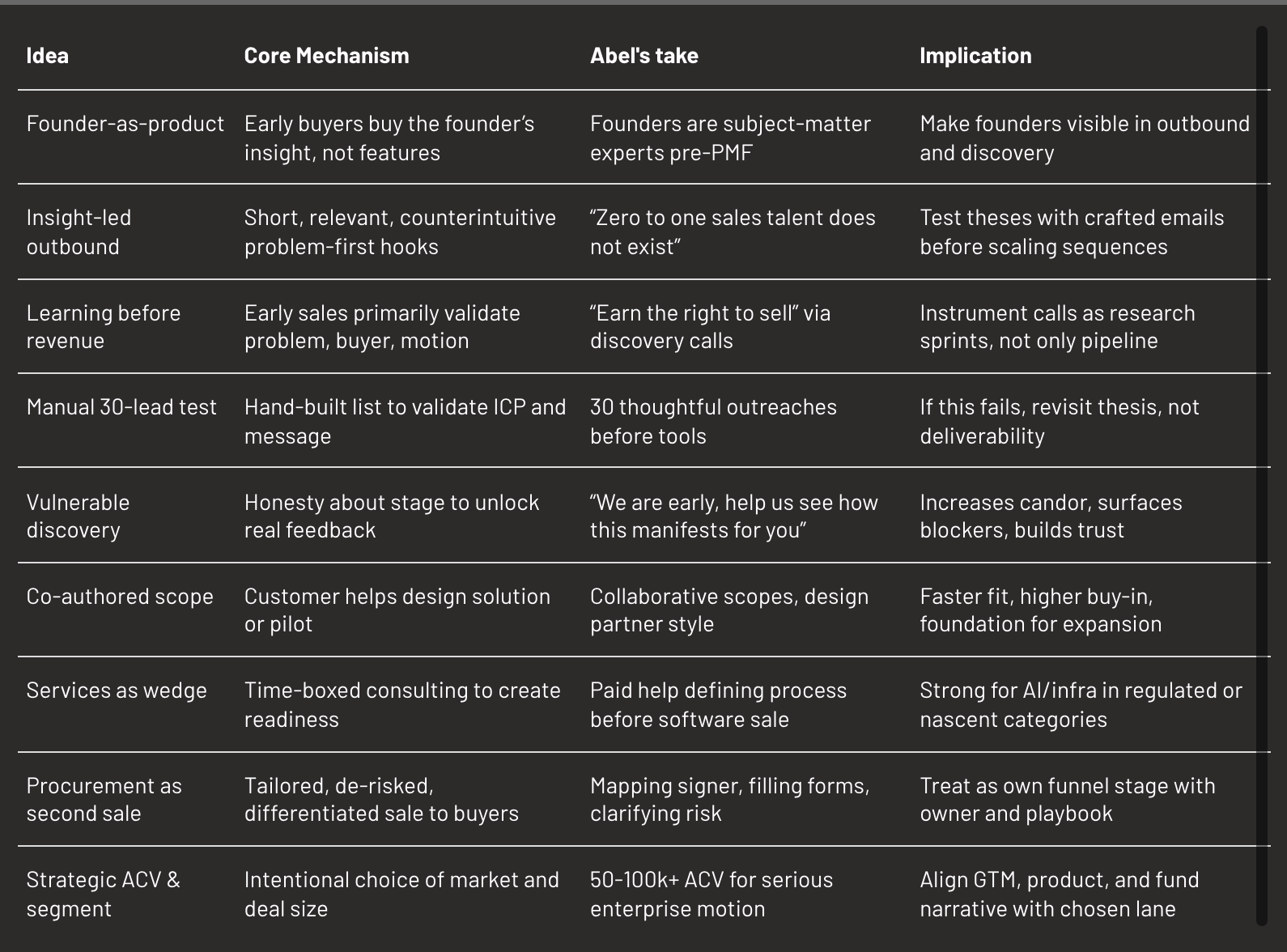
The logic: Founder-as-product + insight-led outbound feed the manual 30-lead test. Successful tests justify vulnerable discovery. Those calls identify where co-authored scopes or services wedges are needed. That motion graduates into structured procurement and strategic ACVs. Learning-before-revenue binds the entire loop.
Four Things to Remember
1. Selling is testing, not convincing
Founder-led sales is a method for testing what’s true about the market (it’s almost an exercice of epistemology), not for persuading people you’re right. Every unanswered email, every objection, is a signal. Abel’s advice is to adjust your conviction based on what the market actually does, not what you hoped it would do. Founders aren’t learning “who buys.” They’re learning “where reality differs from the pitch deck.”
2. The 30-person mirror
Her 30-lead test is simple and unforgiving. No tools, no SDR scripts. Just the founder, a shortlist of 30 qualified prospects, and 15-20 minutes per outreach. If nobody responds, the problem is the thesis, not the execution or the tooling.
Modern analogy: treat each failed mini-campaign like a failed experiment in an ML pipeline. Founders don’t shout at the GPU. They refine the hypothesis.
3. Early customers are co-authors
The first ten buyers aren’t just paying invoices. They’re defining how everyone else will understand the category. Abel’s insight: these customers establish the internal language through which procurement, legal, and future departments will evaluate the product and every competitor that follows. In AI or complex B2B, that first champion doesn’t only validate the product - they help design the narrative. Pick the first believers as carefully as the first investors. There is a reason why they are called design partners.
4. Founder-led sales trains the next system
The goal isn’t to become a great salesperson. It’s to compress what founders learn into repeatable patterns - scripts, heuristics, deal maps. Abel’s hidden message: the founder’s learning loop is the foundation of the future revenue machine. The faster founders systematise discoveries (who, how, what message, what price), the shorter the ramp when “real” sellers arrive. Each early conversation generates the data that will later train the organisation.
Article originally posted on WeLoveSota.com